
Brian Blood and Laurie Kersey are what I guess in the art world you’d have to call a power couple. They’re both outstanding professional painters, and together they’re living the sort of creative partnership that many can only dream of.
Brian, a resident of Pebble Beach, California, is offering two plein air painting workshops this fall. Widely recognized as one of California’s most important plein air impressionist artists, Brian is married to award-winning artist, Laurie Kersey. Together they say, they are living their childhood dreams.
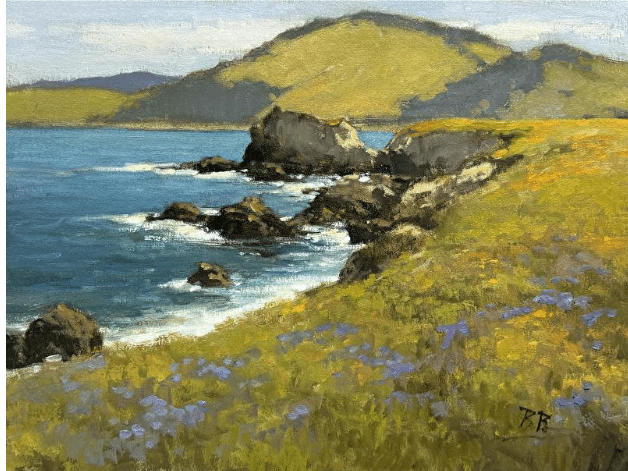
Brian Blood, Spring at Moss Cove, Pt. Lobos, oil, 12 x 16 in.
Brian began his professional life as a graphic artist and art director in Boston, Massachusetts. Although Blood’s career was successful, he was frustrated personally and realized he wanted to be a fine-art painter. A leap across the continent to California took him to the Academy of Art University in San Francisco for both undergraduate and graduate studies. Blood and Kersey were both later instructors at the Academy of Art University for 12 years.

Brian Blood, “China Cove by Moonlight,” oil, 16 x 12 in.
Laurie Kersey grew up in an artistic rural Ohio household. Her mother enjoyed painting in oils when Laurie was young and then later switched to watercolors. Meanwhile, her father was a horseman, training and racing harness horses, and Laurie spent her summers helping out in the barn at the track. Those two influences blossomed beautifully together in her art, which led to the successful painting career she enjoys today.
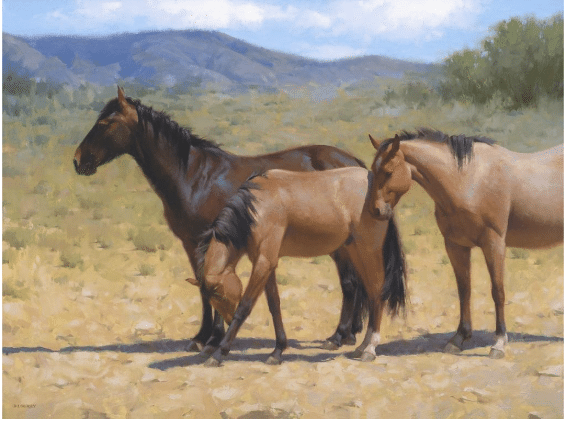
Laurie Kersey, “Familia,” Oil on linen, 30 x 40 in.
Though excited about painting myriad aspects of the natural world, including landscape and floral, a dominant theme in her work is horses. Having ridden for many years, she has come to realize that her hands-on experience with horses uniquely influences the way that she sees and paints them.
“My equine paintings focus on the relationships – between horses, or between horse and human. That’s the part I know well,” she says. “As beautiful as the outside of a horse is, it’s the inside that interests me the most. One of my favorite things about riding is meeting and getting to know so many different horses; different characters and personalities, different quirks, likes, and dislikes. I love discovering those things as a rider, and I love trying to express them in a painting.”
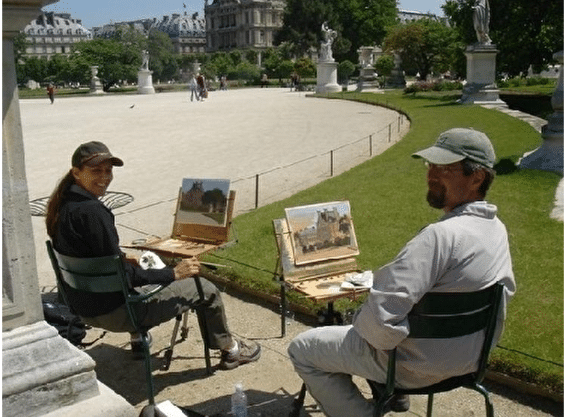
Laurie Kersey and Brian Blood travel the world doing their thing.
Primarily a plein-air painter, Brian creates hundreds of studies directly from nature, observing the ever changing light of day. He then takes his studies and supporting reference photos back to his Pebble Beach studio to paint. He uses these studies as the basis for his larger scale works.
Brian has had his work featured in articles in Southwest Art Magazine, Art of The West Magazine, American Artist Magazine, Plein Air Magazine, Fine Art Connoisseur to name a few.
Brian Blood has a new teaching video out titled “Painting by the Sea.” Check it out here.
Information about his upcoming plein air workshops can be found on his website at www.brianblood.com/workshops

Brian Blood, “Mission Nocturne,” oil, 11 x 14 in.
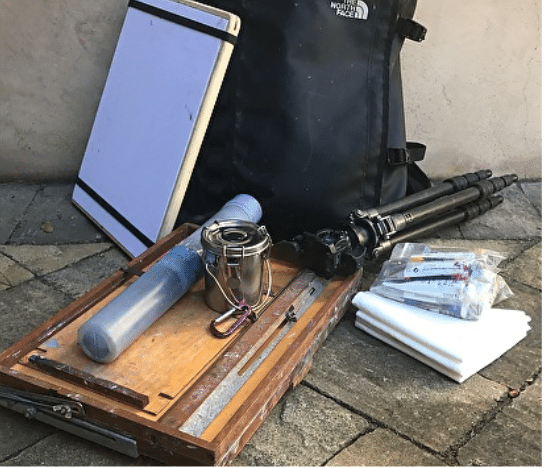
Stolen Picasso, Chagall Found in Basement
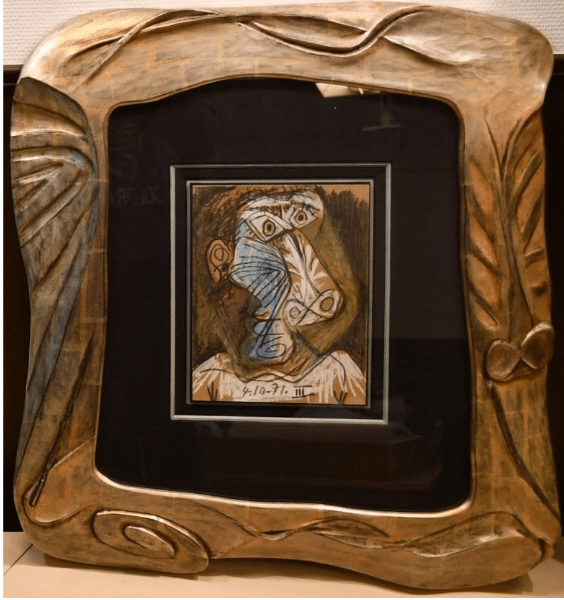
Pablo Picasso’s “Tête” (1971) (all images courtesy Namur Division of Ministère Public, Belgium)
Belgian authorities recovered stolen paintings by Pablo Picasso and Marc Chagall that were being kept in an Antwerp basement. The pair of works — Picasso’s abstract portrait “Tête” (1971) and Chagall’s depiction of a praying man “L’homme en prière” (1970) — were taken from a Tel Aviv home 14 years ago. The problem with stealing valuable works of art is selling them. The regular art market is pretty much closed to would-be crooked sellers; digital images of stolen works are readily available and everyone these days is hyper aware of attempts to pass off forgeries and stolen paintings. The Picasso and the Chagall – small but excellent representations of these artists’ most sought-after periods – were recovered in perfect condition as soon as the suspect attempted to sell them.
In 2010, thieves broke into an art collector’s private home in Israel, disarming the alarm system and making off with the paintings plus $680,000 worth of jewelry, which has yet to be recovered. The stolen artworks were valued at a combined $900,000 at the time of their disappearance.
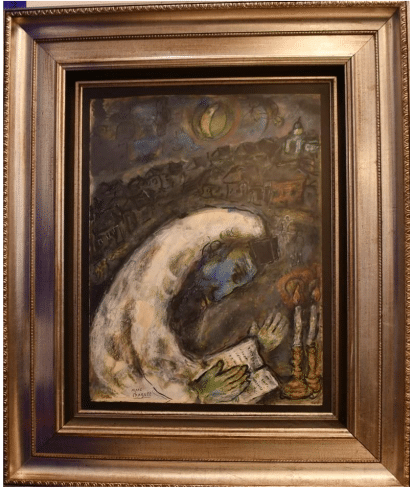
Marc Chagall’s “L’homme en prière” (1970)
More recently, Belgian authorities learned that a man living in the French-speaking central city of Namur was attempting to sell the missing paintings. Police conducted a raid on the suspect’s home, finding a “large sum of cash” but no Picasso or Chagall. After the suspect and his wife were taken into custody, a search at their house revealed the two missing artworks. They were stored (and found) in perfect condition, albeit, yes, in the basement.