
“The artist must work so hard, so long, that a brain develops and lives, all of itself, in his fingers …. The artist must not think of critical rewards or money he will get for painting pictures. He must think of beauty here in this brush ready to flow if he will release it.”
-Ray Bradbury
It’s odd, when you think about it, that so many beginning painters assume if they can’t produce a decent painting on the first, or second, or even 10th or 25th try, that they must not “have the talent” and should take up origami instead. So wrong.
Finding your way as an artist is no different from learning to play the cello. You wouldn’t expect to pick up a cello and be able to play Brahms, let alone compose beautiful original melodies the first two, three, or 30 times you played it!
No, you would work and practice and practice and work, and eventually there would come a day when the instrument seems almost to play itself. And that is joy, and that is how one learns to paint. With enough work and dedication, creating fulfilling art is within virtually anybody’s grasp.

Cesar Santos, Farfalline Della Notte
Getting Into the Flow
Ray Bradbury, the writer, proposed the following three stages for what others have called flow – WORK, RELAXATION, and DON’T THINK. It doesn’t really matter which one you start with – if you just keep going (work), eventually you will encounter the others. If you just start drawing with nothing in mind (DON’T THINK), and stop worrying and let yourself be free to follow every whim (RELAXATION), you’ll find yourself starting canvas after canvas (WORK).
What’ll happen is you’ll enter the flow state, where you do not have to tell your palette knife which color to mix or your brush what the nest stroke should be. “The surgeon doesn’t tell his scalpel what to do. Nor does the athlete advise his body,” Bradbury says. “Suddenly a natural rhythm is achieved. The body thinks for itself.” And so the artist’s hand. It’s kind of like gardening: you have to plant the seeds (WORK), water the whole garden without worrying about each sprout (RELAXATION), and let nature do her thing (DON’T THINK).
And you have to plant a lot of seeds. To a certain extent it’s a numbers game. Quantity leads to quality. You have to leave a mile of canvases behind you until you can reliably make something good. But we shouldn’t think of it as “work” in the negative sense, nor look down on the paintings that didn’t shine as failures. The only failure is giving up. As Bradbury says: “To fail is to give up. But you are in the midst of a moving process. Nothing fails then. All goes on. Work is done. If good, you learn from it. If bad, you learn even more. Work done and behind you is a lesson to be studied. There is no failure unless one stops.”
“We are working not for work’s sake, producing not for production’s sake…. What we are trying to do is find a way to release the truth that lies in all of us.” (from Ray Bradbury’s Zen in the Art of Writing)
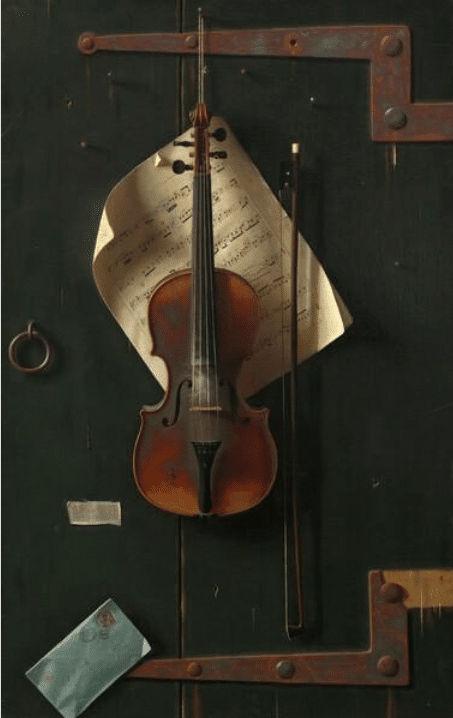
William Michael Harnett, The Old Violin, 1886, oil on canvas, 96.5 x 60 cm (38 x 23 5/8 in.)
As all Zen archers know, it’s when we’re able to do a thing “without trying” that excellence and creativity really begin to flow.
Beginner’s luck aside, you do not get to routinely enter that state without having to work. It’s possible to make friends with work though, to buddy up to it like a partner, trusting it’ll help you get where you don’t yet know you need to go. There’s no way around showing up and doing the work. And this, of course, means frustration, dashed hopes, isolation, and self-doubt … and epiphany, connection, and flow.
This surreal poem by Tom Clark hints at these mysteries of the artistic process:
Poem
Like musical instruments
Abandoned in a field
The parts of your feelings
Are starting to know a quiet
The pure conversion of your
Life into art seems destined
Never to occur
You don’t mind
You feel spiritual and alert
As the air must feel
Turning into sky aloft and blue
You feel like
You’ll never feel like touching anything or anyone
Again
And then you do
– Tom Clark
Cesar Santos, whose painting Farfalline Della Notte is featured in this edition, teaches mastery of the figure in his video Secrets of the Figure, available here.