“Light is therefore color.” – JMW Turner
Surely one of the reasons we go to painting is for the light.
But not just any light! Numerous artists throughout history have used light as a visual counterpart of wonder and spirituality, sometimes in subtle and sometimes not-so-subtle ways.
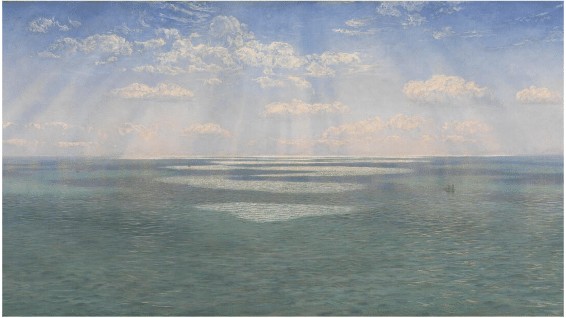
The light in John Brett’s painting (above) instantly lifts us to a higher level of consciousness if we let it. By unapologetically centering the descending rays of the sun, the artist evokes conventions in religious painting of sublime light streaming from the parting clouds of Heaven to fall upon holy figures and saints. In this work, the view is celestial, cosmic even – there’s no hint of an orienting cliff such as the artist must have been standing on for his studies.
Instead, he renders one tiny ship in the middle ground, offering us the opposite: a dizzying sense of immense scale, seen as from a God-like perspective, but not at all kitschy or cliched. This artist didn’t just paint a pretty view; this is an invitation to a vision of life illuminated – a grand immersion in the realm of the immaterial: nothing but water, streaming light, and wind (implied in the patterns on the water’s surface).

Heavenly light: Gold from God for Bernini’s Saint Theresa
You can see John Brett’s painting at the Tate Museums in the UK, where it’s part of a show consisting of more than 100 works surrounding the theme of light, handpicked from the museum’s 77,000-piece collection on view until October.
One of art’s jobs is to wake us from the stupor of workaday life and raise our awareness to a higher level – for our eyes, closed in the darkness waking from sleep, to open onto a new day’s light. Or course, it is light that allows us to see the world at all.
It is no surprise then that light, as a subject of art, has long played a crucial role in creative visual expression. The Tate’s exhibition provides viewers with an extensive timeline of light in art from the end of the 18th century to the present day. It starts in painting, but journeys through photography, drawing, sculpture, conceptual installation, and moving images, all using the power of light to define atmosphere and prompt emotion.
In the section called Spiritual and Sublime Light, viewers will also find Joseph Mallord William Turner (1775 –1851) using oils in transparent glazes and warm-toned colors to express the Biblical light of Old Testament prophecies.
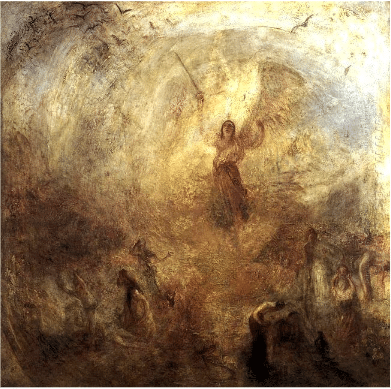
JMW Turner, The Angel Standing in the Sun, oil on canvas, about 24” x 24”
Turner based this relatively small painting, first exhibited in 1846, on passages concerning the “Day of Doom.” We see the archangel Michael announcing the fiery destruction of our “fallen” world to make way for a new Heaven and a new Earth.
Turner’s contemporary John Constable (1776–1837) expressed a far subtler but no less keen sense of the spiritual through his use of light. Constable’s landscapes emphasized naturalism with almost realistic precision despite often being loaded with sentiment and symbolic expressions of religious faith. Constable’s Salisbury Cathedral from the Meadows, 1830, gives us an earthier sense of solid ground than either Turner or Brett, but not without its own heavenly rays and rainbow. The darks are saturated in a way that plays up the light bursting over the scene and making it glow.
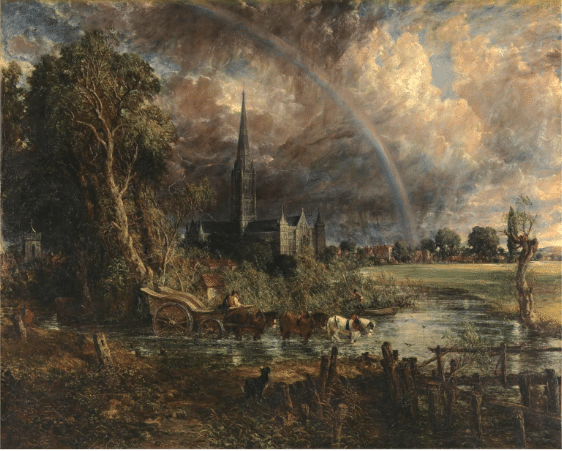
John Constable, Salisbury Cathedral from the Meadows, oil, 1830.
Constable pairs the prominent cathedral with lush vegetation, cultivated meadows and a passing cart-driver under clearing skies; it’s his way of symbolically uniting God with man. As his contemporary, the Romantic poet William Wordsworth phrased it, “God’s in His Heaven and all’s right with the world.” Seen in person, says the Tate, you’ll notice that “fresh raindrops glint and sparkle on the brambles in the foreground” where a black and white sheep dog (a stand-in for the viewer) points our gaze directly toward the church with its skyward gothic spire, the tip of which clears the storm, backlit by the heavenly light.
Claude Monet set an example for plein air artists to this day by making the worship of light in his paintings almost itself a religious practice. According to the Tate, Monet’s Poplars on the Epte (1891) is known to be the artist’s favorite among a series of pictures he painted of rows of tall trees lining a bend in the Epte River.
The Tate says that in the summer of 1891 Monet learned that this row of poplars on the river Epte, near to his home at Giverny, were to be cut down. The artist paid for them to be left standing long enough for him to paint them. In all he executed 23 paintings of this scene, exhibiting a group of them together in 1892.

Claude Monet, Poplars on the Epte (1891)
Monet magnificently handles the light shining through the translucent clouds. The bold and dynamic geometry of the composition, paired with the luscious blues and the very free and active brushstrokes, renders a row of unwanted trees into an icon of heightened awareness, a testament to how beautiful our world can suddenly seem when seen with eyes open to wonder and life.
Bridging the gap between classical and contemporary art, the Tate’s “light show” includes an installation by Japan’s most famous artist, Yayoi Kusama (b. 1929). Her work, The Passing Winter (2005), consists of a mirrored cube with circular holes on the sides through which viewers see the overlapping reflections as light bounces around the cube in a seemingly infinitely receding space. “The title may refer to the snow-like appearance of the floating dots, or suggest the transient, ever-shifting nature of the artwork itself,” says the Tate.
Here too an artist uses light in new ways to create dazzling parallel worlds to surprise us with awe and delight.

Yayoi Kusama, The Passing Winter, 2005, at Tate Modern, Source: B, flickr << https://creativecommons.org/licenses/by-nc-sa/2.0/
Bringing it All Home
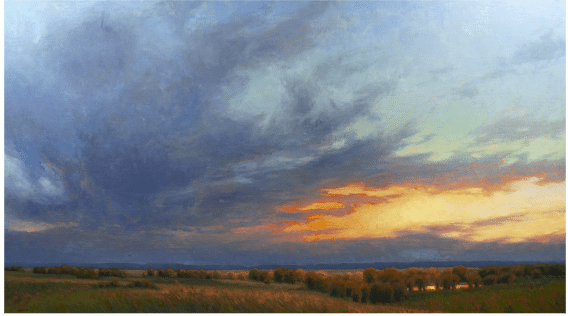
Kim Casebeer, Reverence, oil, 40” x 72”
Kim Casebeer is a contemporary artist carrying forward the notion of expressive, if not spiritual, light in 21st century landscape painting. In titling her large (40 x 72 inches) oil painting Reverence, (above), Casebeer connects a “big sky” view of North American topography with the sense of the sacred we feel when struck with awe by a beautiful sunset.
Really getting light into a painting is a challenge for any artist. You may find it a good place to start with Kim’s demonstration video Dramatic Light.
Have you ever been outside and stopped cold in your tracks by a scene you just had to paint? Ever paint it and realize it did not live up to the feeling you had when you first saw it? Kim says that feeling comes from the impression the scene holds in the light and atmosphere rather than just the objects that appear to your eye.
This is the kind of thinking that transforms paintings from descriptive, lifeless landscapes to breathtaking paintings that express a world of feeling.
Shedding Light on …. an Exploding Shed
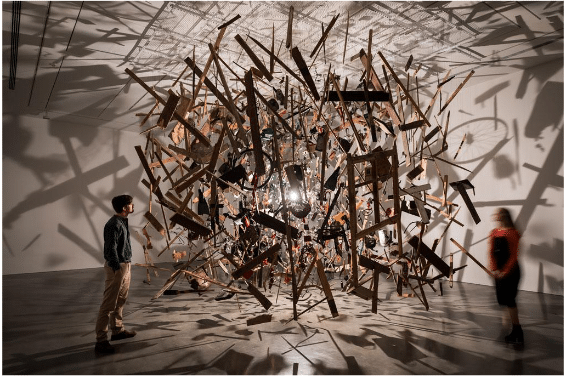
Cornelia Parker CBE RA, Cold Dark Matter: An Exploded View (1991) on exhibit in Australia before settling at the Tate.
Also on view at the Tate, the work of artist Cornelia Parker manipulates light and its opposite, darkness. Parker makes use of the shadows created by the light of a single lightbulb at the center of the suspended shapes in her installation Cold Dark Matter: An Exploded View on display at Britain’s Tate Museum. Says the museum about this haunting work: “To make the artwork, she exploded a garden shed (literally!!) complete with all the tools and the type of junk that gets stored in sheds. By suspending the fragments of the destroyed shed and its contents, the explosion seems to be paused mid-air. You can find out more about the ideas and processes behind this spectacular artwork in this Look Closer resource.”
Where one would normally list a work’s materials (e.g. oil on canvas) the Tate lists “wood, metal, plastic, ceramic, paper, textile and wire” (stuff that anything in your shed is likely to be made of). As for the work’s official dimensions – it’s anybody’s guess, really. After all, its own shadows are an integral part of it as well. The museum lists the dimension as “unconfirmed” alongside an estimate of 13 x 15 feet, or roughly the dimensions of … well, an exploded shed.