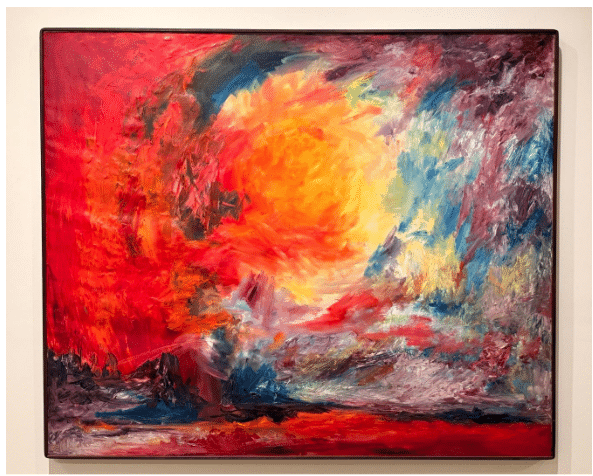
Hot enough for you? What color is “hot” – or “too hot”? If winter’s colors are cool blues and violet-grays, then summer’s are scorching orange, flame-yellow, and fire-engine red. Or so it seems, but not if you read the title of the painting above.
Mid-century abstractionist Jon Schueler’s large painting, “Red Snow, Cloud and the Sun” from 1952 is not the apocalyptic summer painting it looks like. But nor is it really the winter one it claims to be, because first of all snow isn’t red, and second of all GIANT BALL OF FIRE IN A BURNING SKY.
So what’s up here?
This is not a landscape in the traditional sense, nor is it empty abstraction. This is an example of Abstract Expressionism at its core: a visual equivalent of natural energy. Think of it as the four primal elements – fire, air, earth, and water – playing some sort of contact sport with obscure rules. It’s meant to burst and burn its way into your consciousness like a hot summer day, and in person, it does. The title is probably at least partly tongue-in-cheek, but it doesn’t matter – this is not a picture of anything you might see in normal waking life.
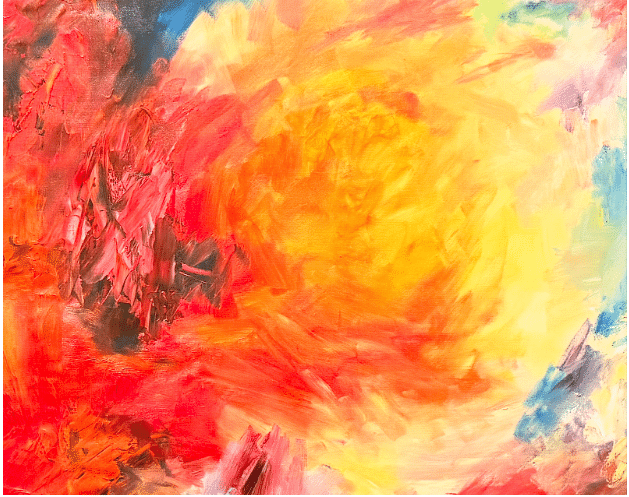
Detail of energetic brushwork in Jon Schueler’s “Red Snow Cloud and the Sun”
Schueler’s painting, which is in the collection of SUNY (Statue University of New York) Purchase’s Neuberger Museum, combines the drama of a magnificent Turner (J.M.W., one of the artist’s heroes) reimagined through big, impolite gestures that express and record for the eye the raw, kinetic energy the artist freely channeled as he worked. It’s a picture of the generative forces of life itself. It’s a picture of the world captured in the very moments of its formation (or is it rather the final day of its existence, right before it explodes?).
Jon Schueler came out of the 1950s West Coast “Ab/Ex” (abstract expressionist) movement that bounced between Los Angeles and San Francisco. Like his colleague, future superstar Clyfford Still, he advocated a new way of thinking about the painted image as a visual equivalent of the sublime in oneself.
He did not want students to paint as he did, nor did he specifically recommend abstract painting. He asked students to make something they had not seen before, and to affirm a positive expression of their deepest connections to nature, their truest core experiences and beliefs.
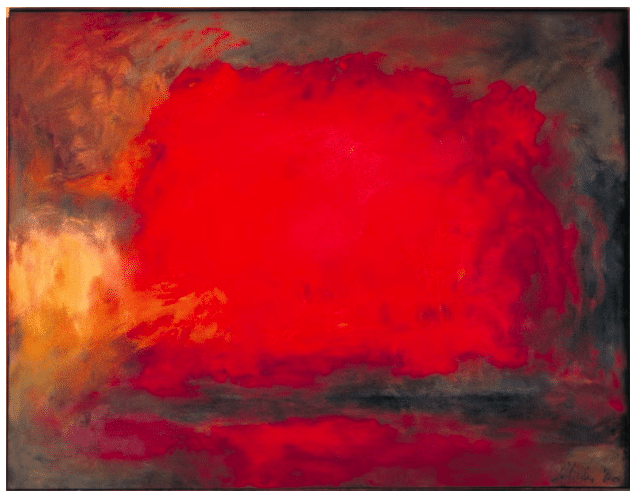
Jon Schueler. Next Summer. 1966. Oil on canvas. Image and data from the Jon Schueler Estate.
After his time with the west coast Ab/Ex had run its course, Schueler moved to New York, where the movement had started and was still going strong.
That’s where he made the painting above. We’re safe in assuming “Next Summer” really is a painting of summer this time. However, if it’s a landscape, it’s only so provisionally; Schueler gives us just the hint of what could be the shoreline of a body of water reflecting the orange-red “cloud”). But that’s not what this painting is “about.”
The main event is that colossal, Judgment-Day-red cloud-like mass smoldering in the center like roiling fire. There’s no explaining, nor shelter from, that giant shape or vapor or atom bomb blast that seems to be continuously exploding and churning like a furnace or a mushroom cloud of raw, untamable heat.
Jon Schueler was an earnest, dedicated painter uninterested in getting rich from his art. He deeply embraced art as a struggle to articulate the fundamental energies of reality and existence itself as he felt them.
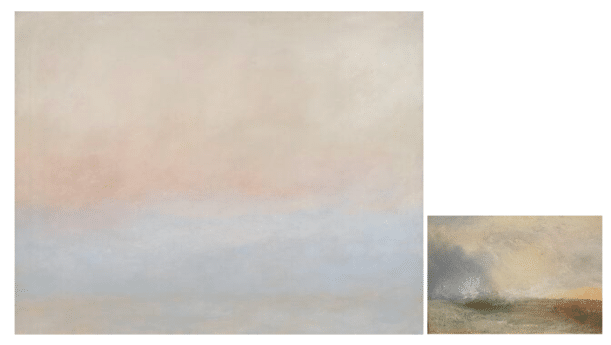
Jon Schueler, “Blue Sky and the Sea.” Nov. 1973. Oil on canvas. (left) Image and data from the Jon Schueler Estate. Late Turner (c. 1845) for comparison (right).
He moved from studio to studio, from coast to coast, but what he was looking for wasn’t a place. It was a mission. “I was left with nothing from San Francisco,” when I left, he wrote, “except for one very important resolve: I would deal with nature and I would deal with the canvas in an organic way. Non-geometric. I was in this sea of primordial ooze, struggling toward form, not knowing or aware enough as yet to just paint the primordial ooze and find the meaning of that.”
It’s there – in that “primordial ooze” – that “Next Summer’ and “Red Snow Cloud and Sun” were born, along with many other big, raw and expressive abstract canvases that “deal with nature” as he understood it.
He painted nature in a way no one had seen before. Through relentless experimental creation, he passionately connected with what he saw as the primal energies under the surface of nature. To do so he had to work blind, “in an organic way,” by keeping the painting “open” as long as possible and not imposing logic and formulas inherited from others too soon. He “took reality by surprise” – that is, he allowed himself to search and he allowed himself to be surprised by his own interpretations of reality taking visible form in front of him.
“Art must take reality by surprise,” the writer Françoise Sagan said in a 1965 interview. Schueler showed that it must take the artist by surprise as well – no surprise for the artist, no surprise for the viewer.
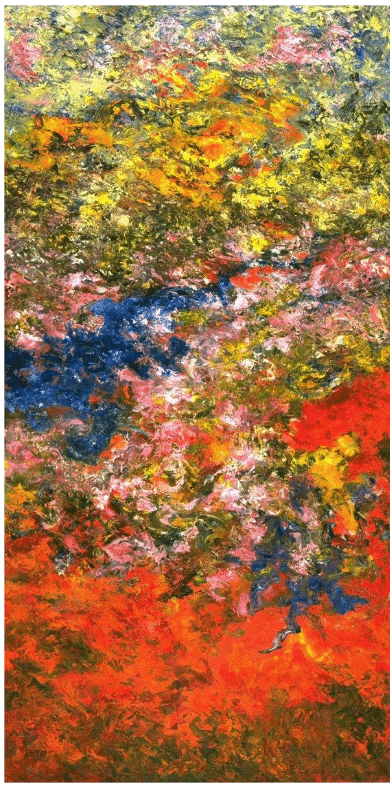
Jon Schueler, Evening I, oil on canvas 1957. 96″ x 48″
Are you ready to open your mind, unleash your imagination and let your creativity lead to new ways of seeing and depicting reality? Why not check out “Abstract Art for the Absolute Beginner” by Debora Stewart, available here.

Debora Steward, abstract floral from her “Whispers from the Garden” series of paintings in pastel.