“Philosophy begins in wonder,” Plato said. I love that, because it reminds us to be surprised by the wonderful things in the world before we get caught up in trying to figure out what anything means. Artists try to honor the joy of being delighted by learning how to express and share a quickened sense of life viscerally, from that place where thinking and feeling are the same.
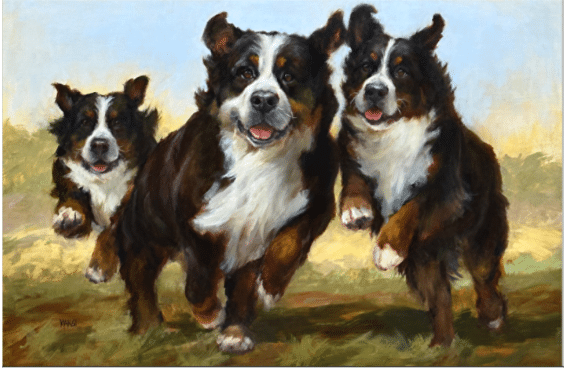
Johanne Mangi, “Berner Joy,” oil. Johanne teaches her specialty of dog portraits in oil in her video, The Fine Art of Painting Dog Portraits
Wonder shows us life isn’t finished delighting us. It’s a sign that we’re still capable of being fully present, as we were as children. We need to pay attention when something announces to us that life still holds naïve charm, ancient mysteries, and dazzling beauty. Clouds still assume the shapes of fancy. There’s still chill dread in the deep end of the pond and there is laughter in the fall of a leaf. The neighborhood stills looks magical from the roof of the house.
“For love and beauty and delight, there is no death or change.”
-Shelley
These moments are signs of what is important to us. The feeling of wonder or joy, the thrill of delight, the experience of beauty, have in common that they are immersive, all-in forms of deep appreciation.
As artists we get the privilege of marveling. Artists read the world like a soothsayer reads signs. Does art have to mean something? Can’t it just be beautiful? It’s easier to talk about composition, color, and value, but I think “something meaningful” is what we all want and why we go to art in the first place.
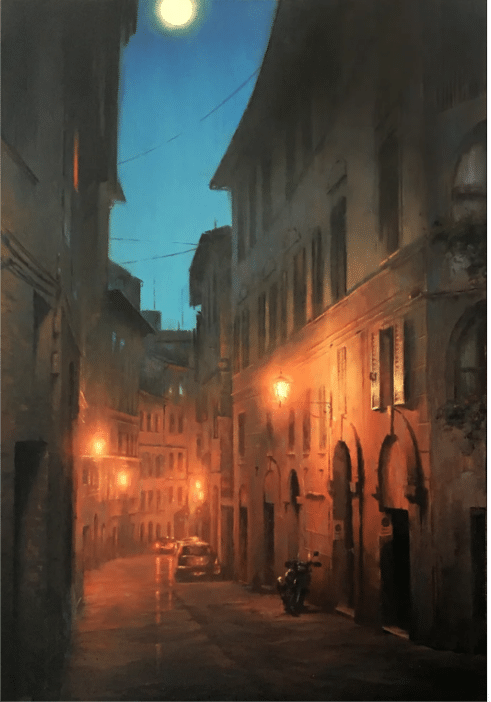
Gavin Glakas, “Alone in Sienna,” oil, 14 x 11 in. Known for “The Glow,” Gavin Glakas teaches his ability to capture atmospheric light in his video, Glow – Creating Depth, Atmosphere and Vibrant Sun
However, “meaningful” doesn’t have to mean everything gets reduced to words, ideas, or analyses – at all. Color alone can be considered a psychological language; it carries meaning for us.
Truly beautiful works are meaningful by definition; the experience of beauty is always a meaningful one. Beauty rescues us and makes life seem important and exciting again. Augustine called it “a plank amid the waves of the sea.”
Experiencing something beautiful, like the experience of wonder, love, or delight, is a birthright of being human. “Beauty quickens,” writes Eileen Scarry in her 1999 book, On Beauty and Being Just. “It makes the heart beat faster. It makes life more vivid, animated, worth living.”

John Pototchnik,” The Golden Hour,” oil. John Potothnik teaches his approach to harmonious, expressive color in his video, Painting Values & Color
Artists know this instinctively. Scarry says beauty sparks the desire in us to replicate it, to prolong it, to join with it and add more of it to the world. “Wittgenstein says that when the eye sees something beautiful, the hand wants to draw it,” Scarry says.
Rembrandt’s self-portraits (or those of English painter Jenny Saville for that matter) say this is me and this is not me and there are things you will never know about me and things you will never know about you and that has to be okay. That’s meaning in art.
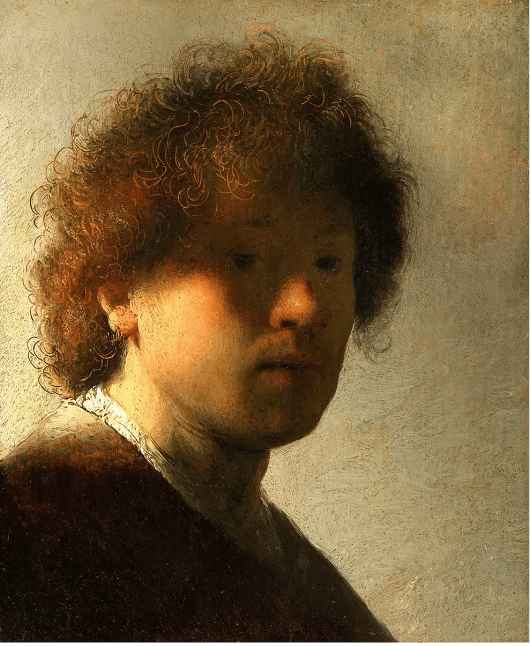
Rembrandt van Rijn, Self-Portrait, 1628
Painting and feeling are not equivalent, but painting is about feeling. The materials of painting are expressive in themselves and awe-inspiring when they work together: color, line, and shape resonate with feeling as in a poem, where line break, word, sound, and image all contribute to the “meaning” of the whole.
Art comes from a life lived consciously and fully, and not necessarily one in which everything is known, safe, and easy to master.
“For the birth of wonder is a marvelous, sweet thing, but the recognition of it is sweeter and more marvelous still. Its growth, perhaps, shall measure the growth and increase of the soul to whom it is as eyes and hands and feet, searching the world for signs of hiding Reality. But its persistence—through the heavier years that would obliterate it—this persistence shall offer hints of something coming that is more than marvelous. The beginning of wisdom is surely — Wonder.” – Excerpt From The Extra Day by Algernon Blackwood