Cityscapes can range from decorative to abstract, and from visceral to hyper-realistic. Here we take a near-random sampling of the genre through time, beginning with the golden age of Japanese color woodblock prints. These works of art, created during the 18th and 19th centuries, are among the most beautiful as well as influential landscapes ever made.
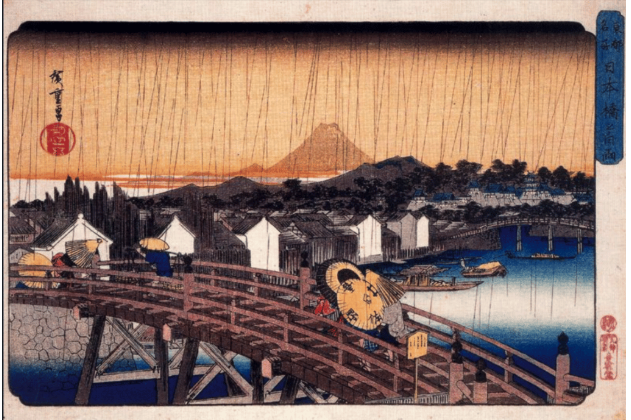
Utagawa Hiroshige (Ando) (Japanese, 1797-1858). Shower on Nihonbashi Bridge, from the series Famous Places in the Eastern Capital, ca. 1832.
Traditional Japanese printmakers adored scenes from everyday life of all kinds, crowded fishing ports, busy villages and bustling cityscapes included. The impact on Western art is hard to overestimate; the proto-Modernism of artists like Gaugin, Whistler, and Matisse would be unthinkable without the prints and reproductions of Japanese art that began proliferating in France in the late 1800s. European artists were awed by the refreshing formal characteristics – wonderfully simplified details, deep colors, brilliant design and compositions with strong diagonals, asymmetrical arrangements, dramatically foreshortened perspective, and an emphasis on flat, linear design. Nothing like the elaborate Academic idealism of the day!
Utagawa Hiroshige (1797-1858) was one of the best known of all Japanese woodblock print designers. He is particularly renowned for his landscape prints, which are among the most frequently reproduced of all Japanese works of art. Hiroshige’s landscape prints such as the above, “Shower on Nihonbashi Bridge, from the series Famous Places in the Eastern Capital, were hugely successful both in Japan and in the West.
Modernist Abstraction
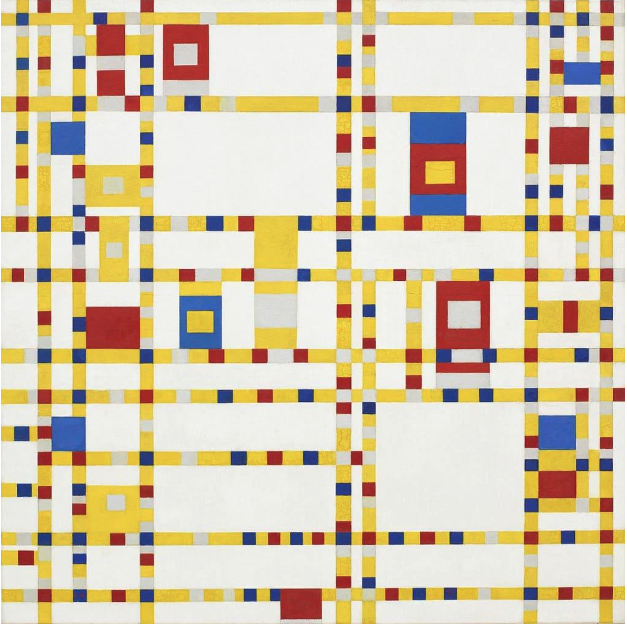
Piet Mondrian, 1942 – Broadway Boogie Woogie 50 x 50 in.
Fast forward to the era of Modernism, and we find something far afield from Japanese observational painting in Mondrian’s iconic Broadway Boogie Woogie of 1942. Here the city appears as a kind of shorthand notation instead of even a quasi-realistic representation.
Mondrian sweeps the rules of perspective and observational painting off the table to reimagine blocks of buildings, streets, and traffic as a map-like grid consisting of visual art’s bare-bones essentials: a radically different kind of beauty consisting solely of geometric form and primary colors. It’s almost like a Platonic Ideal, the archetypal blueprint of all cities.
His skillful use of color animates the geometry. Like saxophone notes in a jazz composition (to which the title alludes), Mondrian’s blocks and spots of color seem to blink on and off in syncopated motion. The painting as a purely intellectual experiment conveys the idea of the constant neon, traffic lights and jostling thoroughfares of the modern city in motion – even as it exists quietly in its own world as a beautiful, non-representational abstraction, pleasing to eye and spirit on a whole other level than that of the senses alone.
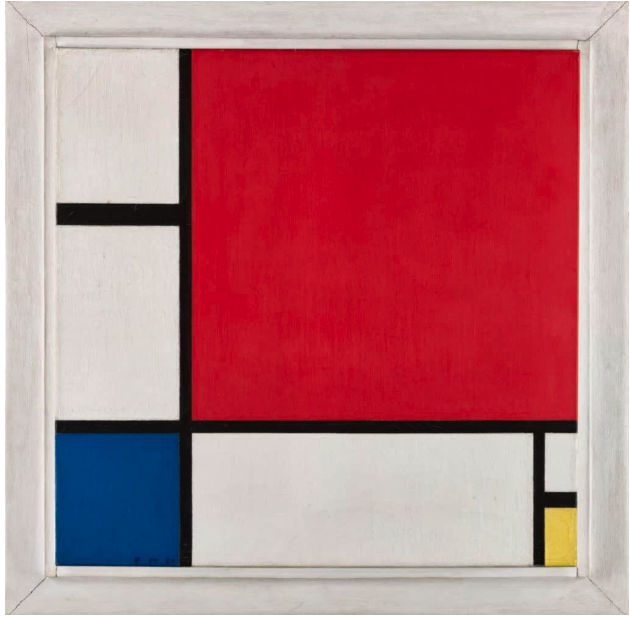
Mondrian, “Composition III,” 1930, one of Mondrian’s “city” (i.e. “Parisian”) paintings.
Abstract Expressionism
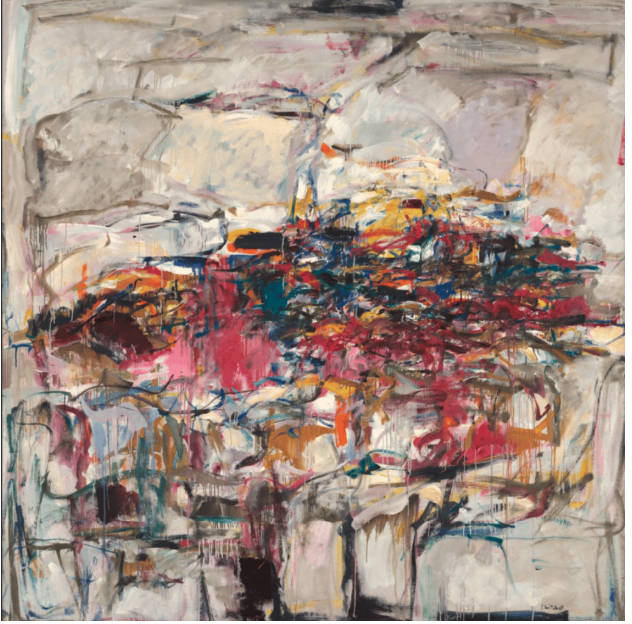
City Landscape, oil on linen, 203.2 × 203.2 cm (Art Institute of Chicago 1958.193, ©The Estate of Joan Mitchell)
Putting bodily sensation and the visceral feeling of the city back into the picture (despite her protestations to the contrary), New York School abstract expressionist Joan Mitchell’s City Landscape of 1955 blares with the fierce and loud frenetic pace of urban life. She insisted her gestural abstract paintings were “about landscape, not about me,” according to the Art Institute of Chicago that owns this one.
Nonetheless, her “large, light-filled canvases animated by loosely applied skeins of bright color” are nonetheless full of personality and “infused with the energy of a large metropolis” as filtered through the artist’s sensibility (rather than her eyes). At about six feet square, the painting above is as confrontational and overwhelming as the American city itself.
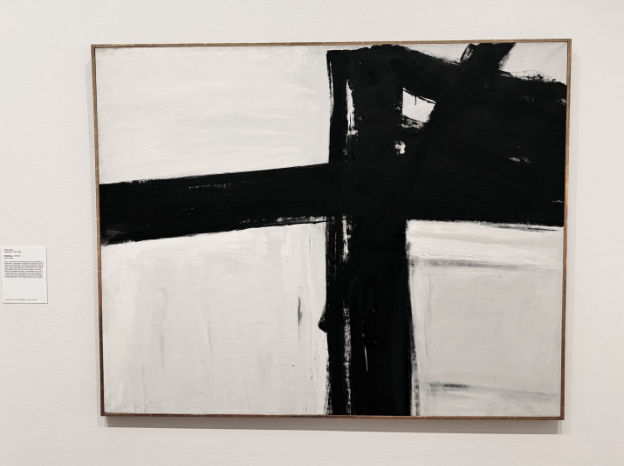
Franz Kline, “Bethlehem (Pennsylvania),” black and white commercial paint on canvas.
The same could apply to the work of her contemporary, Franz Kline, whose works take a different route to the same goal of painting not what he saw in the American city but how he felt about it. Kline’s composition of crossed lines creates expressive tension through a set of formal oppositions: black and white, subject and background, horizontal and vertical. Dark, velvety bands of black paint intersect against fields of radiant white subtly inflected with half-hidden and lightly applied black paint.
While these angular forms recall the iron girders or wooden beams of an industrial structure, visual reference gives way to overall abstraction. Often inspired by the stark landscapes of his home state, Kline named many of his abstract paintings, including Bethlehem, after gritty Pennsylvania town and cities.
Return to Realism: Contemporary Urban Painting

Antonio López Garcia: La Gran Vía, Madrid, 1974-81, about 4 ft. long.
At 90 years of age, Spanish painter and sculptor Antonio Lopez Garcia has pursued his signature brand of realism for more than 50 years. Future art historians will probably cite his work as a major force in the contemporary resurgence of interest in realistic painting. Antonio Lopez Garcia has drawn criticism by some major modern artists for what they consider his neo-academism, and he has received praise from some prominent art critics, such as Robert Hughes, who in 1986 called him “the greatest realist artist alive.”
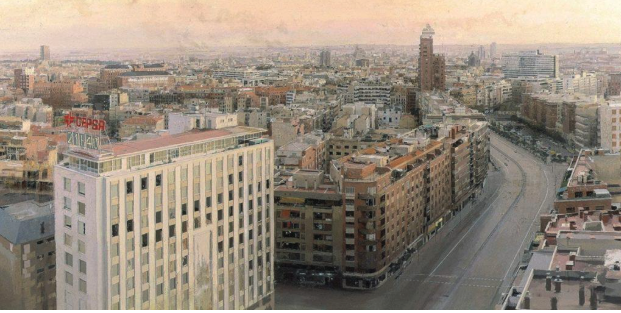
His large cityscapes of his native Madrid are notable not only for their gorgeous palettes and incredible detail, but for their special distinctive atmosphere, a signature characteristic that identifies the work as no one’s but Lopez Garcia’s own. Despite their size, he paints them outdoors, setting up in the same place sometimes for days at a time.

Antonio Lopez Garcia painting on site in Madrid.
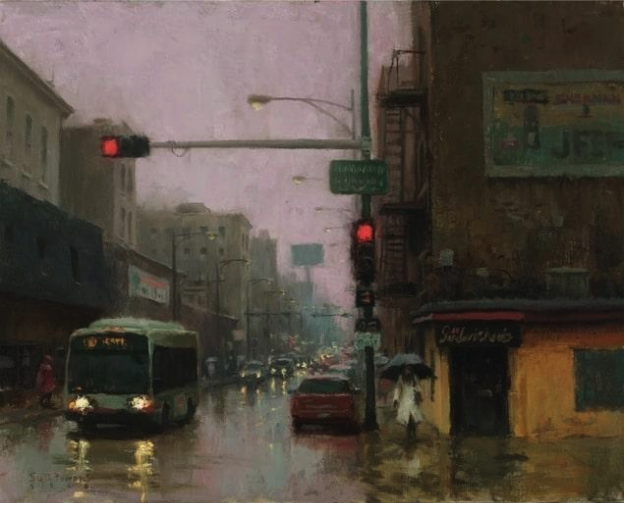
Scott Tallman Powers, Urban Reflections, 16″ x 20,” oil on canvas
Landscape painter Scott Tallman Powers has a video on how to capture an outdoor Chicago scene on a rainy day that breaks down the process in fine detail. His running commentary explains exactly how, why, and what to do and not to do – from the underpainting to the final brushstroke. It’s another one of many instructional videos on painting the contemporary cityscape.

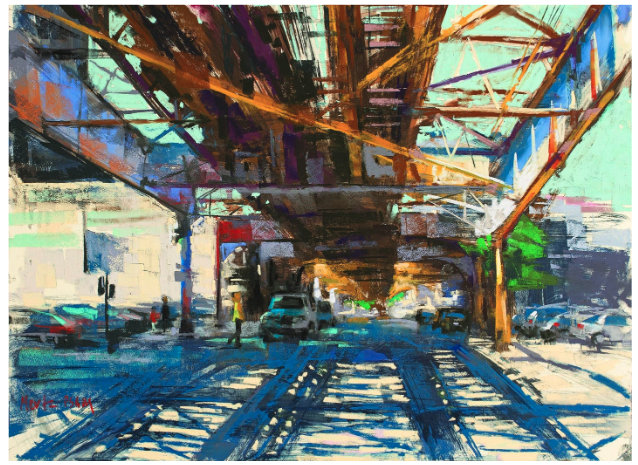
Nancy King Mertz, Crossing Chicago Ave, pastel, 12 x 4 in.
Nancy King Mertz also makes the dynamic landscapes of Chicago’s city streets her subject. Her video on using pastels to capture urban scenes and settings is “Urban Pastel Painting” and it’s available here.