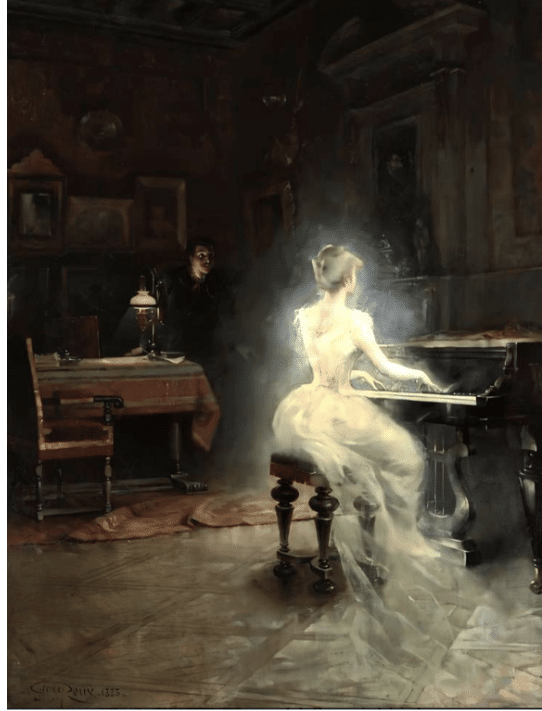
“Spirit” by George Roux (above) is an almost whimsical rendering of turn-of-the-century ideas about “phantasmagoria,” that is, disembodied spirits and ghosts. The glowing spirit of a beautiful young woman, her dress trailing into transparency, runs wispy fingers over the piano keys while a startled young man, perhaps her mourning widower, rises from his writing desk in shock and alarm. It was painted in 1885.
During the Victorian era, great interest arose in “Spiritualism.” This was a widespread fascination with the question of what happens after we die. It often attempted to use the new discoveries and inventions of science to prove the existence of spirits “on the other side.”
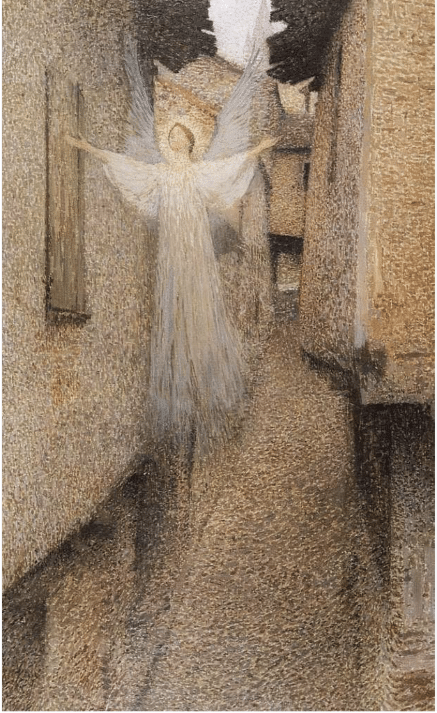
Henri Martin, “Apparition,” 1895
Of that same era is Henri Martin’s “Apparition” of 1895. Martin’s ghost, another beautiful young woman, assumes a quasi-angelic form, hovering “between the worlds,” neither fully existing in material reality or in the immateriality of the eternal and infinite Beyond.
We get a very different kind of specter in the striking Japanese print below.
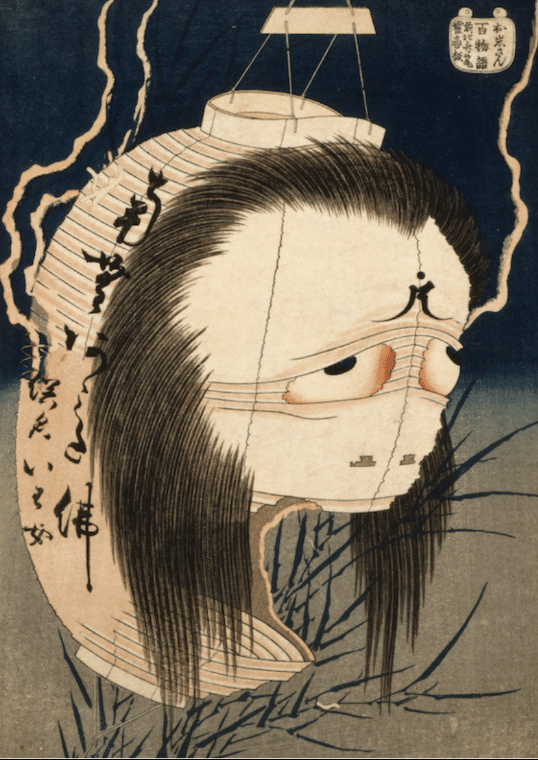
Katsushika Hokusai, “Oiwa (Oiwa-san), from the series “One Hundred Ghost Tales (Hyaku monogatari)” 1831-1832, Color woodblock print, 10 1/16 × 6 5/16 in.
The image above is by the same Hokusai who created the famous woodblock print generally known as “The Wave.” Hokusai painted this haunting print to depict the main character in the ghost story of Oiwa. In the story, Oiwa’s unfaithful husband tried to poison her, but it didn’t work and only disfigured her. Realizing how cruel he could be to her, however, did kill her, as she died of a broken heart. Unable to move on, her ghost haunted him ever after. Here, Hokusai paints Oiwa arising from a Japanese lantern as she would appear in the story – balding, and with bloodshot, drooping eyes, all the effects of her husband’s poison.
Almost equally strange is the painting below by early 19th century British visionary artist William Blake, titled “The Ghost of a Flea.”
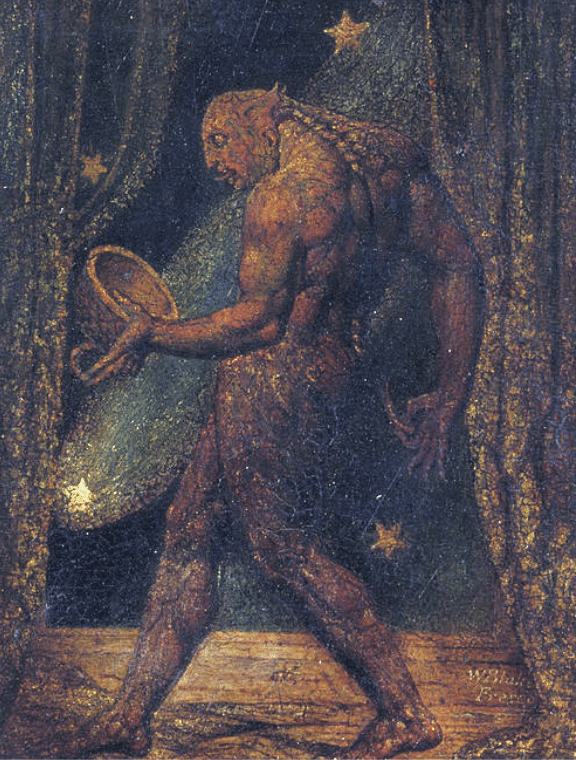
William Blake, “The Ghost of a Flea,” 1819, Oil on wood, 8” x 6”
In this painting a hulking, muscled figure strides forward, his strangely muscled shoulders and articulated backbone turned towards the viewer. In his outstretched hand he holds a “bleeding bowl” made from an acorn. These were used to catch the blood released during the medical procedure known as bloodletting. In the other hand, he wields a knife in the form of a curved thorn. His tongue protrudes from between his teeth and his eyes bulge from his head.
We get a more urbane phantom in “Hamlet and the Ghost,” by Frederick James Shields (below). Shields depicts the young Hamlet on the moors, communing with the ghost of his father. This is the point in “Hamlet” when he learns that his uncle, his father’s brother, has murdered the king, whose place he’s taken, by pouring a powerful poison, “the juice of cursed hebenon,” into his ear while he slept.
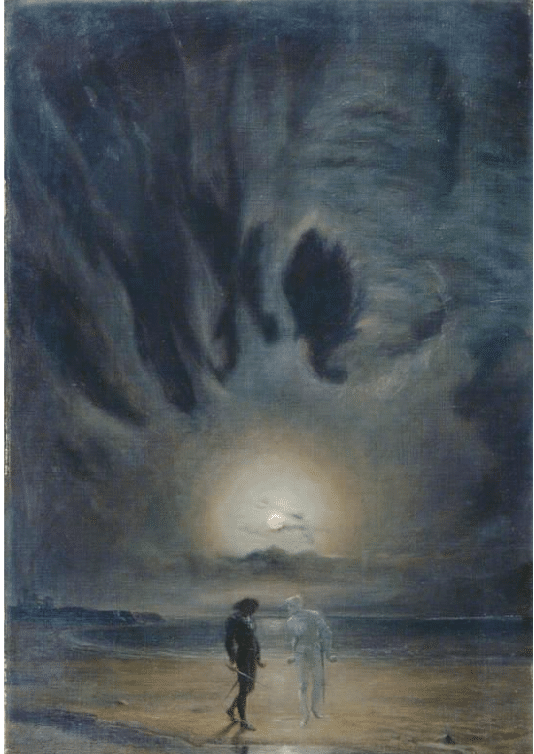
Frederick James Shields, “Hamlet and the Ghost”
In this one (above), it’s not so much the ghost but the eerie shapes in the clouds above that carry the spooky vibe.
Perhaps the most famous “spooky” painting or all though is Fuseli’s “The Nightmare.” A famous interpretation of this painting holds that we’re being stared at for interrupting an incubus, a male demon, who, having arrived upon the “night mare,” the black, blind-eyed horse emerging from the shadowy curtain on the left, perches insolently atop a sleeping figure.
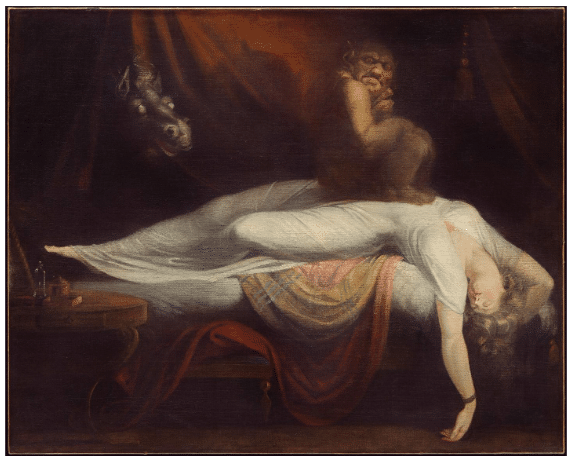
Henry Fuseli, The Nightmare, 1781, oil, 3’4”” x 3’’2”
If you’re interested in art history as it’s playing out in contemporary realism, consider subscribing to Fine Art Connoisseur, the leading publication in the field.