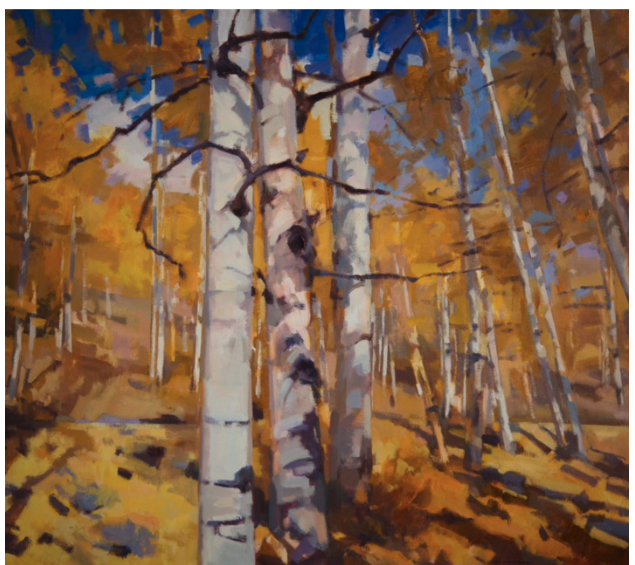
Good artists imitate; great artists steal. This phrase is variously attributed to Steve Jobs (who misattributed it to Pablo Picasso – we’ll get to that), and to Lionel Trilling, Igor Stravinsky, T.S. Eliot, and William Faulkner. (Oh, and the lesser known English man of letters W.H. Davenport Adams, who seems to be one who actually came up with the earliest version of it while writing for The Gentleman’s Magazine in 1892).
“You don’t have to look like your heroes, you want to see like your heroes,” writes Austin Kleon in his book, Steal Like an Artist published in 2012. Like the luminaries above quoted (or misquoted), Kleon doesn’t mean ‘steal’ as in plagiarize or blatantly rip off — but study, credit, recontextualize, remix, mash up, and transform. Matisse said much the same thing: Don’t copy the results, copy the effort. But even Matisse was willing to acknowledge, in the words of Picasso, “He (Meaning Cezanne) was the father of us all.” Cezanne himself kept talking about making something “solid and durable like the art of the museums.” Cézanne wrote in 1905 to Roger Marx, editor of the Gazette des Beaux-Arts : ‘To my mind one does not put oneself in place of the past, one only adds a new link.’ Even those guys had “masters” to admire, and boy did they ever.
And if you’re going to stealn (and you are), you know what they say – steal from the best. Don’t just look at what’s popular or what your contemporaries are doing to be successful. Go deep. “Do your research.” Immerse yourself in the rich history of the craft. Discover the innovators, the great progenitors and prototypes of what everyone else is doing. Find the paintings of the past that you love – and saturate your soul with their marvelous creations. Assimilate – and allow yourself to be changed and inspired by – the very best art of the past 500 years +. That’s the stuff you need to steal.
The science of stealing
Scientific discoveries happen the same way – scientists constantly study, assimilate, share, combine and recombine other scientists’ work to create new insights, theories, and discoveries. That’s just how it works. Like replicating an experiment and gathering new data, stealing (as opposed to copying) isn’t imitating; it’s internal and it’s iterative. In this sense, it’s just how artists learn and make new things.
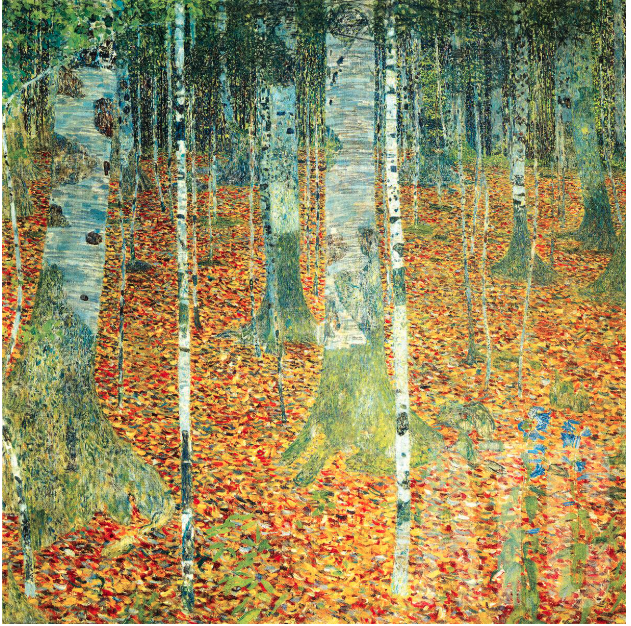
Gustav Klimt, “Birkenwald (Birch Forest),” c. 1911
Creative work builds on what came before, and so in a sense there is nothing new under the sun. Except you: No one has the same creative DNA – the same combination of memories, dreams, doubts, fears, skillsets, secret freak superpowers and fantasies. THAT’S what you draw upon to be “original.” A big part of becoming an artist is consciously not copying what you’ve seen work for others in favor of finding out and learning to accept who you are. As Kleon says, “You don’t need to be a genius, you just need to be yourself.”
The art we admire, the masters who seem gifted by the fickle gods – none of this stuff happens in a vacuum. None of it, that is, except the truly bad “experimental” art made by art students with tattoo sleeves who carry disposable blow torches everywhere for some reason and consciously try to be completely original (and end up derivative of something they didn’t understand in the first place – the definition of pretentious).
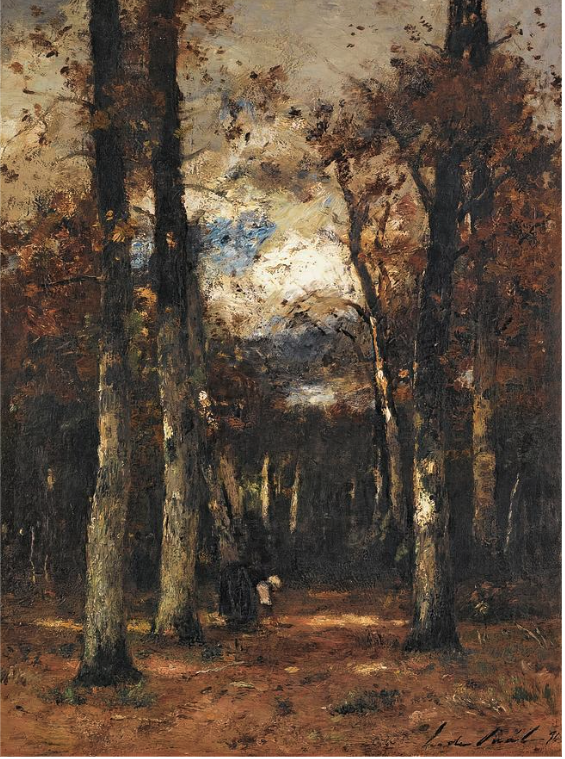
László Paál, “ Forest at Fontainebleau,” 1876, oil on canvas, 75 x 55 cm. Private collection, Paris.
Rather than trying to be totally original, great artists consciously work within the traditions and cultural context they share with all. That’s what leads them, by some mysterious alchemy of psyche and soul, to the real goal – authenticity. To get there, as Matisse wisely advised, don’t imitate the results, imitate the impulse behind them.
It’s a mindset as much as anything else. Somebody once said writers should be reading constantly – even if it’s just the text on a ketchup bottle or a box of cereal at breakfast. So for any artist – always be looking, thinking, and creating. Put yourself in the path of lots of what you like and even lots of what you don’t – everything is fair game for “originality.” Any great artist would say the same.
Jill Carver’s award-winning plein air paintings (such as “Sovereign Presence” at the top of this page) are rooted firmly in tradition combined with a contemporary style. If you’re interested in learning more about her painting techniques, check out here instructional videos here.