“Steal like an artist.”
That’s the title of a popular self-empowerment book for artists and a phrase on lots of peoples’ lips these days.
It’s a variation on “Good artists borrow, great artists steal!” which is excellent, even though it’s misattributed, sometimes to Picasso and sometimes to the modernist poet T.S. Eliot. It actually comes from Eliot (substitute “poets” for “artists”) but not in those words. What T.S. Eliot said is the following and I’ll tell you why it’s worth quoting the whole passage in a minute:
Immature poets imitate; mature poets steal; bad poets deface what they take, and good poets make it into something better, or at least something different.
So, “good artists borrow, great artists steal” is not about “good” or “great” in the original – it’s not about the painting at all, but about the painter – beginners (“immature”) vs. experienced (“mature”). It’s also not about copying other peoples’ work (except to study it). What Eliot meant by “stealing” as opposed to “imitating” is don’t settle for painting the same paintings in someone else’s style – do that, but then take that style and make it into something better, or at least different. We know this as “making it your own.”
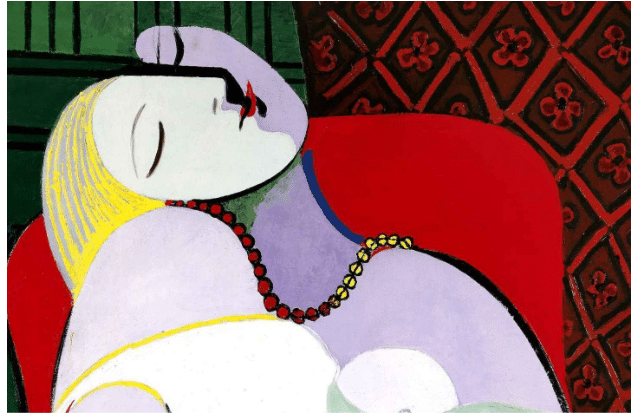
DETAIL, Pablo Picasso, “The Dream,” 1932, oil
In fact, it’s actually a perfectly good idea to copy other peoples’ paintings when you are starting out – it’s one of the best ways to learn to make the kind of work you’re interested in making. This is something classical artists’ apprentices and Academic students of painting did for hundreds of years – because it works. But don’t get too good at it. The best way to learn to paint, (and you can ask Picasso) is to fail at copying so that you have to start making it up.
What Picasso actually said, by the way, amounts to (I’m paraphrasing) Go ahead and try to imitate someone else! You can’t do it! And when you find out you can’t 100 percent do it – when you have to start making it up? If you’ve got the goods, that’s when you start to find your own style.
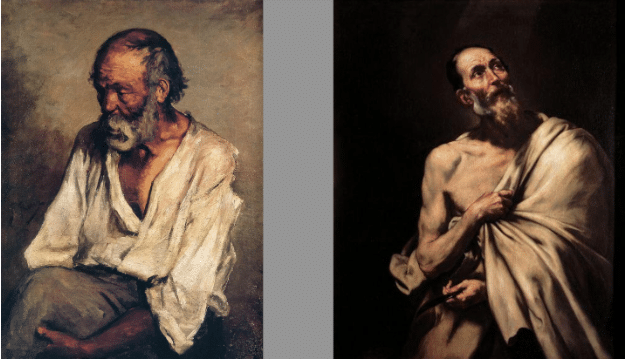
An early painting by Pablo Picasso, The Old Fisherman, 1895. RIGHT: Jusepe de Ribera, Saint Bartholomew, 1791.
“What does it mean,” says Picasso, “for a painter to paint in the manner of So-and-So or to actually imitate someone else? What’s wrong with that? On the contrary, it’s a good idea. You should constantly try to paint like someone else. But the thing is, you can’t! You would like to. You try. But it turns out to be a botch…. And it’s at the very moment you make a botch of it that you’re yourself.”
No artist works in a vacuum. Everything we paint is conditioned by everything we’ve done, thought, felt, and seen, including and especially the art of the past and present and rightly so. I think what all this is getting at is that the ultimate goal, whether we’re talking about realism, abstraction, copying, or improvising, is to learn the ropes only enough to begin to produce art that is yours because it comes from you. You can’t do that effectively without starting with what’s already been done and then deliberately moving on. First learn the technique, so that in the heat of working you can just GO. It’s fine to roller skate holding onto the handrails – you’ll eventually make your way all around the rink. But where’s the fun in that?
Below you see a painting by Edward Seago, a 20th century British landscapist. I love how loosely he paints everything yet how true he is to the nuances of tone, color, and temperature. The brushstrokes (or “marks”) in his paintings often form an abstract pattern on their own that contributes harmoniously to the overall mood and impression of the work.
Here, the brushstrokes and mark-making form their own self-contained abstract pattern and it all combines to contribute to the vibrant sense of breeziness, air, and shifting light and shadow at the heart of the work (even clearly visible in the wide, empty area of the upper sky).
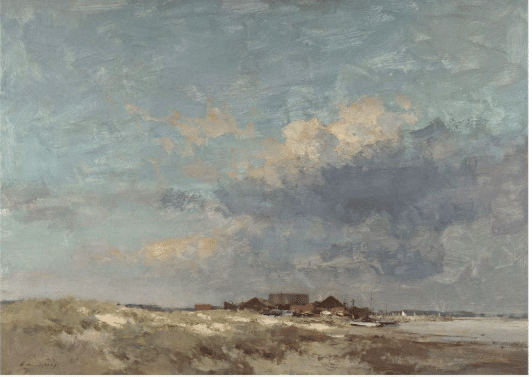
Edward Seago
But Seago owes his palette and even his composition to earlier Dutch artists. Below is a painting by Jacob Maris that contains many of the same elements that Seago’s painting does only in a different configuration: common to both paintings is the typically Dutch division into a small strip of land and a big sky patterned and set in motion with lively brushwork, bright, blowsy clouds composed of patches of warm pigment beside warm blues offset by cool mauves and grays, neutralized green-grays and violets for the foreground and middle-ground land, as well as the overall sense of scale.

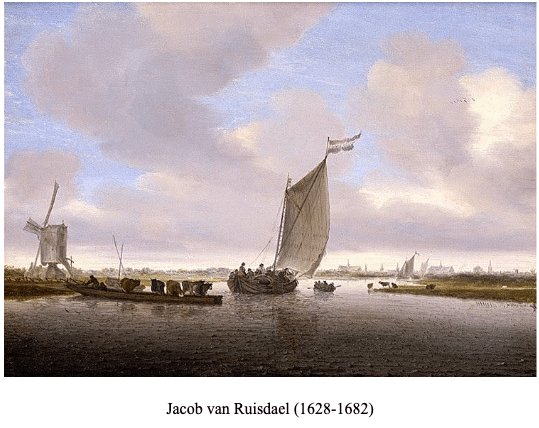
The point is not that Seago copied or “imitated” Jacob Maris. He stole from him, of course, as all great artists do from their masters. And Maris himself was one of scores of painters who worked from paintings made another 200 years earlier than that, by Dutch masters such as van Ruisdael. Below, in the earlier Ruisdael, despite the obvious differences to Maris, we see the same sense of scale, same sky-to-earth ratio, and a similar use of understated chiaroscuro, earth colors, and diffused light.
Now compare that painting by Ruisdael to an early work for the British Royal Academy by genius painter JMW Turner some 150 years later.

JMW Turner, “Rotterdam Ferry-Boat,” oil on canvas, 1833
That 1833 painting above by 19th century English artist JMW Turner may not immediately seem a match for the c. 1660 painting by Dutch master Jacob van Ruisdael, but a close look and a minute of thought reveals the lineage. The paintings have mirror-image compositions – a blowsy sky with a low horizon line and a Dutch ferry-boat in the center (it’s the same kind of boat in both). The center boat is supported by smaller, different kinds of ships in the background. Use of mauve shadow in warm clouds against a warm blue sky? Check. In the Ruisdael, the windmill on the left provides visual ballast, while in the Turner, the frigate on the right serves the same purpose.
This is only interesting, by the way, if you’re aware of who Turner developed into later. You can already see the “Turneresque” light-handling in this early example (you know you’ve made it when the spellchecker doesn’t catch a word made up of your name with “esque” on the end). Once he’d broken free of his early “stealing,” Turner did magnificent and untethered original things, paintings that looked like nothing anyone had seen before. This, for example:
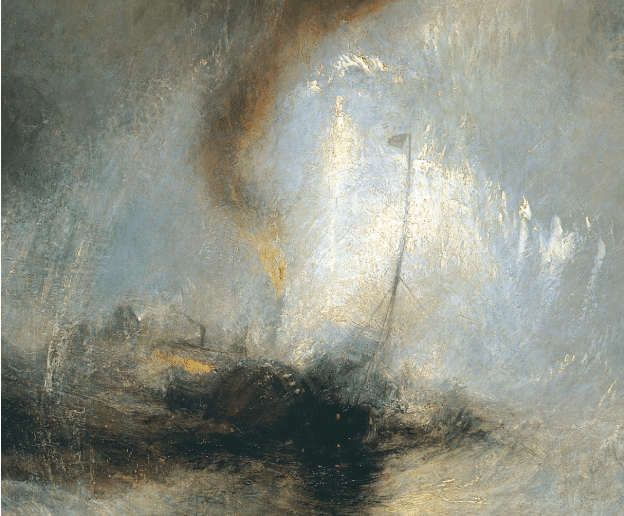
JMW Turner, “Snow Storm – Steam-Boat off a Harbour’s Mouth Making Signals in Shallow Water, and going by the Lead. The Author was in this Storm on the Night the “Ariel” left Harwich,” 1842, oil on canvas, 91 cm × 122 cm
You can still see the debt to Dutch marine painting but just barely. Turner found his own voice through constant experimentation, born of deliberately reacting against (or building upon, if you prefer) what others had done before.
So, if you’re trying to find your style, it’s best to avoid getting hung up on questions of influence vs. plagiarizing or derivation or whatever. Be honest with yourself and your viewers about your take on the world (which you’ll discover through experimentation) and take whatever from everywhere. Know that eventually it’s how much authenticity, joy, and imagination, that is to say, how much of yourself that gets into the work, that will count. So go ahead and copy, copy, copy.
“Copiers don’t bother me,” Picasso declared, “If they have any temperament, it’ll appear eventually to disclose the personality of an artist… It is better to copy a drawing or painting than to try to be inspired by it, to make something similar. In that case, one risks painting only the faults of his model. A painter’s atelier should be a laboratory. One doesn’t do a monkey’s job here: one invents. Painting is a jeu d’esprit.”
Real art isn’t trying to sell you moisturizer. Real art is not an escape from reality. Real art is created in such a way that, through the process of studying it, the viewer is transformed.
Interested in learning the techniques of classical portraiture and figure painting, such as that practiced by the young Picasso and Diego Ribera? Then check out Secrets of Expressive Portraits by Tony Pro.
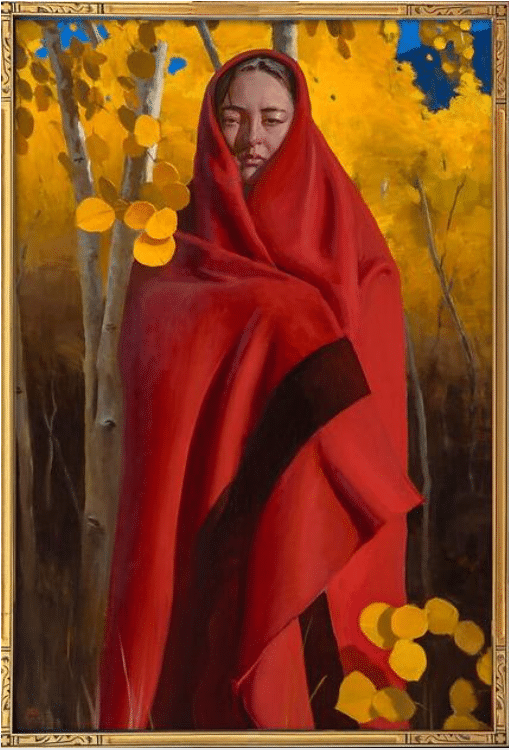
Tony Pro, “Among the Golden Ones, ” Oil on linen, 36 x 24 in.