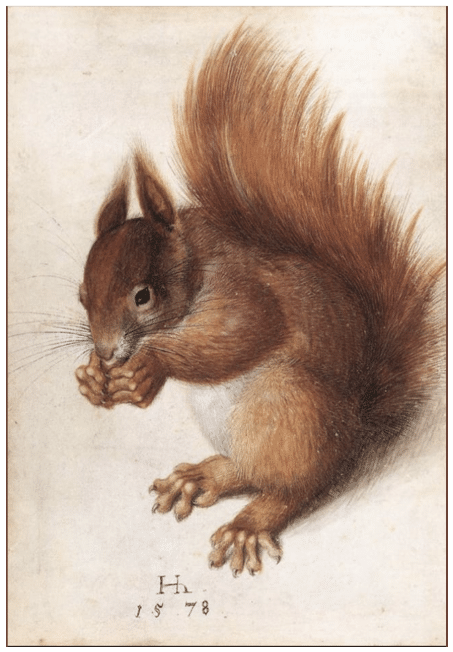
Love or hate the little critters (squirrels that is, not artists!), artists have been making paintings of squirrels for hundreds of years.
A cursory glance at the history of squirrels in art begins with the hyperrealist symbolic Dutch still life genre.
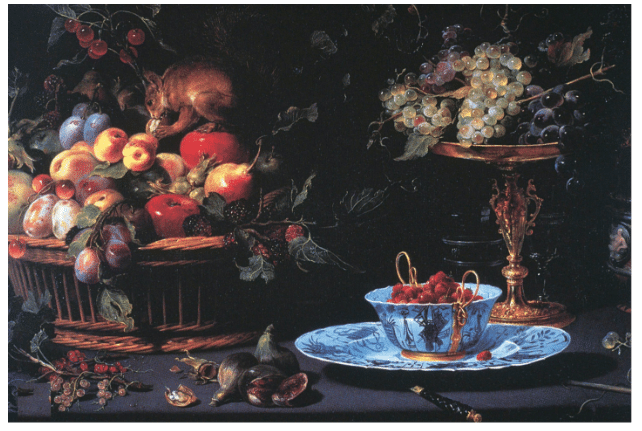
A fluffy guest. Frans Snyders’s 1616 Still Life with Fruit, Wan-Li Porcelain, and Squirrel. Museum of Fine Arts, Boston.
True to form, there are a lot of surprises hidden in the Dutch still life above, which comes what’s known as the Northern Renaissance period in European art. There’s also a rather larger surprise than usual – a whole squirrel, squatting on top of the Deluxe Fruit Basket™. Most everything in these “Old Master” paintings had symbolic meaning for the viewer. As for our fluffy friend, from the Middle Ages until the early 19th century, squirrels were popular pets for the wealthy. So the inclusion of the rowdy rodent here could easily carry the connotation of the patron’s worldly success, just as the wrought gold goblet, the fine China, and all the mad abundance in general are here to do.
However, some sources suggest a secondary association that fits right in with the “vanitas” theme (aka, don’t gain the world and lose your soul) these paintings are all about. Before the 18th century, squirrels got a bad rap; people mistook the thrifty beasties’ sensible hoarding of food for winter for gluttony. So, they were often used in art as symbols of miserly wealth and greed.
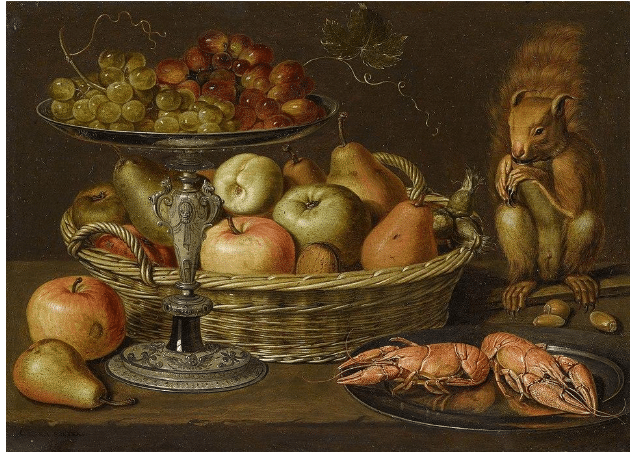
Clara Peeters,, ‘Still Life with Fruits, Langoustines, and a Squirrel’ (detail), c.1612-1615 height: 34.1 cm (13.4 in) ; width: 46.8 cm (18.4 in)
Painted around the same time, Clara Peeters’ still life above gives the squirrel almost a starring role. Rather than just perching, this guy’s standing tall and he’s almost a s big as the main pile of fruit. He looks nice until you notice his paws claws and how he’s rubbing them back and forth like a dastardly bad guy gloating over an evil deed!
A much closer look, however, brings us face to face with a fella with a not so dastardly disposition. Though his ears look suspiciously like little devil’s horns, he’s got a dreamy look in his eye as he savors the last bit of sweetmeat from inside an acorn shell.
Clara Peeters’ still life paintings are the subject of an exhibition
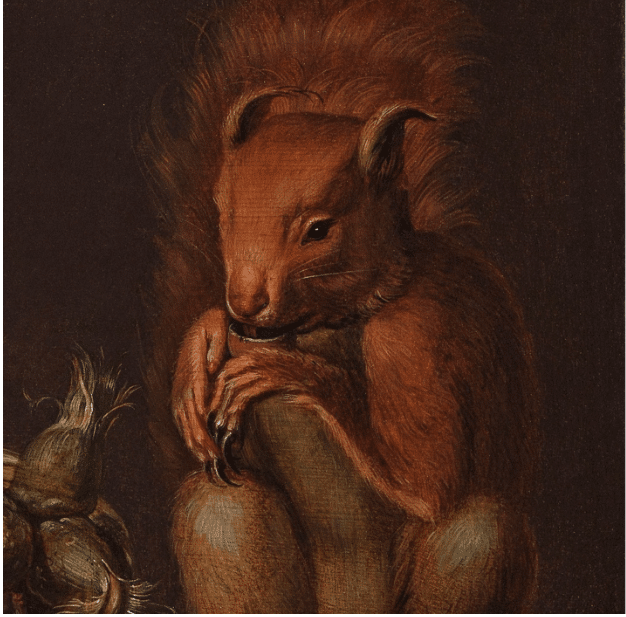
Clara Peeters,, ‘Still Life with Fruits, Langoustines, and a Squirrel’ (detail), c.1612-1615 height: 34.1 cm (13.4 in) ; width: 46.8 cm (18.4 in)
What some say is the first squirrel in this tradition certainly seems to have been intended to carry negative connotations. Look at the gnarly little snarl on Snyder’ 1615 still life below. Unlike the others, in the one below our offending fluffy friend is nestled deeply into the basket quite conspicuously (if not downright insolently, I might add).
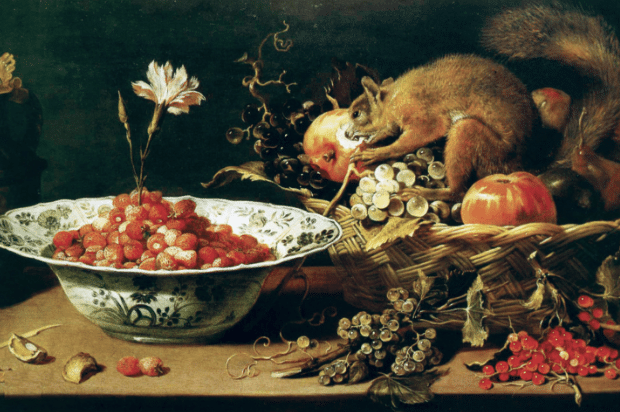
Frans Snyders, “Fruit Piece with Squirrel,” 1615
And the greed! It crouches over the apple it’s been gnawing at while reaching for a tasty grape stem to use as a chaser! Meanwhile, broken walnuts and fallen strawberries—evidence, perhaps, that the scoundrel has been at work for some time —litter the table.
Rather than the pretty pictures or scenes of bounty they at first appears, these paintings are collisions of ripeness and competing species, opulent beauty and remorseless decay. Says one wise commentator online, “The squirrel echoes the viewers’ own rapacious appetites, [as if it’s] our teeth tearing uninvited at fruits our host has strictly forbidden us to touch. We too have transgressed, and are transgressing still.” So, hey stop it now!
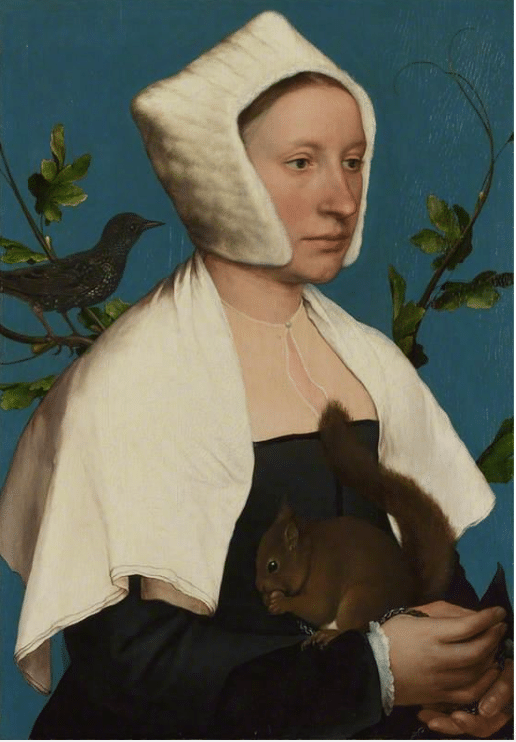
Hans Holbein the Younger, “A Lady with a Squirrel and a Starling,” about 1526-8
We get a kinder gentler squirrel in Hans Holbein’s portrait of a lady with varmint and bird. The little well-fed guy’s gleaming eye, manicured fur, and fine gold chain tell us this is the beloved pet of a well-to-do woman whose life affords her ample space for the finer things.
The strange background with leaves and branches scrolling across a field of intense blue deliberately blurs the boundary between indoors and outdoors, a hallmark of Holbein’s work.
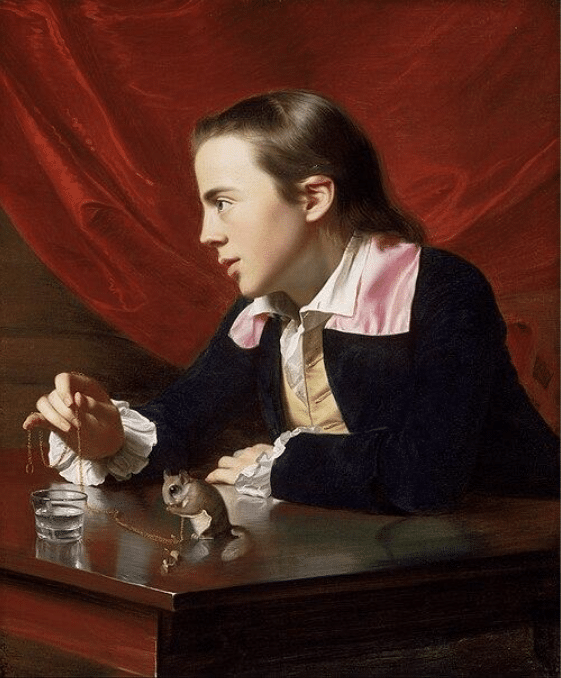
John Singleton Copley, “A Boy with a Flying Squirrel” (Portrait of Henry Pelham), 1765, Museum of Fine Arts Boston.
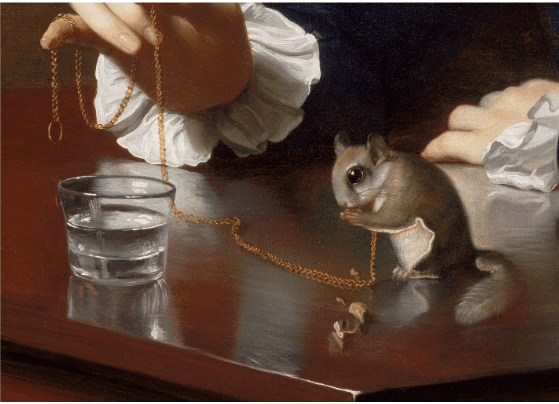
DETAIL: John Singleton Copley, “A Boy with a Flying Squirrel” (Portrait of Henry Pelham), 1765, 30 3/8 x 25 1/8 in., oil. Museum of Fine Arts Boston.
Same goes for John Singleton Copley’s portrait of his stepbrother, pictured as a young American aristocrat with a pet flying squirrel. Copley was an early American master who grew up in Boston before formal artistic training was available in America. Rather like Sargent a hundred years or so later, by the mid-1760s he was the most sought-after portraitist for the wealthy in New England. He aspired, however, to more than provincial success and wanted to know how his work would be gauged by sophisticated English standards. To find out, in 1765 he painted a portrait of his stepbrother, Henry Pelham, not as a commission but rather for exhibition in London, where it drew tempered praise.
He made this painting to show the Big Dogs what he could do. Accordingly, it’s a tour de force of composition, color handling, and a wide variety of realistic textures, for example, the boy’s skin and the soft fur of the squirrel, the highly polished table, the woody nut shells and gleaming gold chain, the fancy pleated cuffs and the reflections of the glass of water.
Warm reds unify the composition in a veritable symphony of tints that plays through the background drapery, the boy’s skin tone and lips, his silken lapels, and the mahogany table. Most brilliant of all though is the faraway look in the subject’s face – once seen, it’s unforgettable. The squirrel is both the cherry on top and a would-be insider’s nod to the European tradition.
So that’s what the artists wanted, but what did the squirrels want? Hm…

If you’re interested learning to paint animals, check out one of the videos here.