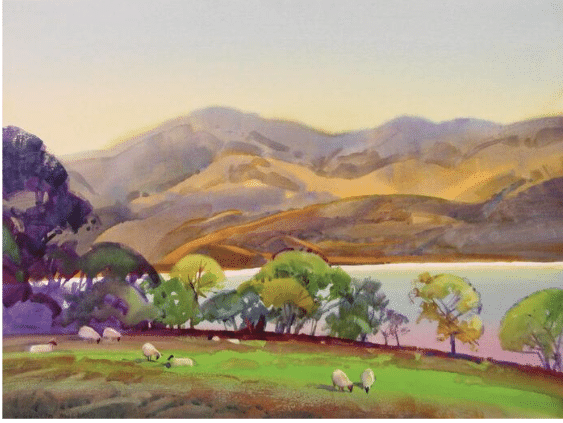
I hiked a ways from the parking site to find this lake and beautiful setting close to the port town of Mallaig.
When Stephen Quiller conducts a workshop out of the country, he often extends his stay from one to four months. Here are a few tips he has gathered from his experiences that can help the serious plein air traveler.
1. Before leaving home, learn a few phrases in the languages of the countries where you’ll be painting. Even if they speak some English, locals are appreciative if you can engage with them even a little bit in their language.
2. Do your research to find small, inexpensive lodgings or gîtes (small, furnished vacation houses in France, typically in the countryside) in the various regions where you want to paint. I typically rent a spot for 10 days before moving on, and leave a gap of eight days or so before going to the next rental, giving me the freedom to explore.
3. Rent a car. If you’re staying three or four months, many car companies have a lease with an option to buy. These extended rentals often have reasonable rates.
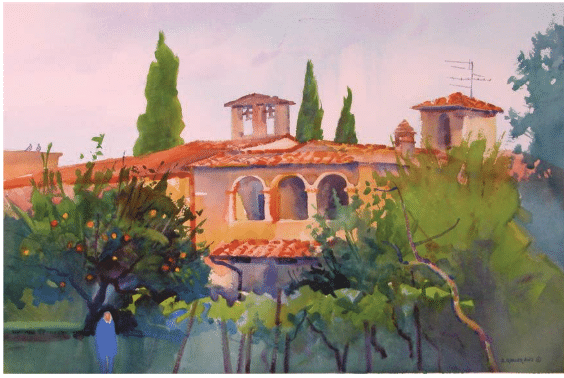
Stephen Quiller, “The Persimmon Tree, Church at Quintole, Italy,” 2004, watercolor, 19 x 29 in., plein air, private collection.
While I painted this scene, a 90-year-old Italian priest worked in the garden next to me. At noon, siesta time, he went in for lunch, and I could hear the radio news blaring away.
4. When you arrive at a location, take the rest of the day to explore the area to make notes and sketches of the places you’re excited about painting. Locals can also be helpful in finding places to paint. I keep a list of suggestions in my sketchbook and refer to it when planning each day.
5. Check the next day’s weather every evening. If it’s going to be raining where you’re staying, look for places nearby that you want to paint where the weather is more promising.
6. Let people come up to you and chat while you’re painting, and try to bring that energy into the work. Keep in mind that although everyone has a grandmother who’s a painter, they aren’t art critics from the New York Times.
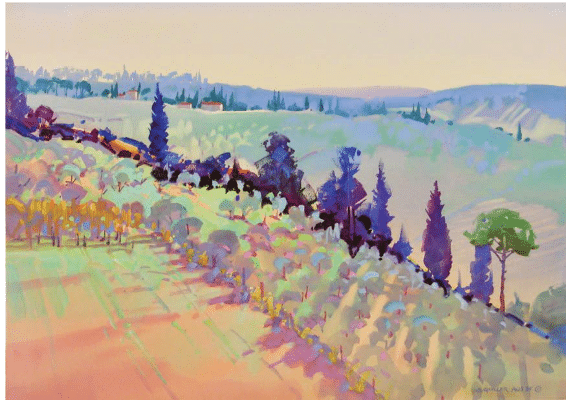
Stephen Quiller, “View Towards Impruneta, Italy,” 2008, gouache and acrylic, 19 1/2 x 27 1/2 in., plein air, private collection.
I started with a transparent acrylic underlay of yellow to yellow orange for this scene that I discovered five miles from Florence, then turned to gouache to capture the soft, hazy light of early October.7. After you finish a batch of paintings (say 20 to 25), ship them home. I leave about 10 percent of each piece unfinished and don’t sign the work, so there’s little value to declare and they won’t be held up in customs. Fortunately, most larger cities around the world have UPS stores.
8. Keep in touch with your framer so they know what’s coming and can get a start on building the frames to have them ready when you return.
9. Remember, traveling for an extended period is 95 percent pure joy. The remaining 5 percent, however, can be uncertain and even scary: getting lost, having trouble finding lodging, getting into fender benders.
10. When you return, finish and sign each painting and give them to your framer to assemble. I’ve loved finishing a painting from the south of France while it’s snowing outside my studio. It brings back great memories.
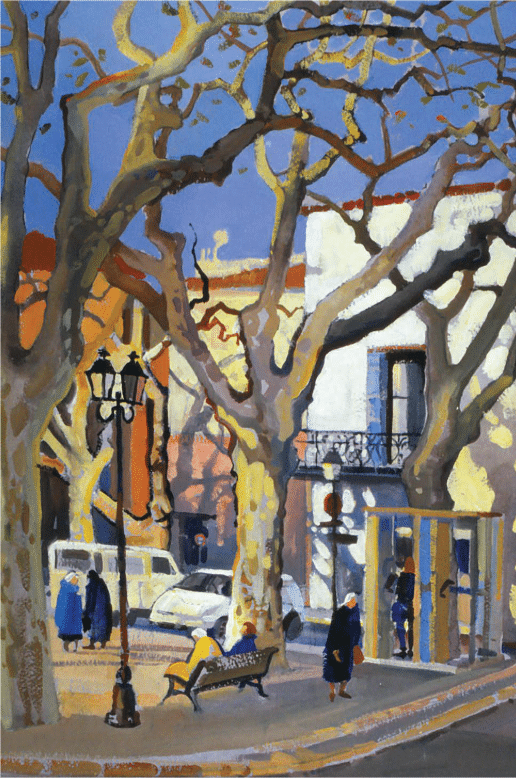
Stephen Quiller, “Centre Ville, Cassis France,” 2002, acrylic, 26 x 19 in., Plein air.
Private collection November was a great time to paint in this small village. The tourists had mainly gone, and I could feel the bones of the community and culture. For this piece, I placed my daughter in the phone booth.
11. Plan an exhibition opening for maximum attendance. I schedule mine for the three-day Presidents Day weekend in February. This gives my art patrons a more relaxed time to travel. That’s also often Valentine’s Day weekend, which makes it extra special.
12. Announce the exhibition opening online and send out invitations far in advance so collectors and art patrons from considerable distances can make plans. At my openings, we play music from the region and hang a flag out front representing the featured country. To encourage people to stay a couple of nights (thus giving a boost to our town’s economy during a normally slow time of year), I work with other local businesses to make it a real event.
***
Editor’s Note: If you’re eager to get your hands wet with water media, you may be interested in the inaugural Acrylic Live virtual art conference and learn from some of the top acrylic artists and faculty from around the world. Acrylic Live is March 26-28, 2025, with an optional Essential Techniques Day on March 25. Register now at AcrylicLive.com!
And don’t forget the PleinAir Convention & Expo (PACE) takes place in Lake Tahoe this May! Find out more here.
Mastering Hollyhocks in Watercolor: A Tip for Crisp, Fresh Paintings

Buffalo Kaplinski, “Scarlet Hollyhock,” 2021, watercolor, 12 x 17 in., private collection, plein air
“Painting hollyhocks looks simple to paint at first, but the characteristic leaves and stalks can be a challenge,” says Buffalo Kaplinski. “I find watercolor to be the best medium for capturing their crisp edges and shapes. Found in a number of Western landscapes, and grown in a variety of colors, they seem to thrive in dry places in my garden.
“Most of us who make representational art are interested in drawing and take time to hone that skill; in watercolor especially, there’s no faking it. The trick to a crisp, fresh, and believable watercolor is making a careful drawing without detailing every shape; watercolor is a fluid media, after all.
“I prefer an HB pencil for drawing, but before putting in even the lightest values, I think carefully about the color I want for the painting. Even when I’m painting en plein air, I use the best brushes I can find to get the best results in my work — most often a No. 7 (or No. 8) long-handle professional red sable by Winsor & Newton, a Princeton No. 6 liner, a No. 4 by Black Velvet, and a No. 6 Silver Brush script. I also like Cheap Joe’s Dream Catcher brushes. I never use any masking fluid. I prefer painting around negative and positive shapes the way I was taught by Irving Shapiro.”
***
Editor’s Note: Join us for the 6th Annual Plein Air Live online art conference, featuring Kathleen Hudson, Kevin Macpherson, Kami Mendlik, and many more! The event takes place November 6-8, 2025, with an Essential Techniques Day on November 5. Learn more at PleinAirLive.com.