By John MacDonald
In addition to the transparent glazing technique, some artists use opaque glazes in the later stages of their paintings. There’s a quick test to determine if a pigment is opaque or transparent: With a palette knife, scrape a small portion of the pigment down a white canvas. If it looks like a stain on the canvas and its saturation remains intense, it’s likely transparent. But if the pigment completely covers the white of the canvas, even in a thin layer, it’s opaque.
If using transparent glazes, all pigments should be transparent. For opaque glazes, if the most prominent pigment is opaque, some transparent pigments may be used (over top of it) to adjust the hue.
My current palette consists of seven pigments: White (50/50 titanium & zinc), Cadmium Yellow Light hue (a homemade mixture of Hansa and Indian Yellow), Prussian Blue, Permanent Alizarin Crimson, Dioxazine Purple, Raw Umber, and Paynes Grey. The Raw Umber is completely opaque. Paynes Grey and the white have a touch of translucency. The remaining four pigments are transparent and work beautifully in transparent glazes.
Opaque Glazes
The term opaque glaze seems like a contradiction in terms. If there is a specific art term for it, I’m unaware of it. It’s not scumbling. Scumbling is the application of a thin, sparse layer of dry paint (little to no medium or solvent), to a painting in which the underlying surface is allowed to show through. Scumbling is used to create similar effects and is applied in a similar manner but the appearance is quite different. There’s no mistaking the liquid quality of an opaque glaze.
The opaque (or slightly translucent) glaze is wiped or brushed onto a painting and then re- moved by brush, knife, or wiping to allow as much of the underpainting to show through as desired. Opaque glazes are used often to adjust values while creating an overall color tone.
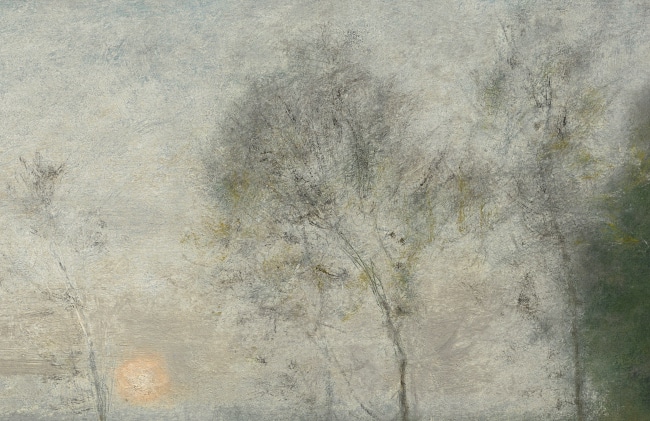
In the sky in this painting by George Inness “New Jersey Landscape,” a light muted, opaque glaze was painted over a darker underpainting. He controlled values and suggested forms of trees by allowing the dark to show through by scraping and wiping away the opaque layer.

George Inness, New Jersey Landscape, 1891, 30 x 45 in. Clark Museum
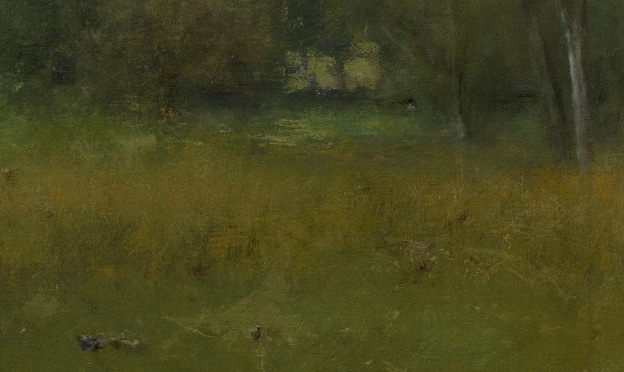
In some places (below), he indicated tree limbs and twigs by simply drawing into the wet paint with the end of his brush, revealing the dark beneath. It’s a very effective technique for showing subtle textures and shifts in value.
(On this point, George Inness Jr. relates an amusing exchange between his father and a young admirer:
“He (Inness) squeezed a lot of raw umber on his palette, picked up the largest brush he could find, and with the aid of a medium that looked like Spaulding’s glue he went at the canvas as though he were scrubbing the floor, smearing it over, sky and all, with a thin coat of brown. The young man looked aghast, and when Pop was through, he said:
“But, Mr. Inness, do you mean to tell me you resort to such methods as glazing to paint your pictures?”
“Father rushed up to the young man, and, glowering at him over his glasses, as he held the big brush just under his visitor’s nose, exclaimed:
 CONSIDERATIONS when using opaque / semi-opaque glazes:
• The point of using an opaque glaze is to allow some of the underpainting to show through. If the coverage is to be totally and completely opaque, don’t bother using a glaze – simply paint over the image with a standard opaque mixture of pigments.
• When working with a high value opaque glaze, the large amount of white in the glaze will often create colors that appear chalky. If that occurs, after the opaque glaze dries apply a col- ored transparent glaze to bring back saturation in the color.
• Generally, an opaque glaze should be no darker than 50% on the value scale. A very dark opaque glaze is indistinguishable from an opaque application of pigment.
• A light, opaque glaze is ideal for raising the overall value key of an area in a painting.
• An opaque glaze can be used to reduce value contrasts between the secondary values in an area by mixing a glaze that lies between the lightest and the darkest secondary values.
• Opaque glazes are wonderful for softening the edges of forms in a dry painting, when blending the pigments is no longer an option.
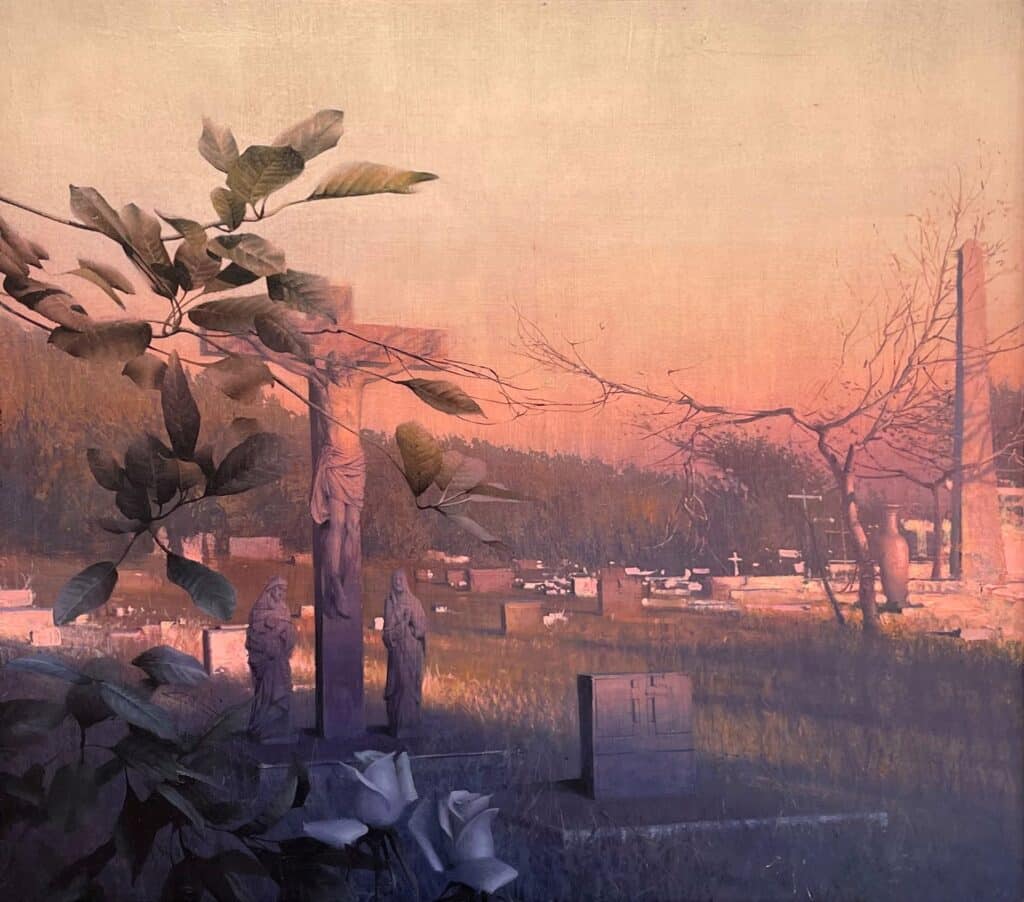
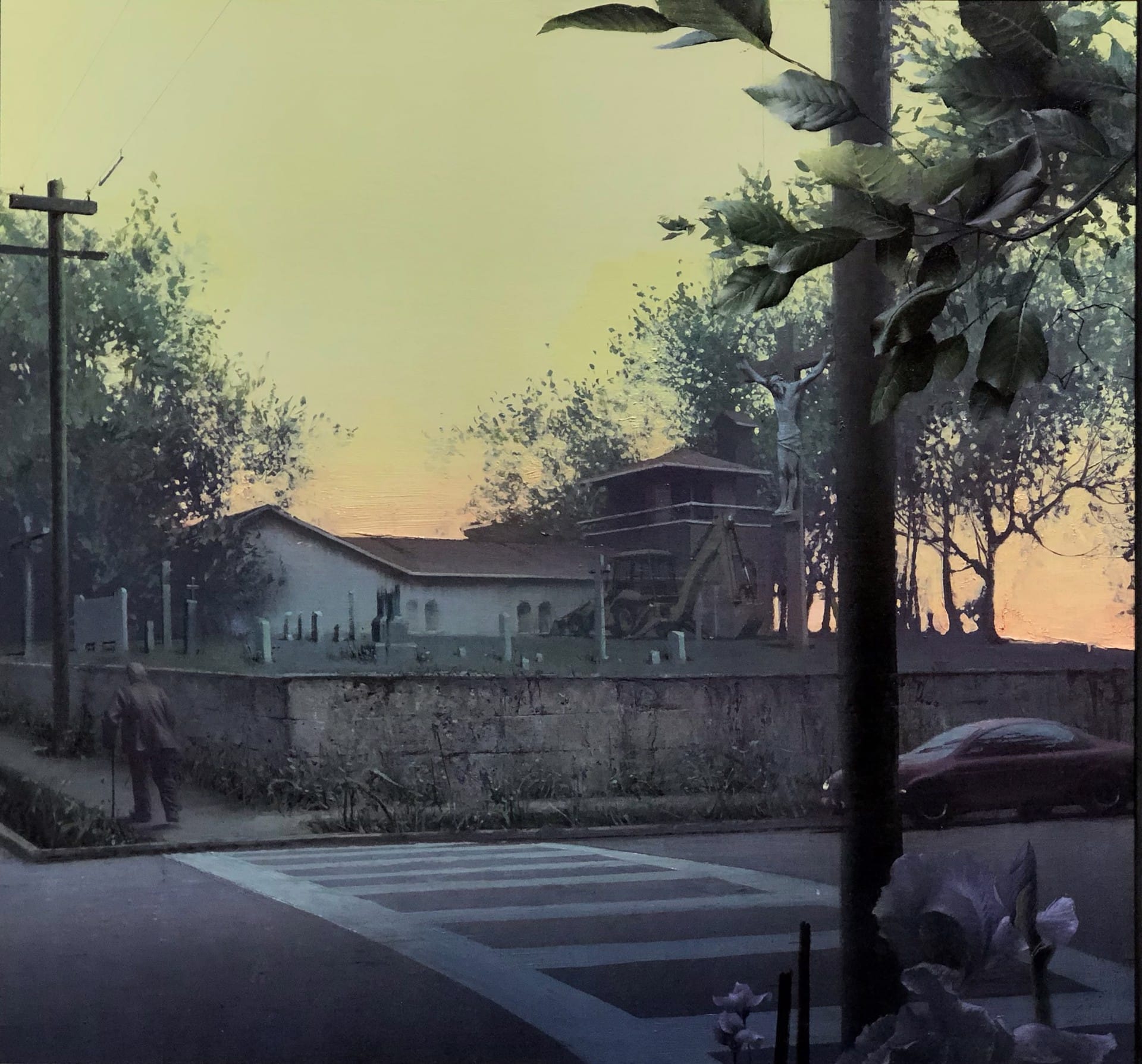
Daniel Sprick, 10,000 Martyrs, 2023 Oil on Board, 22 x 23 in
Glazing Mediums
A quick Google search for glazing mediums results in a long and varied list. Some artists advocate using pure linseed oil, poppyseed oil, or walnut oil. Pure oils work well and are perfectly adequate as a glazing medium when used in very thin layers and allowing for complete drying between application. The drawback to any pure oil is its slow drying time.
I prefer a drying time measured in days, not weeks, which is why I use my own mixture (described in part 3). By keeping the layer thin, it’s usually dry within two or three days.
If you purchase a commercial medium, ensure is specifically labeled for glazing. Gamblin’s alkyd medium and Solvent-Free Gel medium can be used for glazing. Michael Harding, Winsor and Newton, and other manufactures offer mediums specifically created for glazing as well. The ingredients in the medium are less important that its proper application (which is what the next segment of this article will cover).
Coming Soon: Daniel Sprick’s personal medium formula and how to use medium for transparent and opaque glazing
Glazing is for Watercolor Too!

Watercolorist Soon Y. Warren covers how to do this in a video documenting her watercolor painting demonstration of colorful marbles on glass. Along the way, she’ll teach you watercolor techniques for color mixing, wet-into-wet painting, lessons on how to fix mistakes, and more to create this shiny, reflective subject against a dark background. Download Soon Y. Warren’s Glazing and Reflections video here.