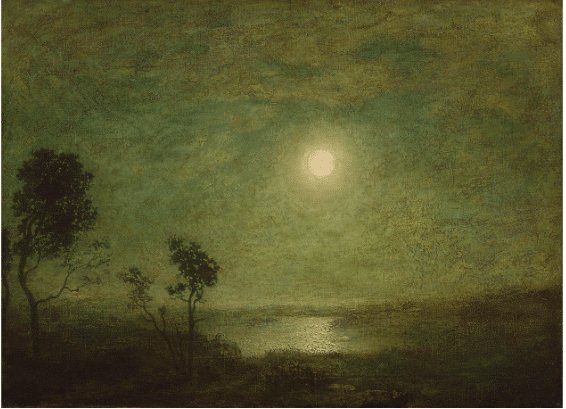
If people cared as much about painting as they do about literature, the name Ralph Albert Blakelock might be almost as celebrated as that of Edgar Allen Poe. At an auction in 1913, Blakelock set the record for the sale of an American painting, though by then he was ill and confined to a mental institution. Today, few people other than a handful of sympathetic artists are familiar with his work.
Blakelock was three years old when Poe died in the autumn of 1849 on the streets of Baltimore, delirious and dressed in someone else’s clothes. Both were born to lower-middle class families in northeastern cities (Poe in Boston, Blakelock in New York). Both loved the haunted American night: effects of moonlight in tree branches, in clouds, and around deeply wooded pools. Both were mentally imbalanced (Blakelock has been called, “the American van Gogh”). Both were American visionaries, passionately pursuing in solitude a formal course of experimental expression in a twilight mood.
Blakelock was doing something no one else was doing in visual art. His moody abstract landscapes and thick, gestural application of the paint, make him, along with fellow New Yorker Albert Pinkhan Ryder, a precursor to mid 20th-century abstract expressionism (abstract expressionist Franz Kline actually had a Blakelock in his personal collection).
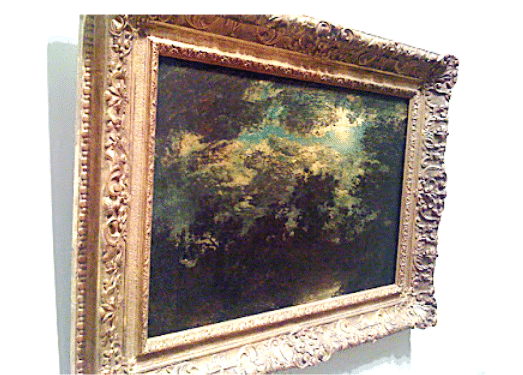
One of Blakelock’s Moonlight paintings
Blakelock is best known for his beautifully haunting paintings of moonlight and American Indian encampments. In these paintings, he often painted around his forms; he would cover the canvas in dark paint and then model his trees and other forms by filling in the negative space around them with the lighter colors (the opposite of what most oil painters do).

R.A. Blakelock, “Moonlight,” 1885-1890, 12 in (30.4 cm); width: 16 in (40.6 cm), oil on canvas, Columbus Museum of Art.
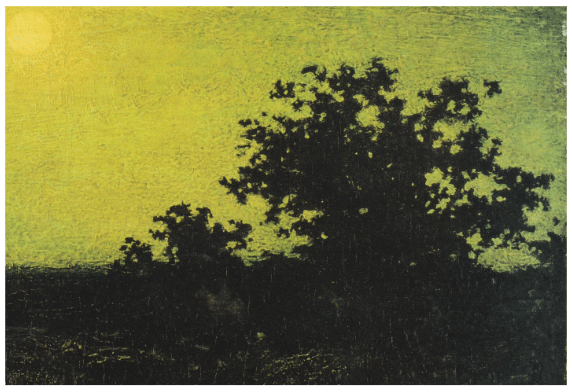
Closeup of the above
For example, in “Moonlight” (above) you can tell by looking closely at the sharp sky-hole shapes that he painted the whole canvas black first and then created the tree and water forms by applying lighter paint on top of the dark.
The son of a New York City police officer, Blakelock in his early 20s dropped out of medical school to travel through the American West, wandering far from American settlements and spending time among indigenous peoples. He set up a studio in New York where he could paint these and other landscapes and scenes, but he toiled away in obscurity.
Unfortunately, Blakelock had no head for business, and as a young artist without connections, he constantly found himself cheated out of his paintings for less than they were worth. Evicted from one domicile to another, he and his wife ended up with nine children, barely able to make ends meet.
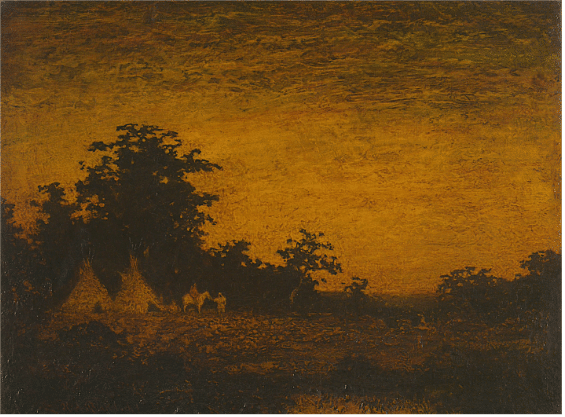
Ralph Albert Blakelock, Indian Encampment, 1877-1885, 30.5 × 40.6 cm (12 × 16 in.) oil on board. George F. Harding Collection, Art Institute of Chicago.
In the strange painting “Ghost Dance (The Vision of Life)”, of the late 1890s, (below), a murky, deliberately ambiguous composition, the dancing figures appear as ghosts or luminous shadows—insubstantial fragments of a memory or a dream. The Ghost Dance became part of the mythology of vanishing American Indian tribes after the murder of great leaders such as Sitting Bull and the massacre at Wounded Knee.
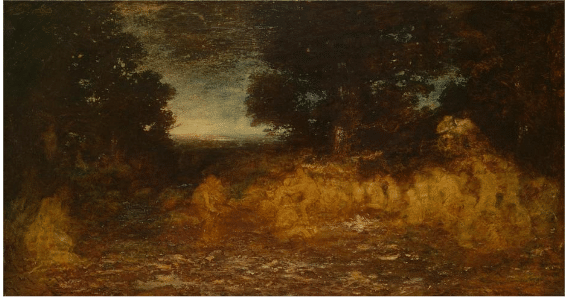
Ralph Albert Blakelock, Ghost Dance (The Vision of Life), 1895-1897, 53.7 × 100 cm (21 1/8 × 39 3/8 in.),, oil on canvas, Charles H. and Mary F. S. Worcester Collection, Art Institute of Chicago.
He began behaving oddly, doing things like writing huge price tags on the back of his paintings. As biographer Glyn Vincent has documented:
“…Mr. Blakelock began grandiosely adding price tags of millions of dollars to the backs of his paintings. He based his images on scratches in his enameled bathtub; started carrying around an antique dagger; and draped himself in embroidered sashes and belts with trimmings that his wife described as “long strings of beads and trinkets of all sorts…”
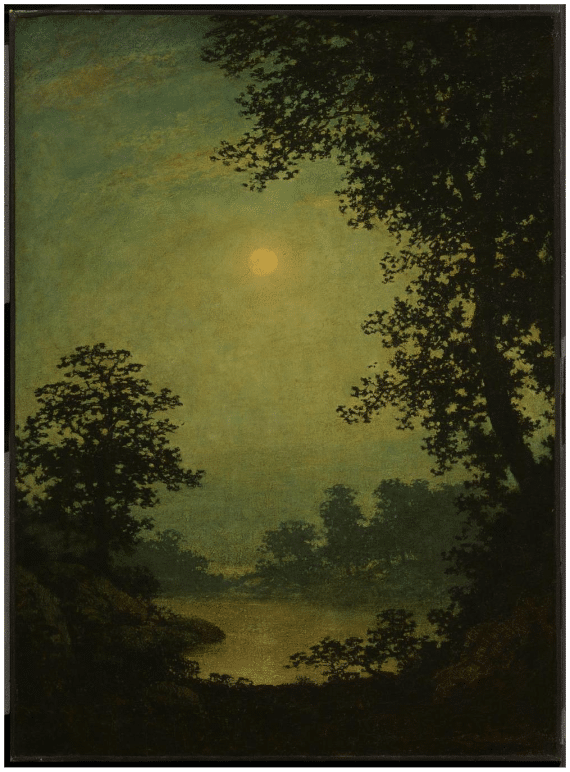
R. A. Blakelock, Moonlight Sonata, 1892, 77.15 x 55.88 cm (30 3/8 x 22 in.). oil on canvas. The Hayden Collection—Charles Henry Hayden Fund.
Constantly stressed and depressed, he suffered a complete mental breakdown in 1891 and spent the remaining 20 years of his life in mental institutions painting on scraps of cardboard and cigar box lids. Claiming to be immensely wealthy, he’d paint scraps of paper to look like hundred dollar bills.
“Almost as soon as he was committed, recognition came and demand for Blakelock’s works grew,” writes one art historian. “Within a few years the paintings he had once sold for next to nothing were resold for thousands of dollars. Of course he was unable to enjoy any of this success. Hospital staff were unaware of his fame and figured his claim that his paintings were in major museums was part of his schizophrenia.”
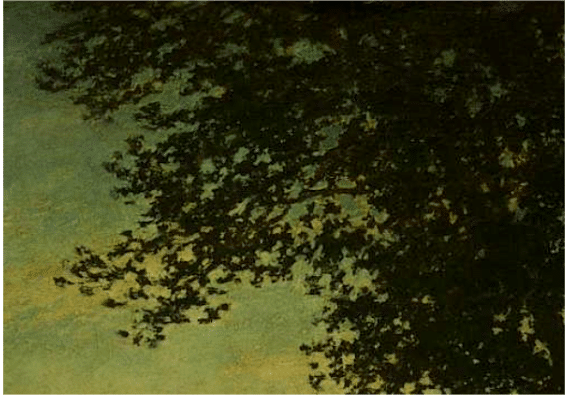
Closeup of Blakelock’s “Moonlight Sonata” above.
“In 1913, one of Blakelock’s moonlights sold at auction for $20,000, setting a record for a painting by any living American artist. The sensational sale prompted a New York Tribune reporter to track down Blakelock in the asylum, where he found him to be coherent and articulate. The reporter explained to the asylum director who Blakelock was and managed to arrange to take him and the director to Manhattan, where a major gallery retrospective of his work was being held. Blakelock was amazed by how much the city had changed in the two decades since he’d last seen it and thrilled to see the recognition his work had received.” All of which made for a fantastic news story.
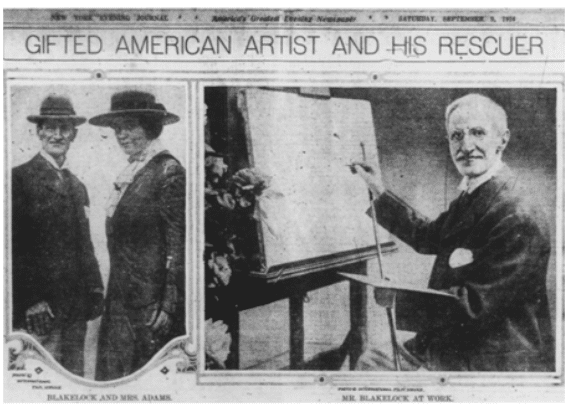
Unfortunately, all the hoopla (especially that huge auction sale price) spawned an army of forgers (he was at one point the most forged artist in America). It also captured the attention of an unscrupulous woman named Sadie Filbert.
A classic scam artist, Filbert was the barely educated daughter of a servant in a wealthy household in upstate New York. Posing as well-to-do socialite “Beatrice Van Rensselaer Adams,” her specialty was swindling the wealthy by persuading them to support charitable causes of which, in fact, she was the sole beneficiary. She started a bogus Blakelock Fund and as soon as she got him released from the asylum into her guardianship, Filbert proceeded to exploit Blakelock, enclosing him in a room with large canvases and painting supplies, isolating him from his family, selling the paintings and pocketing the money, bullying and abusing the gentle man, and hastening his demise at 71.
Though the landscape is still the starting point for Blakelock’s trademark dreamy canvases, the paintings, with their emphasis on texture, color, their wild motifs and intricate dark traceries against a luminous sky, are bewitching physical creations unique in the American canon.
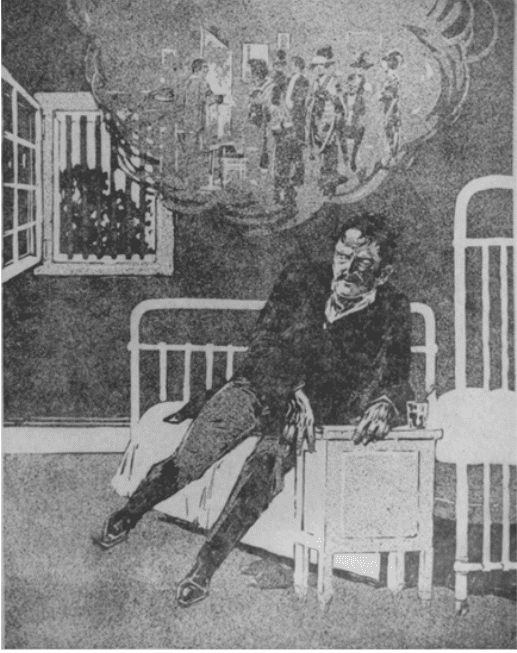
Illustration in Tacoma Ledger newspaper Blakelock confined in an insane asylum