In more than one sense, the 15th century Cestello Annunciation proclaimed the beginning of a new chapter in human history.
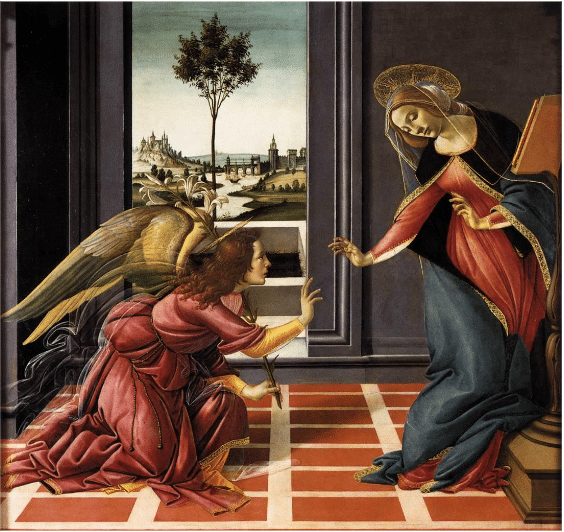
The Cestello Annunciation by Sandro Botticelli is a painting in tempera on wood that adorns the church of the Florentine monastery of Cestello, which is now known as Santa Maria Maddalena de’Pazzi.
The subject of the Annunciation is common in Christian art: The Archangel Gabriel visits the Virgin Mary to “announce” to her (hence ‘Annunciation’) that she has been chosen by God to bear the Christ child should she accept her mission. Upon her decision rests the redemption of mankind. Underneath this painting on its original frame are words in Latin from St. Luke’s Gospel, 1:35, “The Holy Ghost shall come upon thee, and the power of the Highest shall overshadow thee.”
It’s a remarkable painting for its elegantly choregraphed composition of the figures, who pose as though rapt in an eternal ballet. But its deeper power issues from its subtle psychological and iconographic complexity. Contrast the serene acceptance shown in Mary’s expression with the troubled look of the angel!

At first glance, except for the wings, one would naturally assume Mary is the holy messenger and the angel is the mortal. Earlier Christian artists emphasized the superiority of Divine figures by depicting them larger than human beings. But here, Mary is elevated, like a queen, while the holy angel, given a troubled expression, crouches before her, well below Mary’s line of sight.

Gabriel’s expression is full of emotion while Mary’s is calm and untroubled. Inner psychology was new to post-classical Western art in the 1400s, but to reverse the roles, humanizing the Divine and dignifying the human, was a new thing.
Leonardo had set the precedent for Botticelli’s composition with an Annunciation of his own in 1475. Leonardo’s is one of the most famous and celebrated of all Renaissance paintings (and for the same reasons as stated above). However, it’s more traditional in that the figures aren’t given strongly visible interior lives. It’s also easier to see that the angel is blessing Mary.

Leonardo DaVinci, Annunciation, 98 cm (38.5 in); width: 217 cm (85.4 in), c. 1475
It’s in this sense that we can think of these paintings together as an important “announcement” of a new era of European history; they’re quintessential examples of Renaissance humanism.

Carravaggio, Annunciation, 1608
For our last stop, Carravaggio’s Baroque Annunciation of 1608 restores the traditional iconography but retains the introduction of psychology and emotion. Though it was indeed painted for a church, it’s not as immediately apparent now that we’re looking at a religious painting. Carravaggio transports the characters to a timeless space, but his gloomy chiaroscuro, intense detail, and faithfulness to his street-wise models imbues the whole work with gritty realism and a degree of emotional drama unprecedented in Western painting.
Through just these three paintings, we can see the arc of innovation in Western art from the Renaissance to the Baroque period. A new age in painting’s exploration of what it is to be human had begun.
‘BEHIND THE SCENES’ ART TRIPS
Fine Art Connoisseur magazine’s “Behind the Scenes” art trips view great works from a new perspective. Beyond excursions to museums, these are visits with artists and iconic art experiences that leverage deep contacts in the art world. Guaranteed to create lifetime memories.
Hosted by Fine Art Connoisseur Publisher Eric Rhoads and Editor-in-Chief Peter Trippi, it’s a continuation of an 11-year tradition. Learn more here.
Sarita the Sitter with Sita Sitting on her Shoulder

Cecilia Beaux, Sita and Sarita, oil on canvas, 44 5/8 × 33 in
(1921) Fuller Gallery, Washington DC
If there’s something haunting about this portrait by Cecilia Beaux, don’t just put it down to the black cat on the sitter’s shoulder. More unsettling is how the cat’s eyes stare right at the viewer while the sitter’s eyes, set closely to the cat’s, stare sideways.
Either way, Sita and Sarita is a striking painting, and one that hides more under its surface than appears at first glance.
Learn more when this painting becomes the subject of an upcoming Inside Art coming soon!