He was water’s chosen prodigy, the artist every majestic pool and eddy gleaming in shadow or sun chose as faithful champion and mirror.
Norwegian Impressionist Frits Thaulow painted people and places, but he also travelled the world as water’s faithful savant. He didn’t just render amazing wetness or reflections, he painted each waterway’s portrait with all the emotional resonance and psychological depth we associate with that genre.
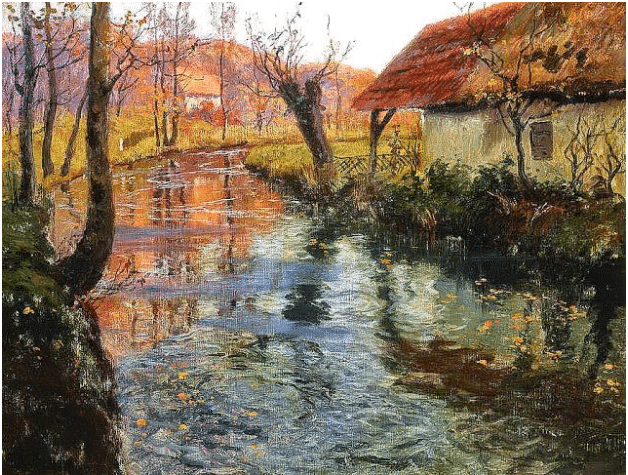
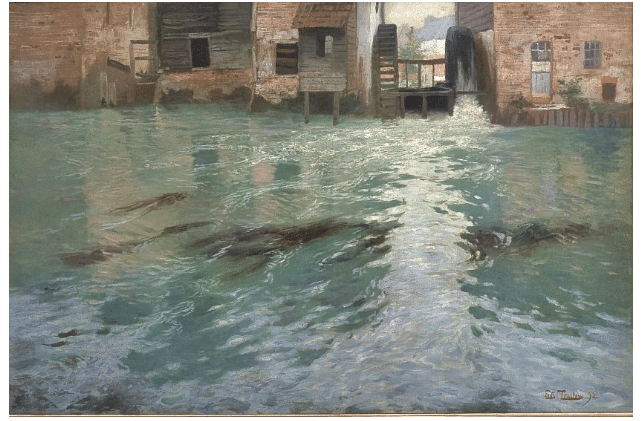
Frits Thaulow, The Mill Stream, 1885–90
Thaulow painted his inspiring painting, “The Mill Stream” (above) in Oslo. His palette is joyous, almost flamboyant, and the painting is saturated, speckled, and sprayed with prismatic colors. Note that the title calls attention to the stream itself, not the picturesque old mill, which nine out of ten other painters would have focused on (all he gives us of the mill is one cropped, anonymous wall with a waning roof).
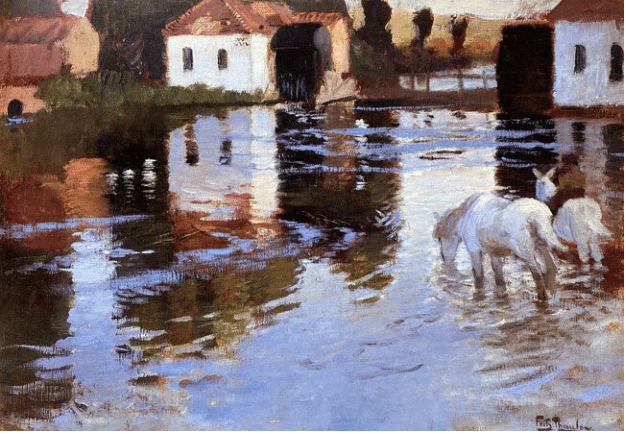
Frits Thaulow, Horses Watering at the Bridge at Montreuil-sur-Mer (c.1893)
Again, Thaulow gives us, in Horses Watering at the Bridge at Montreuil-sur-Mer, sparkling pastoralism and serenity, with lively color and white horses wading and drinking. But let’s contrast those two with the painting below.
In the painting (below) titled “Haugsfossen ved Modum,” Thaulow plunges into the turbulent, muddy ferocity of the falls at Blaafarveværket, an industrial cobalt mining town some thirty miles west of Oslo.
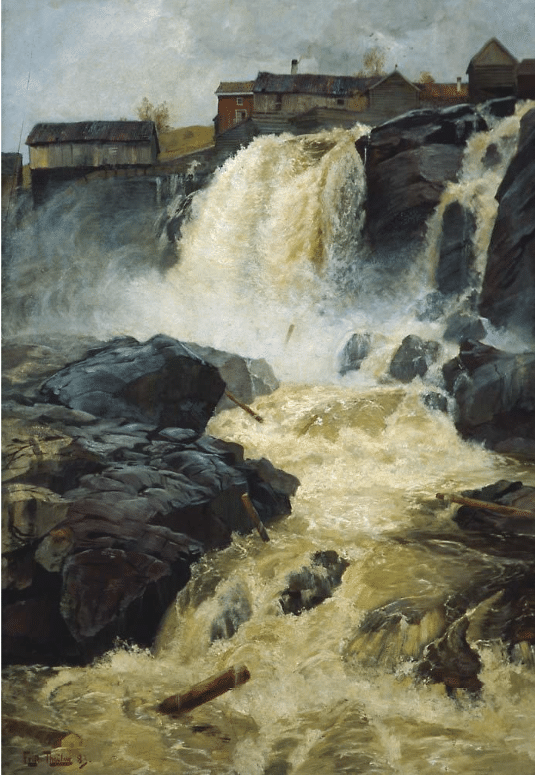
Frits Thaulow, Haugsfossen ved Modum (1883) Again it’s the water, not the buildings, that interests him (and with which he therefore fills the painting).
All of these works represent beyond masterful renderings of water, but how different, how distinct one from the other! Each conveys a distinct feeling and expresses a different truth! He could lean into a grittier realism too, as for example, in the painting below. He painted this crowded section of houses in Kragerø, the country’s largest urban shipping town, at a time when Norway was in a depression and many were leaving for eastern Europe and America.
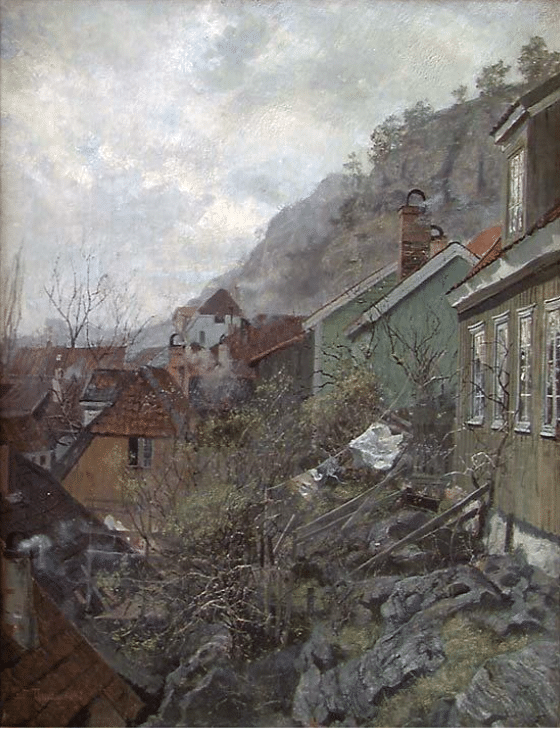
Frits Thaulow, Houses in Kragerø (1882)
Ten years later, he’s living in France, where flowing water continues, as always, to seduce him.
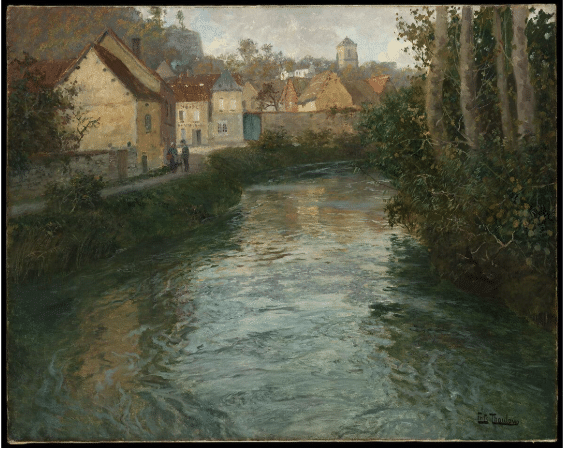
Picquigny (village of Picquigny, near Amiens on the river Somme, northern France), 1899, 28 3/4 × 36 1/4 in. (73 × 92 cm), oil on canvas
Thaulow did particularly well with his depictions of the rivers and byways north of his adopted hometown of Paris, where he moved in 1892. This canvas (above) shows the village of Picquigny, near Amiens on the river Somme, where he worked for several weeks in the late autumn of 1899.
The composition, as in many of Thaulow’s paintings, adopts a downward vantage point that emphasizes the eddying water and its ever-changing colors, reflections, and illumination. Thaulow’s excursion was part of a characteristically ambitious professional schedule, including a summer exhibition with his friend Monet, an extended trip to Venice, and serving as Norway’s commissioner at the 1900 Paris World’s Fair.
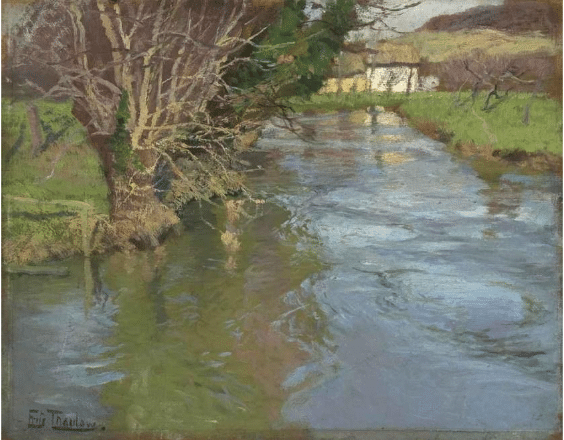
A Stream in Spring by Frits Thaulow
If you’d like to follow in Frits’s footsteps, there’s a great instructional video out from contemporary painter Kami Mendlik. Check out her video, “Mastering Water – The Secrets of Color and Reflection.”
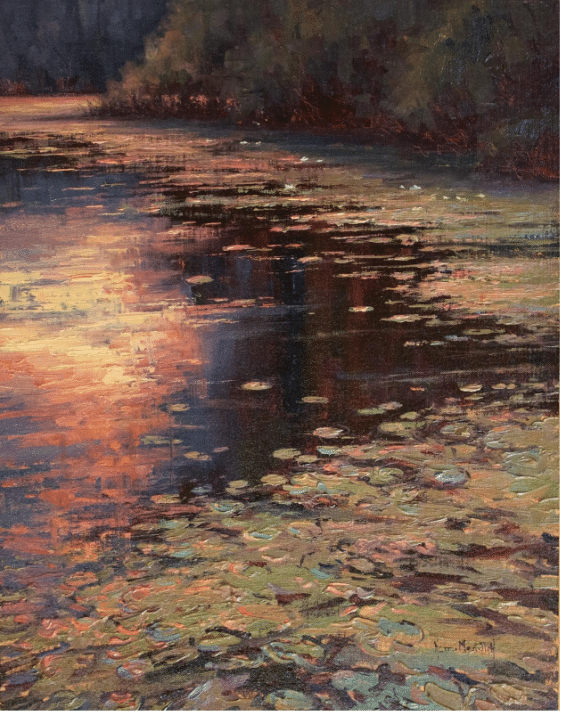
Kami Mendlik teaches you how to make this painting in her video, “Mastering Water”