
Of all the moderns, Matisse is the most lighthearted, the least angst-ridden, the most, well.. summery. His mission was to paint the exuberance of life – the best of us, our “best side” as human beings trying to make sense of what’s going on here before we die.
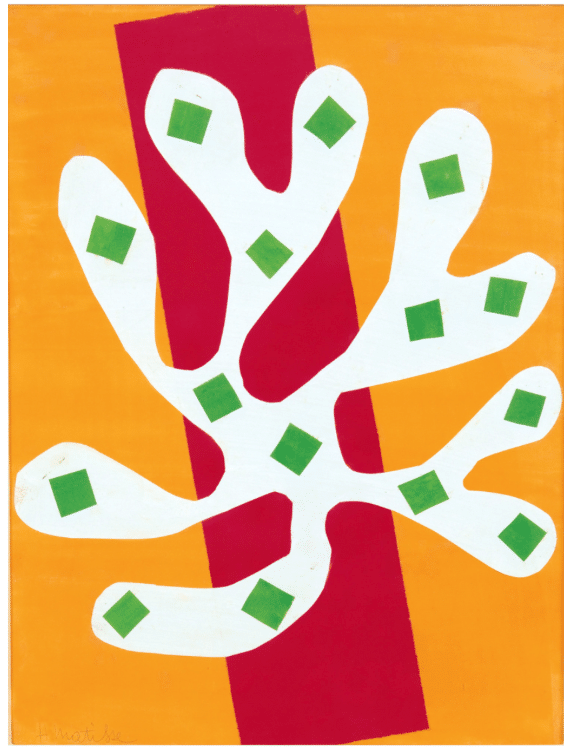
White Algae on Orange and Red Background (Algue blanche sur fond orange et rouge)” (1947)
He never stopped loving the French Riveria, the Mediterranean islands off the southern coast of France, such as Nice and Corsica. “Matisse, who sought to express his own perception of landscape, had a conceptual
relationship with the sea, and with the Mediterranean in particular,” says the Musee Matisse in Nice, which is showing the exhibition “Matisse Méditerranée(s)” this summer, “a sea made of places that are lived in, experienced, dreamed of or fantasized about.”
Many of his most beloved paintings reference forms of marine life – seaweed especially. No one could use that famous “Matisse shape” in a painting now without everyone knowing where it came from.
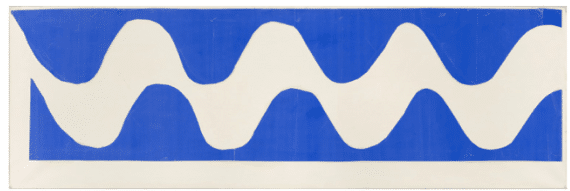
Henri Matisse, La Vague [The Wave], Nice, ca. 1952, Gouache on paper, cut and mounted on canvas, 51.5 × 160 cm Musée Matisse Nice, gift of the Héritiers Matisse, 1963 Photo © François Fernandez
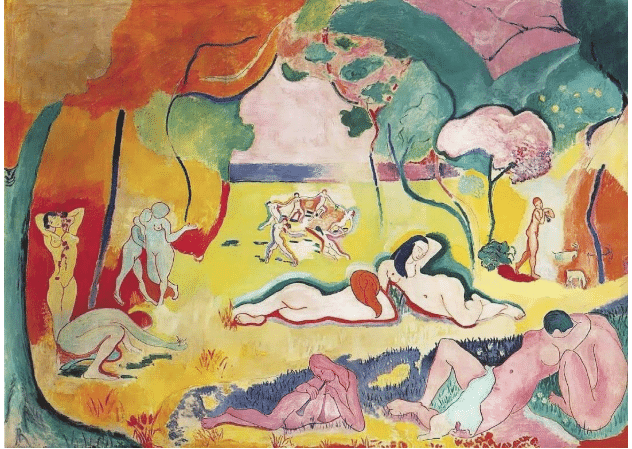
Henri Matisse, “Le Bonheur de Vivre,” 1905-1906, Oil on canvas, 176.5 x 240.7 cm (69 1/2 x 94 3/4 in.). In the collection of the Barnes Foundation.
Few artists in art history have had such a wide-ranging impact on art and culture. This was new. The world had never before seen color used like this, this expressively vs. representationally. We’re fortunate that Matisse was also a thoughtful and prolific writer who often reflected on art and the life of an artist in letters and essays, from which come the following sayings attributed to the artist:
“I would like to recapture that freshness of vision which is characteristic of extreme youth when all the world is new to it.”
“The essential thing is to spring forth, to express the bolt of lightning one senses upon contact with a thing. The function of the artist is not to translate an observation but to express the shock of the object on his nature; the shock, with the original reaction.”
“I am unable to make any distinction between the feeling I get from life and the way I translate that feeling into painting.”
“I wouldn’t mind turning into a vermilion goldfish.”
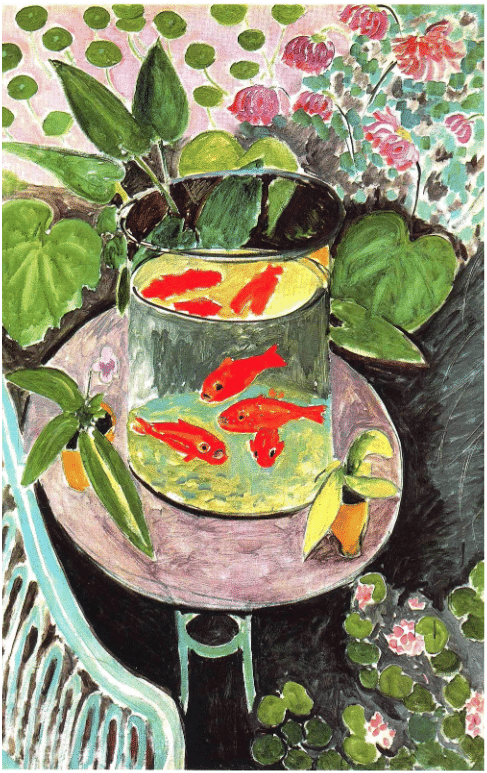
Matisse, Goldfish, oil, 1911
“My curves are not crazy.”
“Jazz is rhythm and meaning.”
“My mother liked everything I did. It is from her affection for her that I always drew what theory failed to offer me….”
“You must forget all your theories, all your ideas before the subject. What part of these is really your own will be expressed in your expression of the emotion awakened in you by the subject.”
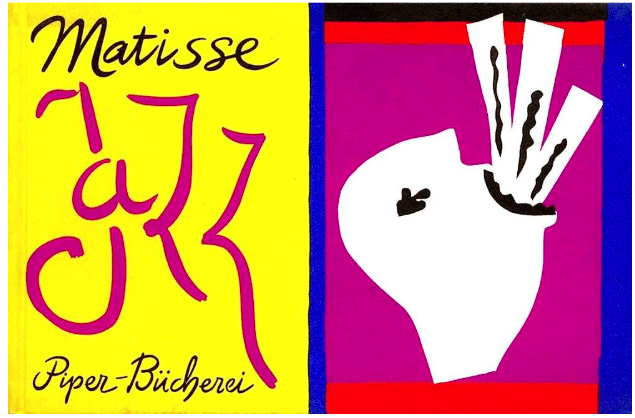
“Seek the strongest color effect possible.”
“There are always flowers for those who want to see them.”
“There is nothing more difficult for a truly creative painter than to paint a rose, because before he can do so he has first to forget all the roses that were ever painted.”
“An artist must possess Nature. He must identify himself with her rhythm, by efforts that will prepare the mastery which will later enable him to express himself in his own language.”
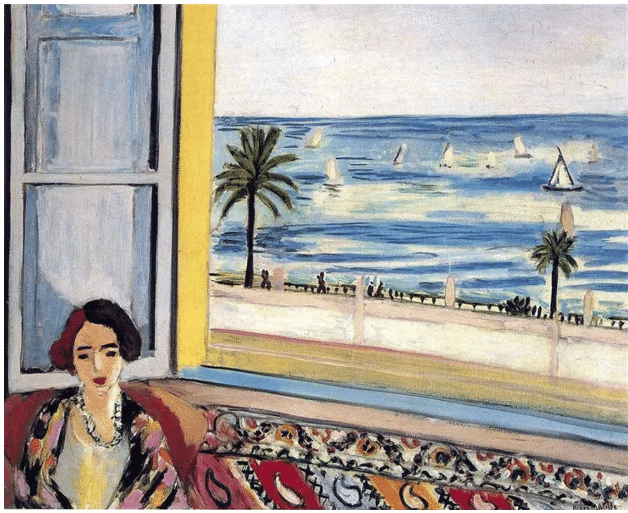
Matisse’s view onto the Mediterranean … It must have been Nice…
“Time extracts various values from a painter’s work. When these values are exhausted the pictures are forgotten, and the more a picture has to give, the greater it is.”
“What I dream of is an art of balance, of purity and serenity, devoid of troubling or depressing subject matter, an art which could be for every mental worker, for the businessman as well as the man of letters, for example, a soothing, calming influence on the mind, something like a good armchair which provides relaxation from physical fatigue.”
“When I add a green, it is not grass. When I paint a blue, it is not the sky.”
“Why have I never been bored? For more than fifty years I have never ceased to work.
With color one obtains an energy that seems to stem from witchcraft.”
“Work cures everything.”
― Henri Matisse
If I had to pick one aspect of painting to identify with Matisse, it would be COLOR. If you’re up for learning new ways of handling color in your own work, maybe check out a teaching video, such as Stephen Quiller’s Color Foundation for the Artist, a Complete Guide.

Stephen Quiller’s got mad color skills!