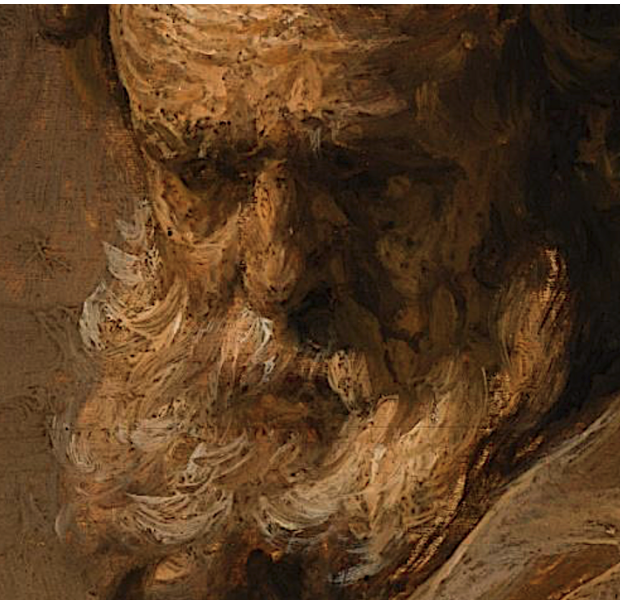
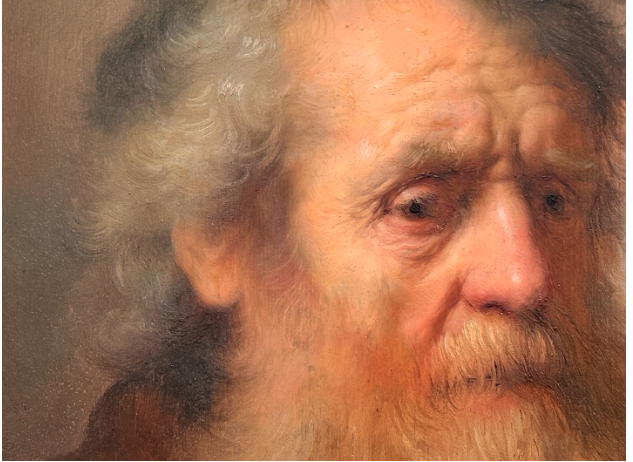
It looks wrestled and wrought into existence, chiseled out of stone from the primal bedrock of life, death, and eternity. The “bearded old man” in the painting by Rembrandt of the same name (above) might as well be the old and mad King Lear from Shakespeare’s tragedy or a rough-hewn modern sculpture by Rodin.
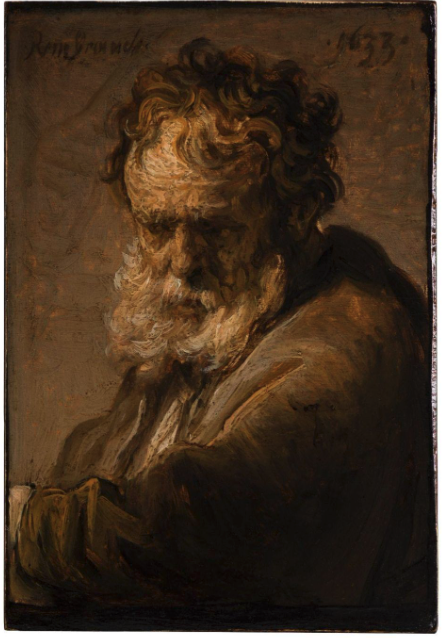
Rembrandt, Bust of a Bearded Old Man, 1633. Oil on paper, mounted on panel, 31/2 x 21/2 in. Courtesy the Nortom Museum of Art and the Leiden Collection, New York
Rembrandt’s greatness was his ability to join immense skill in rendering with a profoundly deep feeling for humanity. “His drawing is made with the might of an age of study,” commented Robert Henri AND, he adds, “his lines are filled with a great man’s sense of life. Every touch on the canvas is laden with his interpretation of life. His drawing gives the essence of his character. His greatness lies in his intense feeling for his subjects.”
This painting is currently being exhibited in “Art and Life in Rembrandt’s Time: Masterpieces from The Leiden Collection” now at the Norton Museum of Art in West Palm Beach through March 29, 2026.
The painting below resides at the Harvard Museums in Cambridge, Mass.
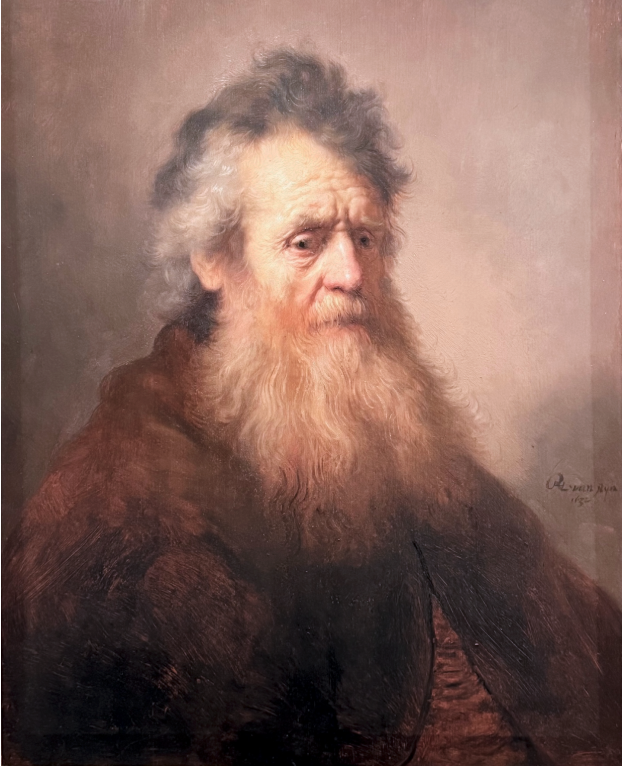
Rembrandt, “Portrait of an Old Man (Study),” Oil on panel, 1632. Fogg Museum.
It’s a studio painting, not a portrait, so it’s meant to provoke feelings, ideas, and thoughts rather than to preserve a likeness. Hanging next to it at Harvard’s Fogg Museum is a work by Rembrandt’s contemporary, Jan Lievens. Both painted head studies – but what a difference between their paintings!
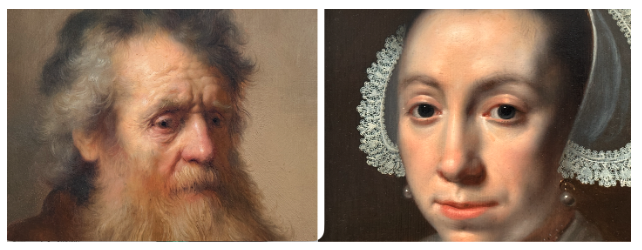
Henri goes on in his passage about Rembrandt to suggest that we respond not just to the artist’s ability to suggest the personal histories and psychologies of his subjects. It is something more. It is this plus the artist’s will to encode a profound feeling for humanity itself into his paintings.
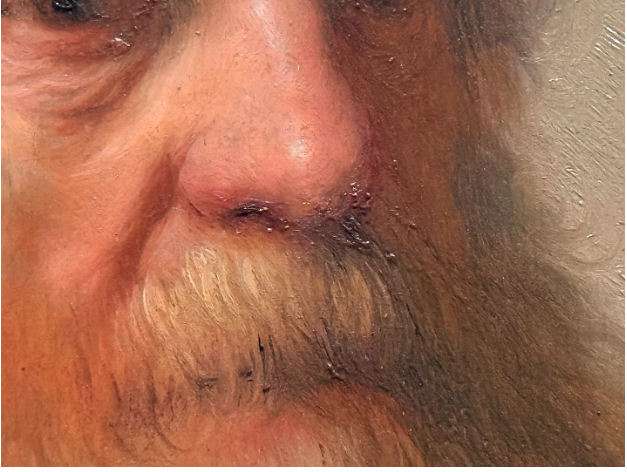
Great art touches upon what used to be called “the human condition” – the perennial mysteries and predicaments humanity has always reckoned with beyond boundaries of geography, time and culture. It’s why Rembrandt is often compared to Shakespeare.
Both Shakespeare and Rembrandt paint the most emotionally complex and insightful portraits of the human condition ever created. As with Rembrandt’s aged men, Shakespeare’s portrait of an ailing father in King Lear is not just f a character study or even a psychological portrait of a personality in extremes, though it is that; “King Lear,” the play as a whole, is also a probing meditation on the primal dilemmas facing human life itself – what is love, what is personal responsibility? What is truth, what’s right and what’s wrong and why do we choose so poorly? What, if anything, makes life worth living after it’s proved its inevitable bent to horror and suffering?
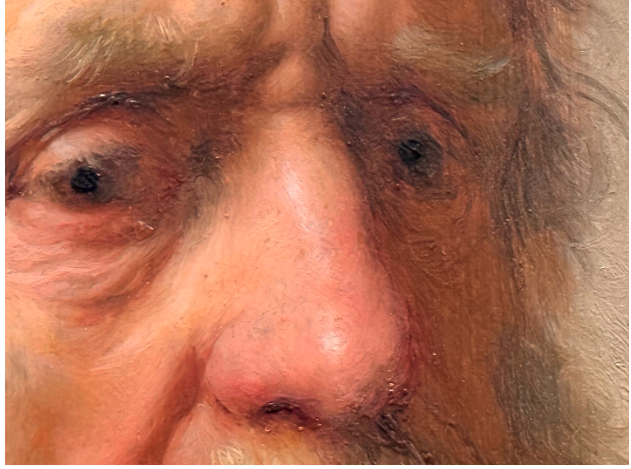
In a similar way, Rembrandt uses his figures to embed insight into the condition of humanity as a whole. The greatness of Rembrandt can only be fully experienced by a thoughtful “reading” at the level of the paint itself – his colors, textures, slight gouges, bumps, blurs, and scratches – all the traces of his paint handling – and an intellectual/emotional engagement with the ideas such a surface corresponds to.
The painting’s depth resides in the paint itself, the way he uses it. This seeming paradox is something you understand best though experiencing the work in person. Form reveals content. The deeper you penetrate below,” says Henri, “the better you will see the surface.”
One contemporary painter who deeply admirers Rembrandt is Juliette Aristides. “The detail is concentrated on the wrinkles and furrows and the careful modeling of the worried lines,” she says of Rembrandt’s self-portaits. “I searched for clues of how Rembrandt created such a perfect illusion of life, yet although I can point to all the artistic elements, the painting transcends that kind of language…. like another form of flesh and spirit.”
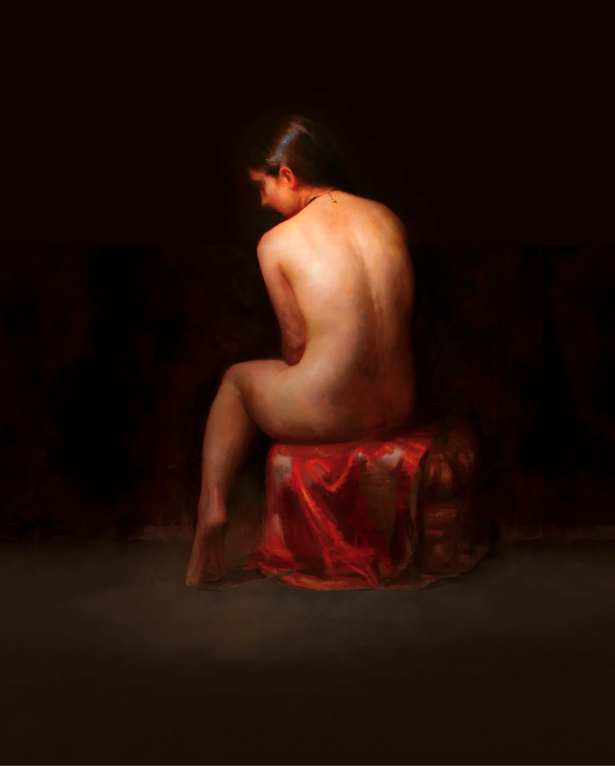
The “Old Master” approach to the portrait and figure is still a vital creative choice for contemporary artists. Juliette Aristides teaches theory and approach in her video, “Secrets of Classical Painting.”