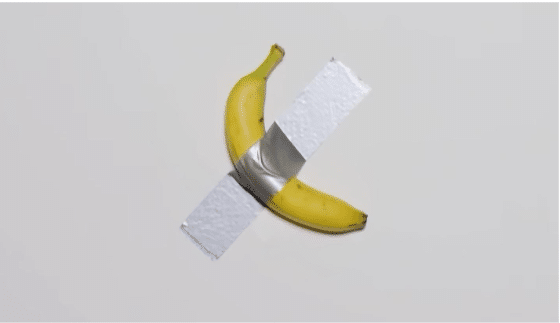
An acclaimed work of art consisting of a banana and a roll of duct tape has sold at one of the world’s most prestigious auction houses for more than $6 million.
When Italian artist Maurizio Cattelan’s “Comedian” first appeared at Art Basel in Miami Beach in 2019, it was valued at $1 million. It “quickly erupted into a viral global sensation that drew record crowds, social media inundation, landed on the cover of The New York Post, and divided viewers and critics alike,” Sotheby’s said. At that initial debut, Art Basel had to take it off the wall because of how many people were having too much fun taking selfies and jockeying to see it.
So, faithful readers, the $6 million question ….. Is it art?
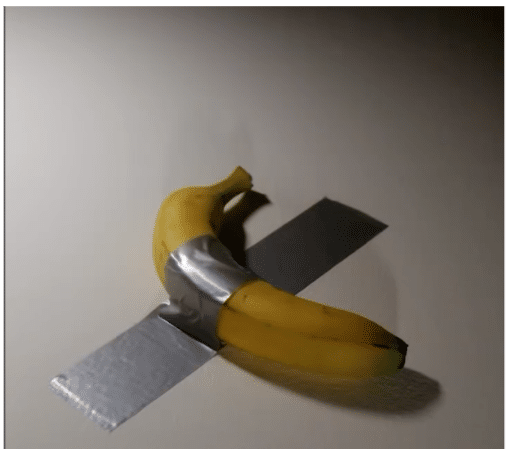
Maurizio Cattelan, “Comedian,” assemblage
Yes! Is it good art (if art’s purpose is to wake us up and make us think, then Yes, yes it is).
Is it great art? No, not in the sense that we commonly understand that category – the category that includes the work of Michelangelo, Turner, Rodin, and Monet. And THAT is very much part of its meaning. Make no mistake, this is a joke with a serious purpose – and that’s what the best comedy is, and that’s why this work’s title is “Comedian.” For the set-up to work, the art itself must be utterly lame. Otherwise, “Comedian” would not perform its main function, which is: To show up the snobby, money-soaked art world for what it is and to lambast it on behalf of art lovers everywhere.
Once you realize that this absurd transaction nets the artist sees ZERO MONEY (the only people getting rich from this are the seller, the buyer, and the auction house), whatever knee-jerk reaction you might have had (e.g. “That’s not art!”) gets replaced with the righteous indignation this sly work is meant to stir up.
Because a banana duct-taped to a wall is patently meaningless outside the context of the outrageous history of the buying and selling of art for profit.
Remember the artist sees none of this money. And money is the point. The “serious” part of the joke is the implicit question, how do we as a society “value” art? That there isn’t any way more conspicuous than piles of money says a lot.
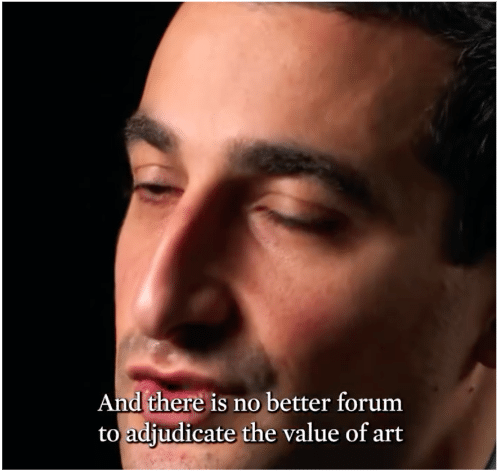
Sotheby’s spokesman, Instagram video capture.
If we take it on its own terms and give it the same amount of thought as any work of art (remembering that the outrageous price tag is an essential part of this artwork – maybe the most important part) its meaning and purpose become plain:
“Comedian” reminds us that the whole question of what is or can (or should be) considered art may never be settled but that we do have the power to address the wider question of art’s relationship to the culture: The sad fact is that in our society the art world “values” art primarily for the dollar signs it can attach to it. It’s on the rest of us, I think, to change that if even a tiny bit we can.
Not convinced? Think this is a colossal waste of time and money (you’re right and not right, btw, and that’s the whole point, for the reasons stated above)? Don’t care? Does all this BS make you want to double down on beautiful, traditional representational art? Then Johnnie Liliedahl’s video, “Old Master Methods: The Grissaille“ might be for you. Check it out here.
Postscript – Esoterica
There is a legit art historical context for “Comedian,” which further underlines that it is indeed “art.”
In the early 20th century, the definition of a work of art was expanded to include not just objects but actions, performances, provocations in general. The first and most infamous was Marcel Duchamp’s work, “Fountain.” And it’s just like “Comedian”:
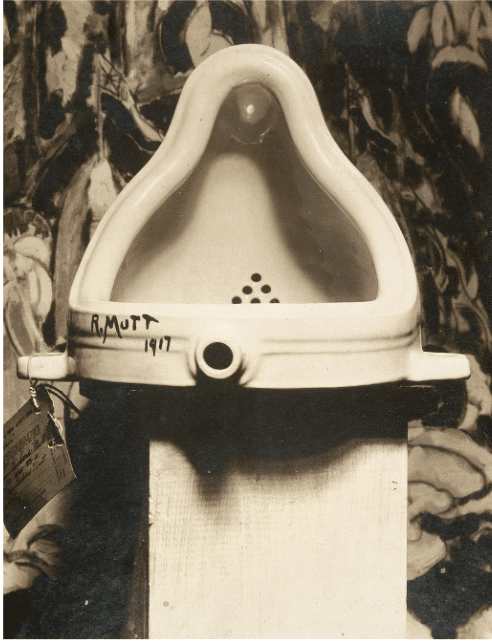
Marcel Duchamp, “Fountain,” assemblage, 1917.
In 1917, Duchamp saw an opportunity to let all the hot stale air out of the tires of the stuffy Art World. At the inaugural exhibition of The Society of Independent Artists in New York, Duchamp submitted a urinal signed “R. Mutt” (a play on words likely meaning “art has gone to the dogs”) by the artist. The urinal was rejected as a grotesque and indecent joke. Duchamp resigned from the Society in protest and gleefully published a “defense” of the work under a pseudonym, stoking a debate about what constitutes art that became a central part of 20th century art history.
The justification Duchamp used in his defense of “Fountain” went as follows: “whether R. Mutt with his own hands made the fountain or not has no importance. He CHOSE it.” And with that, the first work of conceptual art was born. What most people forget is that it was intended as a huge anarchistic joke designed to bring down the High-and-Mighty-Art-World a peg or two.
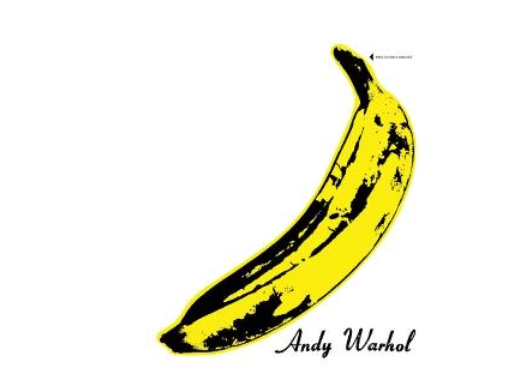
The humor in “Comedian” is right in the title. Sotheby’s pointed out that “a banana is an inherently funny fruit” and that the work references vaudeville and the whole clown-slipping-on-a-banana peel gag.
There’s also an inside joke about Andy Warhol going on here. Warhol’s controversial silk-screened Marilyns and Campbell’s soup cans would not have existed if not for Duchamp and his “Fountain.” In the late 1960s, Warhol used a banana motif in various works, including on the album cover for the debut of The Velvet Underground, a rock and roll band he launched under his creative wing.
Would “Comedian” have worked as well if Cattalen used a grapefruit? I doubt it. So, if not, what do you think that says about it?