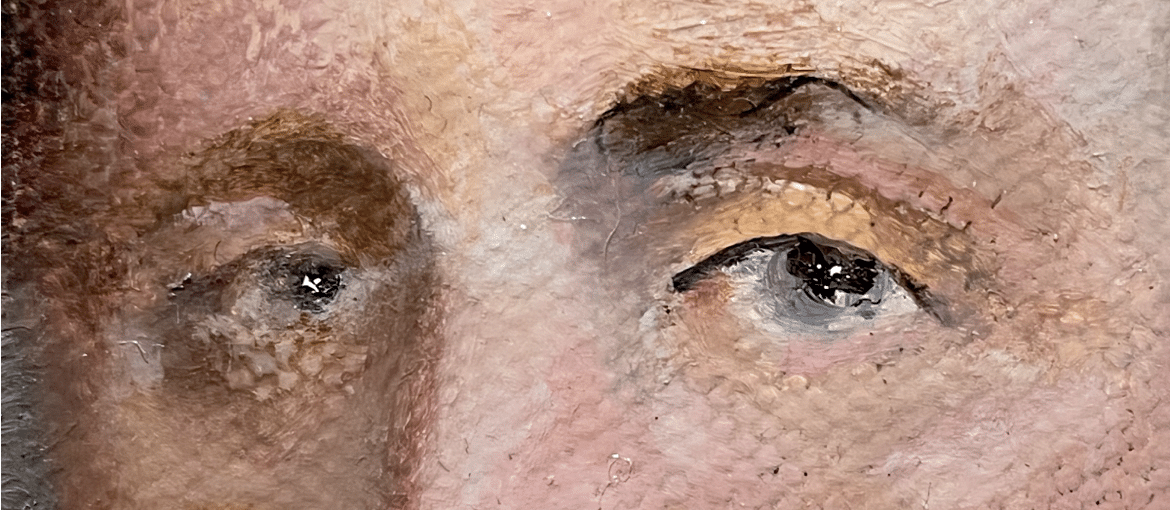
If portraits seduce, confront, and fascinate us, it’s not least because they put art directly in the service of the human psyche, with all the mysteries that entails. Out of the several genres of realism – landscape, still life, the figure – the portrait is a different kind of beast. A portrait is art that returns our gaze, involving questions of how we look at art and what we think we see or don’t when we do. And that’s got everything to with eyes.
The Eyes Have It
Where a portrait’s eyes are looking greatly influences how the portrait affects us. Painted eyes may be looking straight at us, beyond us, or seemingly right into (or through!) us, or a combination of all of these at once. Such differences may seem trivial, but they actually hold the power to define a painting’s very meaning and purpose, how we respond to the image that we see – even as it looks back at us.

Vermeer’s Girl with a Pearl Earring (above) famously “fixes us with her gaze” – but why? It must have something to do with how she’s posed – looking over her shoulder, as though casually turning her head to look at us. Then there’s the mild half-smile that plays so subtly about her glistening lips.
But really, it’s her eyes – they’re large, clear, lashless, very alert but not exactly friendly or “smiling” – it’s just a direct gaze, unburdened by too much emotion or age, a natural, guileless look that engages us in the moment. (Is there a very faint hint of sadness – loneliness or something – in her eyes, especially her left eye (on the right side of the image) – or is that just me?)

You can probably guess whose eyes these are (above). It’s the Mona Lisa’s smile that gets all the hype, but look what Leonardo did with her eyes. Scholars talk about how, unlike other early Renaissance portraits, she “looks directly out of the painting into the eyes of the viewer” (T. Flanagan, “Mona Lisa’s Smile,” Studies in Iconography Vol. 40 (2019), pp. 183-230). To my eye though, compared to the girl who sat for Vermeer, Mona Lisa appears to be looking past us, averting her eyes or at least looking not at us, but at something off to the side or behind us.
Then again (is there a conspiracy theory to be developed here?), it kind of looks, if you cover the eye on the right with your hand, like the eye on the left is looking toward us, but if you cover that eye and look at just the one on the right, that eye seems to be looking off to the side. Could that mismatch, that subtle twist, be partly why the Mona Lisa seems so sphinxlike and endlessly intriguing? Something in her “look” inspired the famous line about her “smiling at things beyond our ken (i.e., knowledge),” as though she knows a secret. And it isn’t just the smile. It’s the eyes as well that suggest the sitter is “full of strange thoughts and fantastic reveries and exquisite passions” the truth and meaning of which we, her viewers, will never know.
On the contemporary side, while much has been made of “the male gaze” in art history, at least one artist, Diana Corvelle, is taking that concept forward creatively while turning it on its head. Corvell’s intriguing “Lover’s Eyes” series of seemingly decorative works encircles exquisitely painted eyes within intricate paper cuts inscribed with statements by women — the eyes’ owners — relating personal experiences to do with patriarchy and outright misogyny.

Diana Corvelle source: @ dianacorvelle
“What began as an extended autobiographical series has since expanded to include the personal narratives of close friends and family members,” according to her website. “Symbolic cut-paper imagery alludes to, without entirely revealing, the complex realities explored in each hyper-realist portrait. Innumerable layers of delicately cross-hatched color give a solid presence to each portrait, while boldly graphic and precise cut paper form a fragile landscape of paper and shadows. Like remembered experiences, each component is both elusive and concrete.”

“I would sooner paint people’s eyes than cathedrals,” Vincent van Gogh famously wrote in one of his many letters, “for there is something in the eyes that is lacking in a cathedral – however solemn and impressive it may be. To my mind a man’s soul, be it that of a poor beggar or of a streetwalker, is more interesting.”
The purely technical mechanics of drawing eyes involve some basic knowledge of facial anatomy and careful attention to value, shadows, and highlights. The basic steps of drawing an eye are simple:
- Draw a wide upside-down crescent (“U” shape)
- Draw and connect another crescent into an irregular almond shape
- Add the pupil, iris, and lashes
- Finish with shadows and highlights

Hahaha!
That aside, careful study of relatively simple painted eyes will show the essential moves you need to make to paint believable eyes.

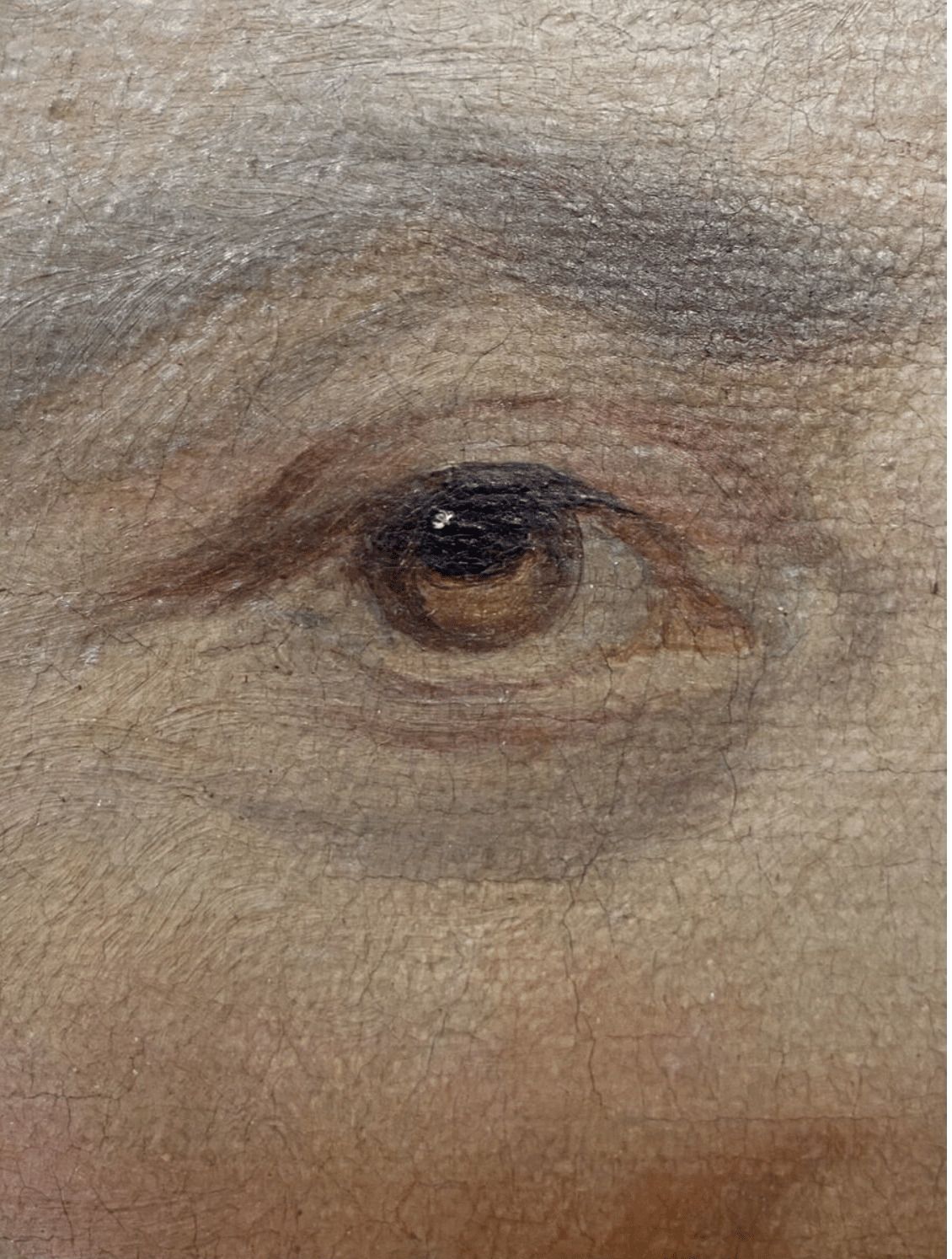
It’s not that complicated: This eye, with minimal color, emphasizes the 5-10 essential lines and shadings involved.
If portraits are for you, you can learn a lot in a short period of time with Joshua LaRock’s video Classical Portraits