
There’s a bank of trees in my neighbor’s yard, across the street from our house, that often stops and make me listen. This straight stand of pine trees (I’m told they’re called wind breaks, at least in New England) consist of a single row of tall pines of slightly varying height, a bit like the strings of a harp. On windy days (and especially nights) the branches whisper and swoosh like an auditorium full of ghosts playing air guitar. (If you’d like to hear it, click here.
An aeolian harp is a sort of musical instrument played by the wind. Named after the Greek wind god Aeolus, the instrument catches passing breezes that stir the strings, creating strains of music that rise and fall with the movement of the air. The English Romantic poets loved the idea, seeing in it a metaphor for artistic inspiration. Chief among them, S. T. Coleridge described aeolian harp music as “a soft floating witchery of sound.”
Part of Romanticism was about putting aside logic and reason and becoming receptive enough to allow Nature to stir one’s imagination. In special moments, such as in love and tranquility, Coleridge mused, it can seem as if “all of animated nature” is filled with “organic Harps… That tremble into thought, as o’er them sweeps … one intellectual breeze, At once the Soul of each, and God of all.”
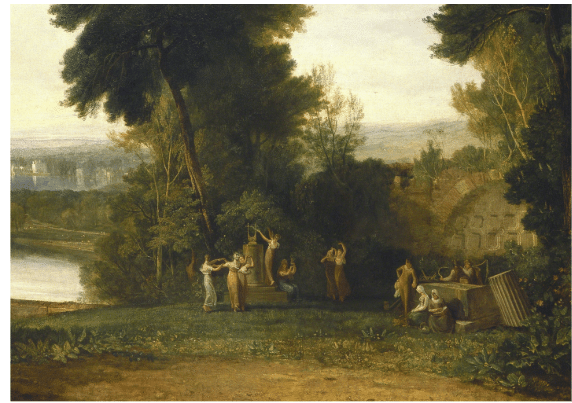
JMW Turner, “Thomson’s Aeolian Harp,” (detail), oil on canvas, 1809.
There’s a surprising story behind Hudson River School artist Homer Dodge Martin’s painting, known as “Harp of the Winds” (at the top of this page). Martin was quite well-known in his day, but he was always slightly out of step with the art world, forever just missing the bus, and he fell on hard times in his later years. (We wrote a whole piece about him that you can read here.
When in the late 1890s Homer Dodge Martin’s friends learned he was homeless and living with relatives, destitute and sick with terminal throat cancer, they solicited money through the New York Academy of Art’s membership. Rather than accept it outright, Martin insisted it be regarded as an advance on the purchase of what he called the “Seine picture” i.e., “The Harp of the Winds.” By purchasing and donating this painting to the Metropolitan Museum of Art, his friends saved his work from being forgotten. The museum to this day attributes the acquisition to the generosity of “Several Gentlemen, 1897.”

Homer Dodge Martin, “Mount Washington from Randolph Hill.
The Hudson River Style is alive and well in the paintings of Eric Koeppel. If you’d like to learn the authentic techniques of this phase of American landscape painting check out Eric’s videos, Techniques of the Hudson River School Masters, volume 1 and 2.

Eric Koeppel, “Autumn Evening,” oil on panel, 13 x 24 in. (2024)
Acrylic Live Faculty Painting Spotlight: “Chromatophilia”
by Angela Bandurka

Angela Bandurka, “Chromatophilia” (2021, Acrylic on Ampersand Gessobord cradled panel)
It’s not too late to join us for the inaugural Acrylic Live virtual art conference and learn from some of the top acrylic artists and faculty from around the world. Acrylic Live is March 26-28, 2025, with an optional Essential Techniques Day on March 25. Register now at AcrylicLive.com!
Chromatophilia is a word that describes the love of color. It’s a sensation I’ve felt since I was a child, and some of my most memorable gifts throughout the years were art supplies.
This painting was created from a photograph I had taken inside the gorgeous art supply store L Cornelissen & Son in London, England. The way they have displayed raw pigment and tubes of paint is just so delicious – you want to live inside that store! I loved every inch of it.
Having a figure inside was even more important, as he represents all of us artists, at once indecisive and at the same time energized and in awe. I even painted a bit of a halo around the figure’s head where the light would hit it, to indicate how alive and full of excitement he was in that moment.

Join Angela Bandurka on Essential Techniques Day of Acrylic Live, March 25!
At the Essential Techniques Day of Acrylic Live (online, March 25), I’ll be giving a demonstration of painting a teacup, and how composition matters when laying out your still life scenes. Guiding you through the process of creating a balanced composition on a square canvas, I’ll use a few simple props such as flowers and cutlery to inform the design.
Props are a big part of my process, as is light source. I’ll direct the light source and place my props around the teacup until I find a composition that supports my overall design plan. As I move into the painting phase, I’ll share techniques to use the compositions of these elements to direct your focus to the focal point and establish a smooth visual flow throughout the piece, and then evaluate with a quick critique to see if I was successful.
Learn more about the event and register now at AcrylicLive.com!