1. The Sublime and the Picturesque (Romanticism)
Understanding the Hudson River School starts with recognizing the European influence. The artist and early environmentalist Thomas Cole (1801–1848) founded the influential 19th-century art movement known as the Hudson River School of American landscape painting. Cole insisted that American artists need look no further than their own natural environs for magnificent subject matter that no painter of the past had ever committed to canvas.
Training in his native England imprinted on him a love for Romanticism of the Salvator Rosa variety (see example below) in which the creative imagination expresses the feeling for wild scenery, sublime majesty, and “picturesque” natural beauty – all of which Cole found in the Hudson River and Catskill Valleys and the White Mountains of New Hampshire from the 1820s on.
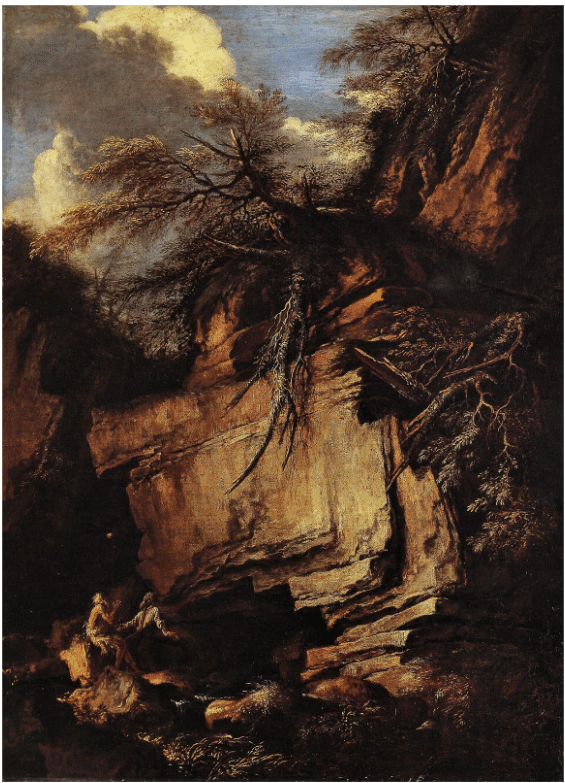
Salvator Rosa “Landscape with Saint Anthony Abbot and Saint Paul the Hermit” About 1660 – 1665. Rosa inspired the Romantic landscape painting that Cole brought to North America.
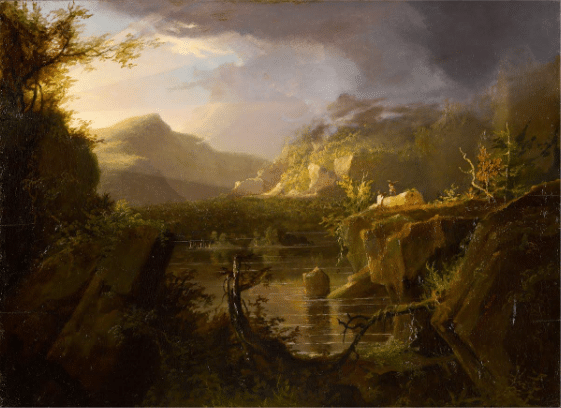
The painting by Cole titled “Romantic Landscape” (top of page) shows the blueprints he laid down for his followers in the soon-to-rise Hudson River School: a wide-format view of a pristine natural wilderness with identifiable North American flora and fauna, a combination of sublimity (menacing storm clouds, dead trees, and wild rocky crags) and picturesque beauty (sunlit verdure, a native man living close to and in harmony with nature, light bursting forth in golden rays reminiscent of the blessings of Heaven).
2. The Pastoral
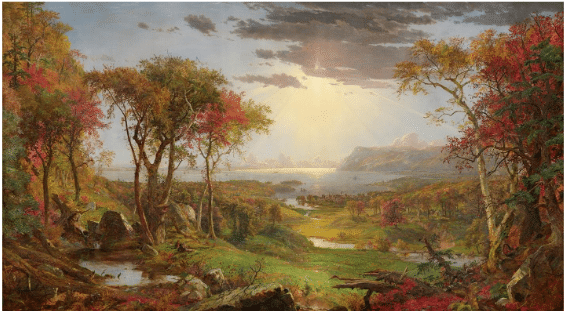
Jasper F. Cropsey, “Autumn on the Hudson River – 1860.” Oil on canvas,
59 3/4 x 108 1/4 in. National Gallery, Washington D.C. (painted from memory in his London studio)
Many Hudson River School artists who followed Cole leaned away from the more severe Romantic sublime in favor of the “pastoral” mode, where calm and beauty reign over softly lit, atmospheric, and at times half-imaginary landscapes, again drawing on European sources (see below). To borrow on a description from Wordsworth, in these paintings of peace and prosperity, “God’s in His Heaven and all’s right with the world.”
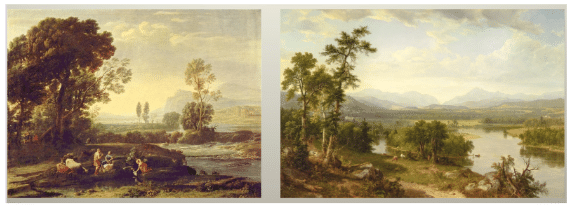
Typical pastoral painting (left) by Claude, c. 1650, typical Hudson River School landscape (right) by Asher B. Durand, c. 1840.
3. The Grand Vista
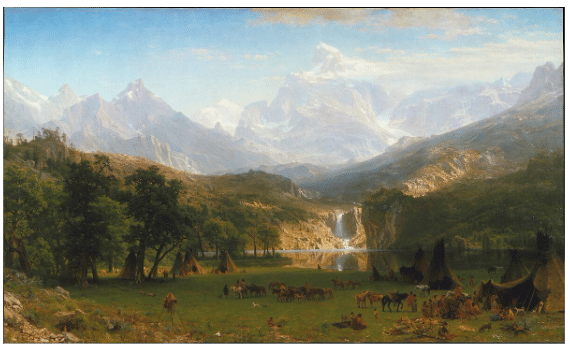
Albert Bierstadt, “The Rocky Mountains, Lander’s Peak,” oil on canvas (1863), 73 1/2 x 120 3/4 in.
From a painter’s perspective, this photo does zero justice to what it’s like to stand in front of this work and study its incredibly beautiful details.
Majesty, especially as found in the American west, became a touchstone for the so-called Hudson River School painters as the movement reached its peak just about the time of the American Civil War. When the United States government wanted to promote western colonial expansion, it funded artist-accompanied expeditions that resulted in the giant, colorful, and cinematic paintings of artist-explorers such as Thomas Moran and Albert Bierstadt.
4. The Spiritual: Light Fills the Stage (luminism)

Sanford Robinson Gifford, “The Wilderness,” (1860), oil on canvas, 30 x 54 5/16 in
The history of the Hudson River School ends with a strange and beautiful twist. Amidst the pessimism born in the aftermath of civil war, as the movement trailed off toward the later 19th century, the craggy rocks and Edenic valleys and mountains finally evaporated in a haze of immaterial light. Dubbed “Luminism” by art historians, this final development in the Hudson River School story seems to cede nature to the divine almost completely. The Luminism Movement featured a return to tranquil scenes of calm water, hazy skies, and light-suffused aerial mountains. That’s the official story, anyway. In truth, the sense of the landscape infused with spiritual light was present throughout; witness the 1860 painting by Sanford Robinson Gifford above. The text from the Toledo Museum of Art that owns it perfectly sums it up:
“A masterpiece of what has been called “luminism”—precisely rendered, poetic depictions of landscapes that focus on effects of light and atmosphere—”The Wilderness” evokes an idealized vision of humans living harmoniously with nature. Though in reality, such vistas were being encroached upon by industrialization and urbanization, “The Wilderness” is an homage to what had become central to American identity: the space, beauty, and unspoiled land that spoke of national destiny, spiritual renewal, and endless possibilities.
In the end, as in the beginning, the single thread running through the history of 19th century American landscape painting is the relationship of humanity to the natural world. It is an arc that stretches from the forbidding foundations to the spiritual ether. Perhaps, they thought, we might learn from nature something important about our culture and ourselves. As the corresponding American philosophy of Transcendentalism put it, with a sensibility nourished by the beauty of nature, “every spirit builds itself a house; and beyond its house a world; and beyond its world, a heaven. Know then, that the world exists for you.” (Ralph Waldo Emerson, “Nature,” 1836)