“It has always seemed to me that a picture does not rest upon beauty alone.”
– John Carlson
Paintings, like people, have an outer surface that they present to the world and an “inner life” that may or may not fully reveal itself to those who get to know them. In my opinion, we get to know and like (or not like) a person – or a painting – based on personality, not just looks.
I’m one of those people who struggles to make small talk. I yearn for real emotional connections and shared interests, even though I’m terrible at initiating them in actual conversations. Just as with new people, I do like paintings that get right to something real, that say something honest or interesting about what that artist has seen and felt. The paintings I most admire express the artist’s personality, usually bound up with something deeply felt combined with a skillset fitted to convey it as directly and compellingly as possible.
Paintings needn’t rely solely on technique nor on the inherent beauty in the visible qualities of the subject, be it a bowl of fruit, a boat, or meadow. Beyond technique and subject matter, a painting has its own “inner life,” just as the artist does, and it has it because the artist put it there.

John F. Carlson, Brooding Silence, oil on canvas, 37 1⁄8 x 52 in.
The painting by John Carlson above isn’t just an image of trees. Rather, it’s the artist’s rendering of an experience – hence the title, Brooding Silence. That’s what’s great about it, and that’s why it was owned by Henry Ward Ranger (himself a great American landscapist) and why it now resides in the Smithsonian American Art Museum.
Carlson brought his desire to share an experience to bear on his choices about color, value, and shapes. So, how on earth do you do that? How do you get yourself into your painting? Some people say it just happens while you’re concentrating on other things. I think you actually have to consciously push for it, to keep the desire to express your experience conscious, to prioritize it over the many other reasons we make paintings.
You already know how you feel about the world and the things inside it – and you probably already know enough about painting to start getting something of that into your work however you can – by any means necessary – but preferably the clearest and most direct methods available to you, that is, the ones closest to hand. Remember that color, line, and visual weight are not just the tools of painting, they are the tools of expression. Or better yet, just push your current work’s boundaries and discover yourself there.
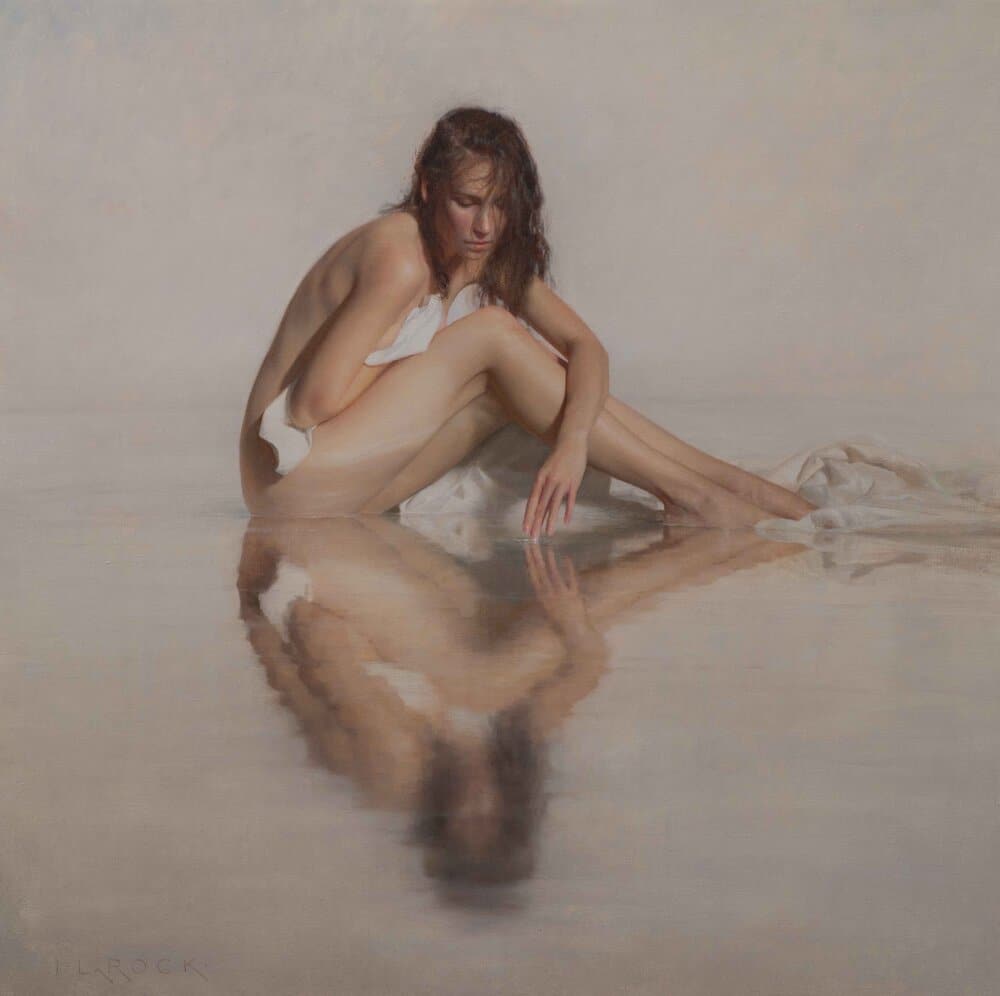
Joshua LaRock, Drawing on the Water, oil, 24″ x 24″
Think of a painter like Carlson, and I could name many others but for the sake of argument let’s put Joshua LaRock and Douglas Fryer in this category too. The true unspoken subject of their paintings comes down to not just what they see but what they can make us see and feel.
As Carlson put it, “The beauty and the recognized elements of subject matter (with the unity of idea in which they should be represented) together signify something to us.”
Breath-catching paintings, then, combine the character of a thing (as the artist perceives it) with the painter’s knowledge or developed instinct of how best to represent his or her own experience so that others see it too. I don’t think you develop a personal vision without developing the skill to express it at the same time; it’s through making the work that we find ourselves.
Can you envision what would your work might look like if you truly put feeling first?
Curious how others see this. Send me your thoughts and I’ll include them in a follow-up post.
If you’re intrigued with Douglas Fryer’s approach to landscape, check out his instructional video, Painting with Intuition. Fryer’s methods prioritize the experience of painting over the finished outcome until it’s actually time for the finish. If painting the figure appeals to you more, let Joshua LaRock in his video Classical Portraits lead you through the step by step process of how he creates paintings rich with depth and meaning.
David Hockney Embraces “Immersion” Spectacles
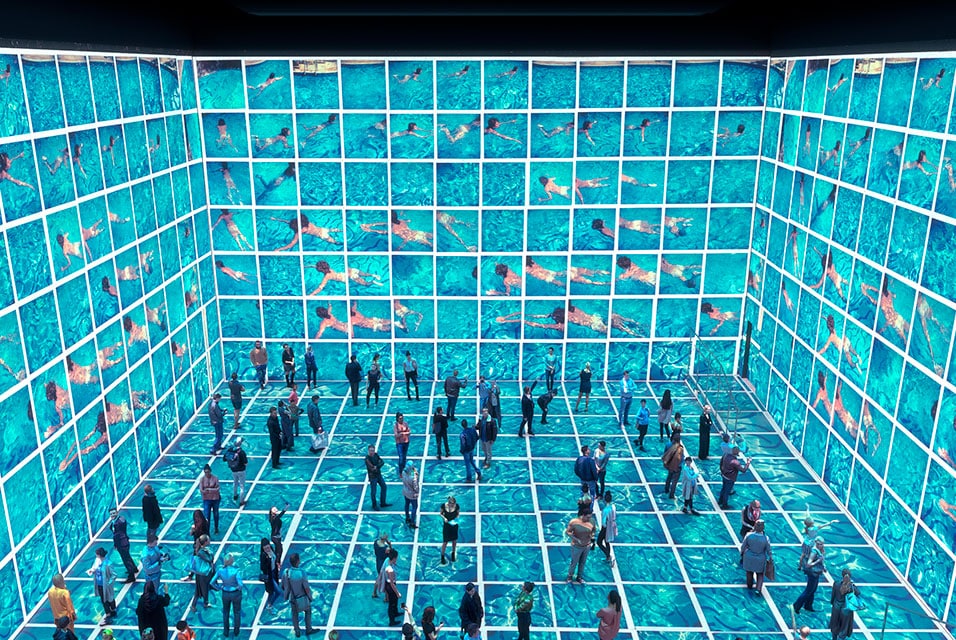
Although English-born post-pop painter David Hockney is a critics’ darling, his latest working medium is less favored. Immersive art extravaganzas have mushroomed around the globe of late, including in places such as Bordeaux, France; Abu Dhabi, United Arab Emirates; Boston and New York. Most of those shows follow a strict formula: digitized masterpieces by long-dead artists such as Salvador Dalí, Henri Matisse or Vincent Van Gogh are projected at enormous scale onto expansive, warehouse-like walls, then animated to an orchestral soundtrack. Discussing two recent immersive Van Gogh spectacles in New York, the Times critic Jason Farago noted that, in those shows, “sensuous selfie backdrops come well before intellectual engagement.”
Hockney’s new work, “Bigger & Closer” mounted at Lightroom, an arts venue in London, deliberately piggybacks on the fad. Hockney said that he hadn’t seen any of those spectacles based on other artists’ work but that he knew his was different. “They’re dead,” Hockney said. “I’m a living artist, so I’ve come in and actually done things.”
“Bigger & Closer” has been more than three years in the making. In 2019, 59 Productions, a British design company that works in theater and opera, noticed the boom in immersive experiences and began looking for ways to make similar projects with living artists. Mark Grimmer, a director of 59 Productions who led the work on “Bigger & Closer,” said in an interview that he wanted to make events that were “more about storytelling than simple spectacle.”
“I don’t care what critics say about me,” Hockney said. “I think it’s really good,” he added, “and if I think it is, that’s all that counts.”
This article originally appeared in The New York Times.