By Tibor Nagy
Painting became my mode of expression during times of rapid change. An extremely fast-paced world engulfs everything. It offers us values in the form of short, often absurd glimpses of show business that tend to leave a strange feeling in one’s stomach. Immediate enjoyment and gratification arguably have become the most sought-after products. We are willing to go anywhere and give everything for it. But a box of colors and thinners reminds me of the emptiness of such frivolity. It helps me to live my own identity and cast out the laziness of consumerism.
I am a self-taught artist who has never been afraid to learn. My experience usually comes from hard-learned lessons, and I’ve found that gaining the experience needed to achieve a particular goal often takes considerable time. For me the inner fire is too strong, however, to let doubts trouble my mind about whether what I do is right or wrong. I simply try to do things as well as I can, letting them flow, and not being concerned about them more than is necessary. Nothing more and nothing less.
Education always teaches me great patience. Unlike innate talent, I think an artistic skill is not something a person is born with, but it is something we learn like any other craft. Mind and body must be in unity for the inner impulse or idea to manifest spontaneously on canvas. This expression can be compared to playing a musical instrument. Discipline and practice are necessary before one’s mind can be fully expressed through the instrument, with as few obstacles as possible.
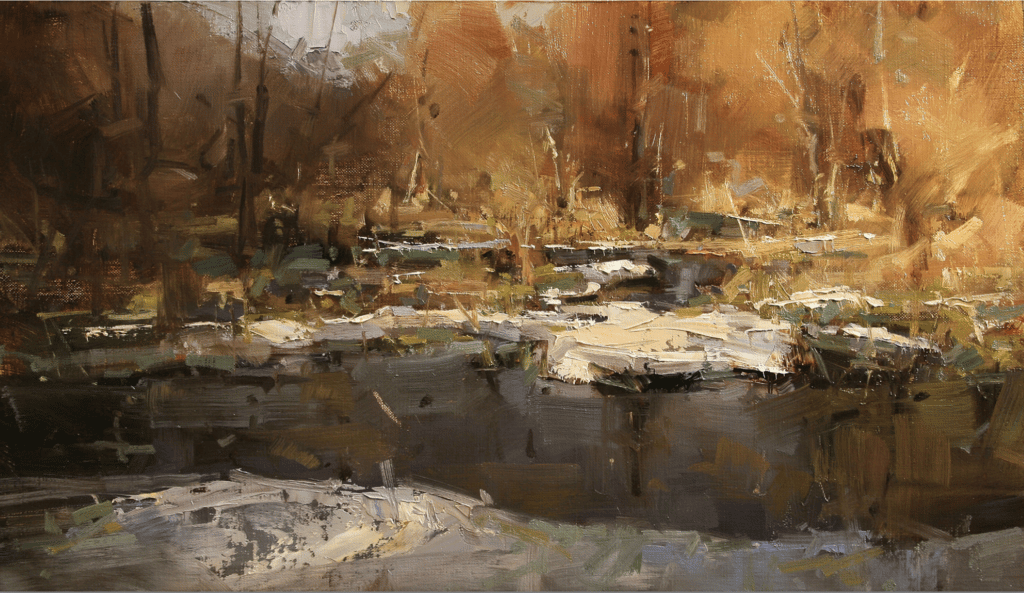
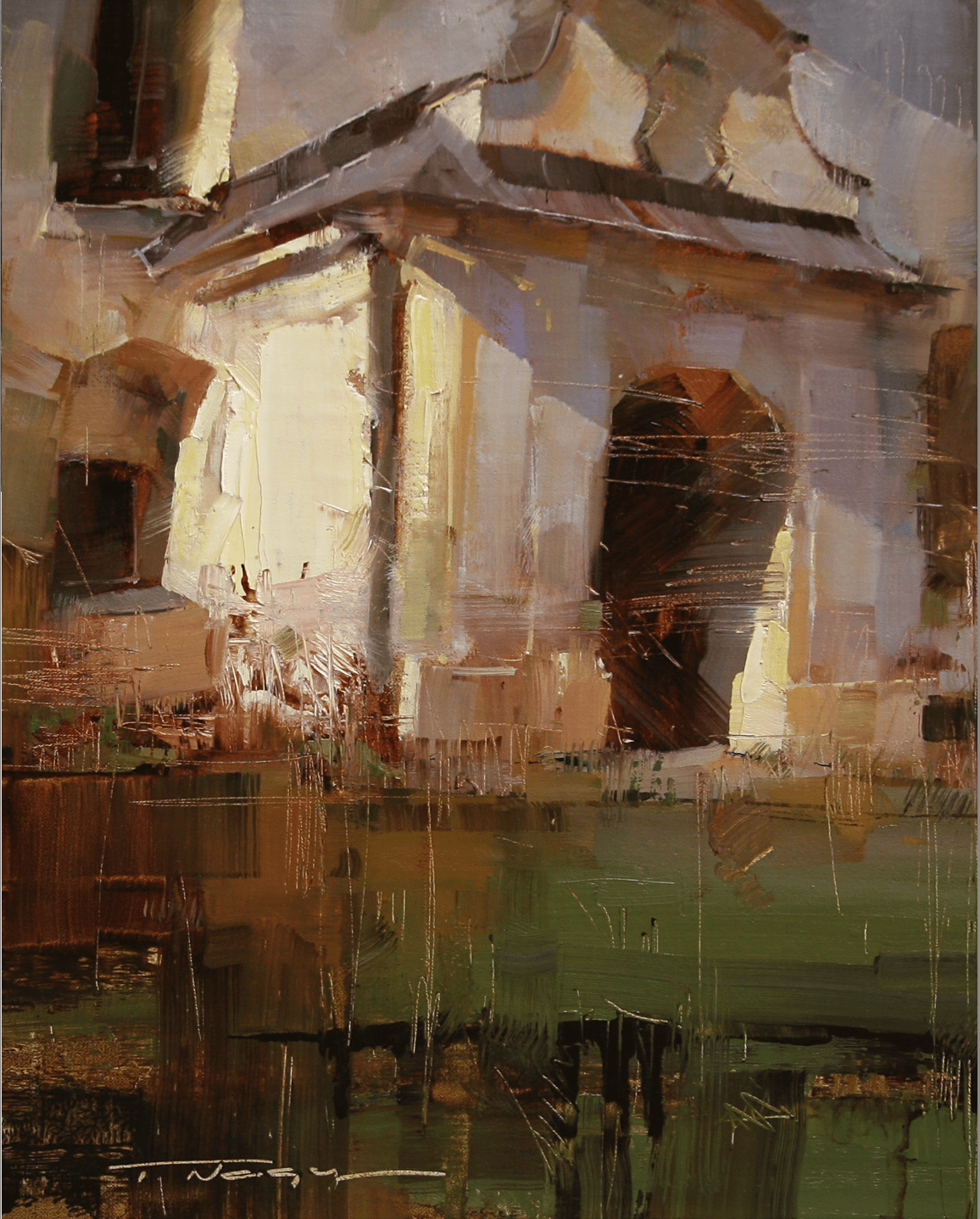
Tibor Nagy, Last Spring, oil, 12″ x 9″
As my artistic ability slowly develops, I become less restricted by the painting process, allowing the whole painting experience to become simplified and spontaneous. This also creates a gradual unification of the inner impulse and the medium, which results in unobstructed graphic expression— basically a speech of colors. For me this inner voice has matured slowly, and gives me the ability to perceive softer, more subtle layers of reality. At first glance hidden, this softer game of environmental harmony gives richness to a painting.
The first intense moment of perception is created by dramatic changes of light or color that quickly grasp our attention and pull us immediately into the scenery. These changes cause powerful experiences that are more or less transitory. What follows are perceptions that are softer in nature, typically caused by less intense contrasts, colors, atmospheres and moods, all of which speak differently to us. They tend to grow on us after a while, sometimes awakening even the deepest emotions. Suddenly, we see ourselves in a painting, and the link between the painter and the observer is established.
Working Process
Perceiving the nature and environmental surroundings of our home usually depends on personal experience. This personal experience is unique. No two people perceive that specific experience the same way. That is why the first impression I get from the landscape is based on my own experience, which is formed by examining the patterns of the landscape, doing plein air studies, drawing sketches and taking lots of pictures. All these references inspire me to create an artistic piece with its very own emotional background. I then usually go through the material I gathered outdoors and sort it out in my studio. Sometimes I play around with the pictures I took earlier, add different layers to them, and from time to time envision and create my own landscapes.
Technique
Your technique should feel as natural as possible. It is something like listening to one’s own instinct about which tools to use, and when and how to use them in order to put something on canvas. What matters, of course, is the result, not the means used to achieve it. Immediately after finishing apainting I believe we should always ask ourselves: Is this really what I wanted to paint?
Technique also serves as a bridge between the invisible inner world of the painter and the world of colors and shapes I leave on canvas. This bridge is shaped by both concrete and abstract forms and objects. A concrete shape could be an object which evokes an aesthetic or emotional feeling. It is of little importance what that object actually is. Sometimes it could be a really simple item such as a dusty old vase lying somewhere in the corner; at other times it could be glorious scenery. The important thing is to carefully capture this impulse, because it is this impulse that tells us we should stand in front of the easel and start painting.
Abstract forms, on the other hand, thanks to their character, do not offer us much specific information. Absence of
form does not allow us to concentrate on the shape, but instead stimulates our feelings and moods. This is what I personally like the most about abstract forms. They provide an opportunity to put the emotional context into an object, as well as provide room for spontaneity. Attempting to depict joy, softness, hardness, movement and many other elements can become a very intense experience. It is also useful to attempt to paint these features one at a time.

Tibor Nagy, On the Street, oil, 17 x 17 inches
If we manage to successfully incorporate these moods and feelings into a painting, we create a more complex picture.
Among other things, such paintings also carry the author’s emotional perspective. Technique itself offers limitless potential for portraying a certain reality. That is why I also consider it beneficial to occasionally experiment with different types of techniques, rather than simply sticking with and using one familiar concept all the time. Overdoing one thing may result in boredom and loss of creativity. When this happens, the joy and mysterious power that draws us back to the easel can be forgotten, or slowly fade away. Having the courage to leave the safe but often boring road and stay “alive” is what matters to me. I also make an extra effort to remain constantly open to new possibilities and innovative ways. In this way I give new creative processes the opportunity to carry me forward.
Cesar Santos Sells alongside Bouguereau and Friends

Cesar Santos, Valentina, oil on canvas
Earlier this week we featured Elizabeth Jane Gardner Bouguereau, and also this week Sotheby’s held Bouguereau and his Circle, Then and Now, at which a number of Elizabeth’s paintings sold for new records (at least one fetched over three quarters of a million dollars). Alongside the Bouguereaus, a portrait by Cuban-born contemporary realist Cesar Santos blew past its estimate of $8K – $12K to sell for $22,680. Santos’ work, titled Valentina, depicts a young woman with a lace blouse, a kerchief in her hair, and a haunting expression in her eyes. Santos painted this work, full of emotion and grace, on camera for one of our most popular instructional videos ever.
Click here to own the documentation of exactly how Cesar Santos painted Valentina, from start to finish from a live model, in Secrets of Portrait Painting with Cesar Santos.