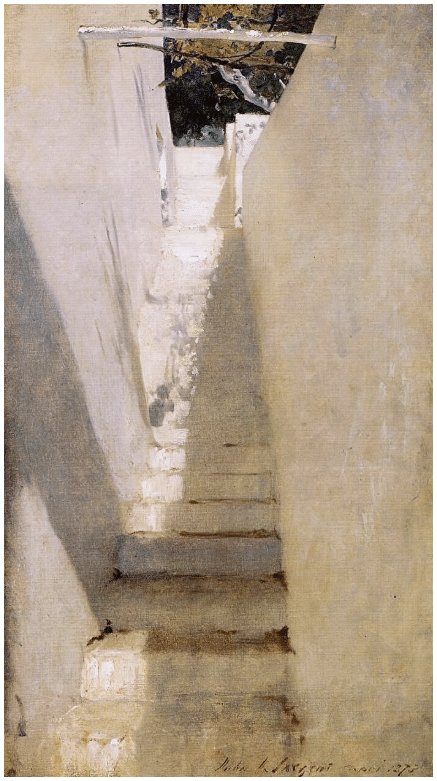
How many people have walked up and down these old stone steps? What sort of lives have navigated this narrow, sunlit passage? A young woman hastening to meet a lover? An old man with a parcel under an arm, stooped over a walking stick, picking his way one step at time? A boy with dreamy eyes sent to buy bread?
This is another one of those “What is it about this painting?” posts where I go off the deep end, speculating about what’s so special about some ground-up minerals suspended in vegetable oil brushed onto an old piece of cloth.
Special isn’t the word I’d use for the painting by John Singer Sargent at the top of this page. Miraculous is closer to it. There’s not much like it previously in Western art.
Sargent’s 1878 “A Staircase in Capri” is a tour de force of one of Sargent’s favorite rockstar skills – painting white on white. How do you paint white on white and make it work? A major key is temperature; warm and cool areas of sunlit stone, stone in shadow, stone receiving ambient (reflected and dispersed) light, and even light bouncing between the walls.
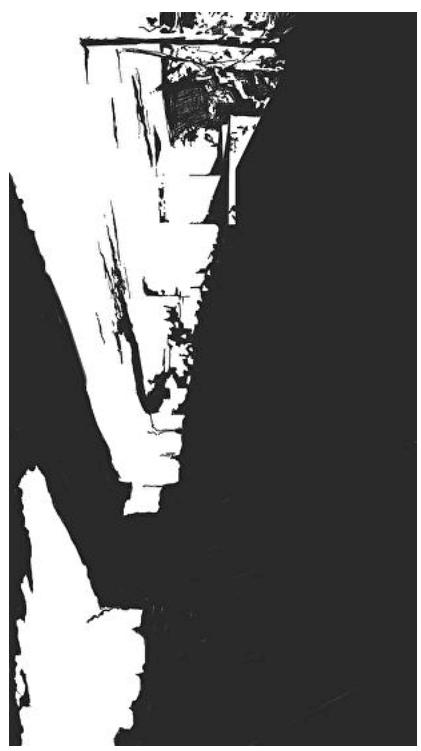
If we reduce this painting to a Notan (value study) and turn up the contrast, we can see that more than half the painting is designed to be in shadow, despite the luminous, airy feeling of the original. We can also see the interesting interlocking big shapes in play here.
But none of that says ANYTHING about why this is such a good painting or why we care. Why do we care? For that, we need to talk about what It makes us feel and think when we look at it.
So, let’s put technique aside and talk instead about what associations it brings to mind if we let ourselves just look and dream on it for a minute.
Forget analyzing anything or trying to figure out why it works or what it means. Let’s look instead for miracles, the kind that Sargent and other perpetually relevant artists see and celebrate in their art. Doing so might give us a little insight into how artists develop the ability to see like artists – meaning the ability to recognize the miraculous in the everyday and get excited enough to share the miracle as strongly and as clearly as possible in paint.
What might Sargent’s painting make us think of? Sunlit stone, of course, and the poetry of quiet nooks and crannies of the Mediterranean. We are invited to dream for a moment about sunlit, shaded corners of the ancient world far from the noise of industrial towns and cities. There are silent, half-hidden places veiled in years, centuries even, of unrecorded history, with hidden courtyards full of ivy, opening onto olive trees and old marble fountains. And what else does it make us think of, if we continue to daydream about it? …. Waterfalls? (It’s steep enough!) … An empty sun-washed tomb?… Radiant shafts of divine light?
A painting like this is not “about” light. Rather, it’s “about” what light means to us, something far more difficult to put to words. Light is illumination, and on the deeper , archetypal levels it’s safety, knowledge, goodness, and hope. Western painters who have felt this too have used light and shadow as a visual language of the divine.
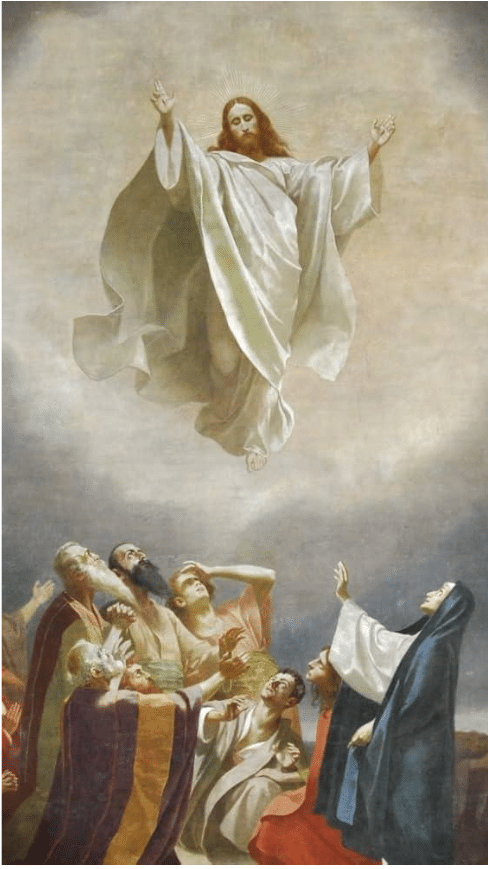
Gebhard Fugel, “The Ascension of Christ,” c. 1893.
In Gebhard Fugel’s 1893 Ascencion of Christ a soft, heavenly light emanating from the holy apparition or “spirit body” of the resurrected Christ shines down on his mother, Mary (blue robe), Mary Magdalen (red robe), the apostle John and several other astonished disciples.
Caravaggio’s many shafts of slanted light cutting through shadow represent the divine glimpsed in reality, the intervention of the Heavenly in the daily struggle for the salvation of mankind.
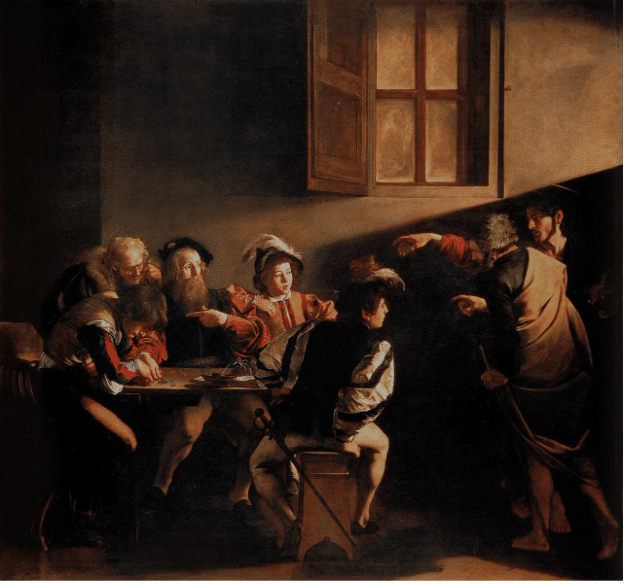
Caravaggio, “The Calling of Saint Matthew.” “Jesus walks into a bar in Italy and picks out Thomas from a bunch of other guys gambling…” (it sounds like the setup for a joke, but’s it’s not. It’s brilliant painting).
Did Sargent “put” all this symbolism into the staircase painting? Nope. Not a bit of it. All he did was paint a staircase. But no, that’s not right either. The staircase Sargent gives us is not the staircase that was “there”- it’s the staircase that he loved. Sargent painted the staircase as it appeared to his artistic imagination, with an eye and mind steeped in the history of Western art and sensitive to what things right in front of him made him see and feel.
For Sargent, certain things seemed to leap to his vision and sort of shine with a combination of excitement, beauty, and truth. That’s what happened when he painted this staircase in Capri. He seized and held for all of us something of the miraculous, right there in the everyday.
That’s what artists do.
Handling Architecture in Watercolor
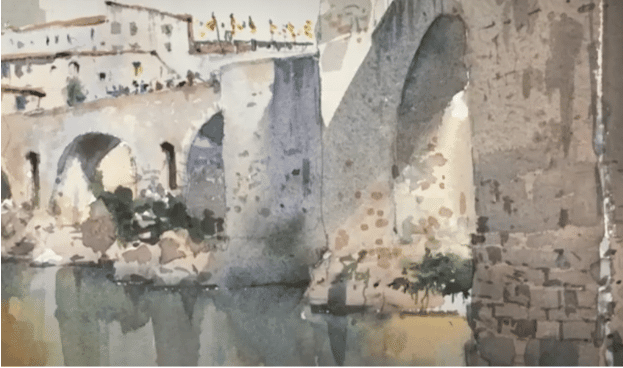
Speaking of light in painting, what holds many painters back from taking architecture as their subject is forgetting that “the main reason for painting architecture is painting the light,” says renowned watercolorist Stewart White. White is especially known for his masterful and elegant architectural watercolors, including plenty of, well, white on white.
White says painters looking to create great renderings of beautiful architecture would do well to look past the intimidating prospects of challenging details, geometric angles, and proportions in perspective, he says. Rather one should look to simplify the visually complex by concentrating on the quality of the lights and the shadows.
Stewart demonstrates the surprisingly straightforward and relatively easy methods he uses to the correct geometry taken care of so he can allow the light to make his paintings shine in his video Painting Architecture in Watercolor.
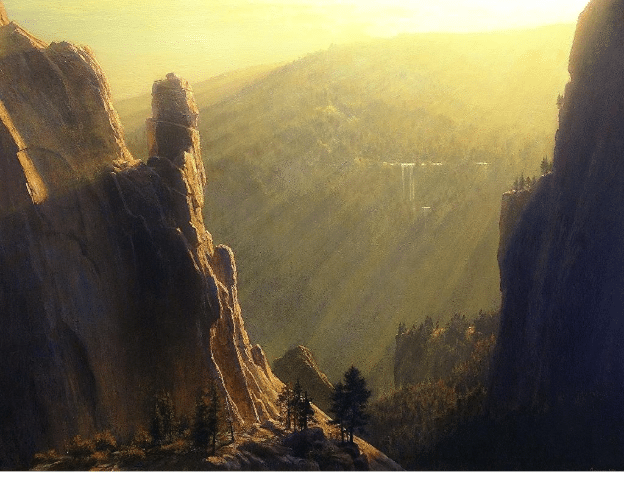
Joseph McGurl, “Light Streams,” oil, 30 x 40 in.
For another take on painting light, check out Joseph McGurl’s instructional video, “Painting Light and Atmosphere”