“With almost any creative endeavor, we mistakenly think that we know what translates into success.” – Susan J. Langer
Most people look at paintings in galleries and museums and think that artists are special people, endowed with extraordinary talent – as if there were only one way to make good art.
But the more you look and learn about the many kinds of paintings there are, the many ways of painting, and the many DIVERSE skills that go into it, the more you discover that there are multiple types and varieties of “good” art. So, it follows that there isn’t just one but a multitude of possible ways of defining “good” and multiple definitions of “talent” as well.
What people often mean when they say, “I have zero talent,” is that they tried an artform once, lacked the skill (the skill, not the “talent”) to make an excellent likeness of something, and then ran away. The problem is thinking we’re supposed to be good out of the gate. But why? You wouldn’t expect a future guitar hero to be able to play like Hendrix the first time they pick up a guitar. Heck, the first few times you try painting, you don’t even know what skills artists require to make art – and the reason is that this is something only continued firsthand experience can reveal!
We’re looking at end results without realizing there’s a process. “Our admiration of the result – the great painting, the inspiring performance, the perfect approach shot,” says Harvard creative psychology professor Susan J. Langer, “ignores the process – the struggles, uncertainties, and false starts that even ‘the talented’ confront.”

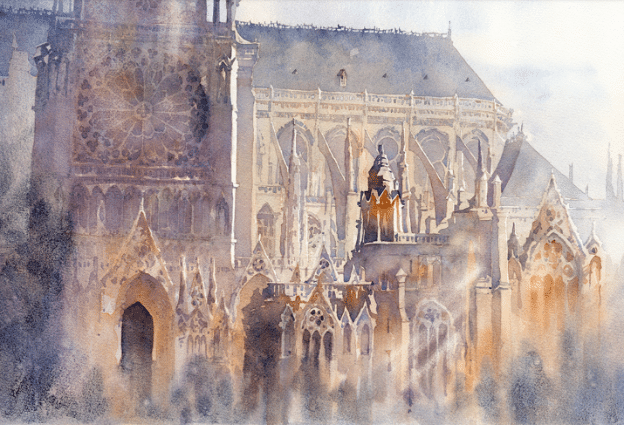
Iain Stewart, Grand Corniche Maison, watercolor, 11″ x 9″
Langer, in her (highly recommended) book, On Becoming an Artist (Random House, 2005), illustrates the mistaken ideas we tend to have about so-called talent. Say I decide to paint a flower, Langer says, but the result doesn’t look very much like a flower – what should I conclude? Most people will say, “see, I told you I don’t have any talent” and get out of it that way. But as Langer points out, that’s a totally wrong conclusion. “It’s not that I don’t have the talent,” she says, “it’s that I don’t yet know the subtleties of flowers.”
Think about that for a minute.
It’s not that I don’t have enough talent to paint a good flower (or tractor, for that matter). Rather, it’s that “I haven’t yet learned enough about flowers (or tractors) to capture them in a painting.” The truth is, if I’m willing to invest enough time and effort into learning about flowers or tractors, observing how they’re put together, how they’re shaped and proportioned to perform their respective jobs, etc. – then it comes down to learning the skills that the thousands of other artists who’ve painted flowers and tractors have learned already. Taking it step by step, I can actually look for the differences in my results vs. other paintings of flowers and tractors and learnas I go.
At this point, the question of whether I’m “talented at painting flowers” or anything else, is essentially beside the point. It’s the wrong question!
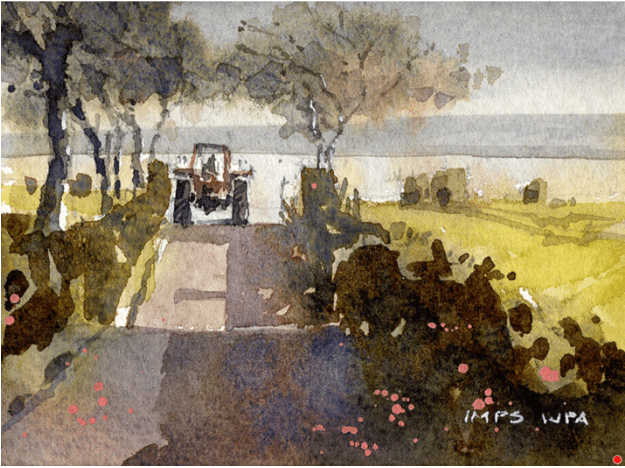
Iain Stewart, Fife Tractor, Scotland, watercolor
The key is knowing that there are steps to learning anything, Langer says, especially creative endeavors such as painting, playing an instrument, writing well, engineering an innovative design for a new bridge, arranging flowers, or writing code.
Don’t let the myth of talent – the mistaken idea that, “you either have it or you don’t” keep you from being creative. Take note n ot just of where you fall short but of how you’re progressingand improving. Artists aren’t people blissfully endowed with superhuman, God-given abilities to make near-perfect paintings from the get-go. Everybody works step by step.
Can’t draw a straight line, you say? When people tell me that, I say, neither can I! Luckily, that’snot a requirement for making art. And anyway, pretty much anyone can learn to draw.
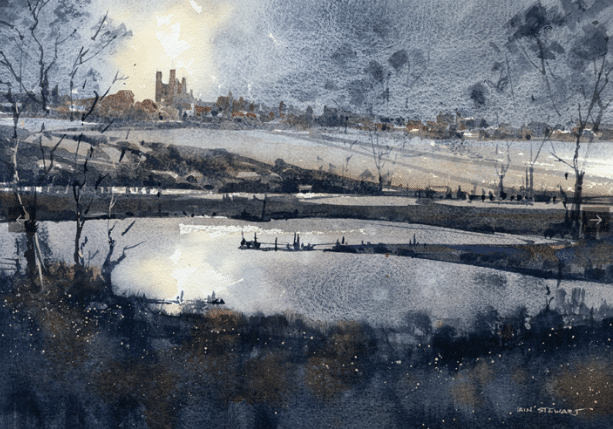
Iain Stewart, Southwold Imagined, watercolor, 10” x 14”
Instead of asking yourself, “Can I do it?” flip the question: “How do I do it”? Painting, like anything else (and probably more-so!), is an acquired skill, something that you must learn by doing.
What is talent” What even is art? How can people say, “I’m not creative enough, I can’t make art,” when we can’t even agree on what art is? Besides, isn’t what we really want to live creatively, to feel alive and to perhaps even enliven others? Some people complain, “Anything can be art!” To which I say, “and?”
Because “if we allowed ourselves to see the art in everything, it would be that much easier to see how we may all be artists,” Langer says. “And how much simpler it would be to live the artful life.”
The paintings in this edition of Inside Art were painted by Iain Stewart. His new video on handling watercolors with the fearlessness of the sketcher is called High Level Sketching. He’s also got a nice book on plein air for watercolors, which is available with the video in a specially priced combo.