At this time of year in North America, the sunsets seem to smolder, and the backlit trees resonate with a feeling of mystery, depth, and isolation.
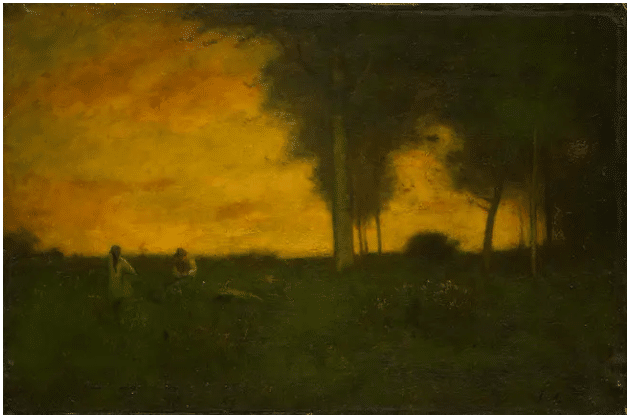
During the golden age of American landscape painting, no one painted trees, backlit or otherwise, quite like George Inness. Inness loved the dusk, bathed in gold and autumnal darks. His elegant, often darker trees have a unique gauzy character, as though emerging and dissolving between a visible and an invisible world.
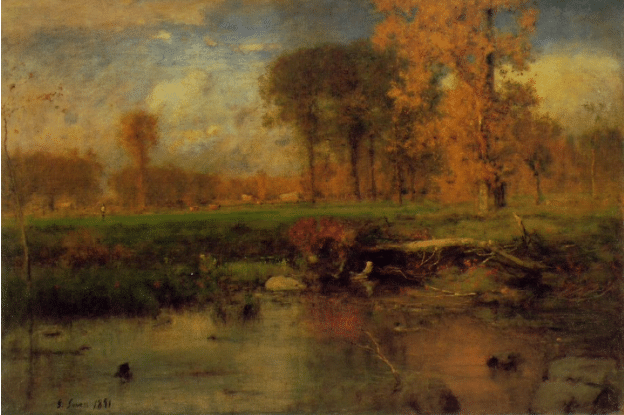
George Inness, Spirit of Autumn, 1891, 76.2 x 114.3 cm. Colby College, Maine.
Inness (1825-1894) was not a “Tonalist painter.” Rather, his spiritual approach to painting (a search for the eternal through the timebound) spawned a legion of followers whose works borrowed from the look of his canvases. Later, their work would be categorized as American Tonalism (which as a “movement” can be said to have lasted about 1880-1920). Following Inness’s innovative example, the Tonalists emphasized mood and immeasurable gradations of tone over realism. They used color not to describe but to evoke emotion and what they might have called, the feeling of truth. To convey their intentions, they chose suggestion over delineation. (In one of his writings, Inness explained that an “elaborateness in detail did not gain me meaning.”)
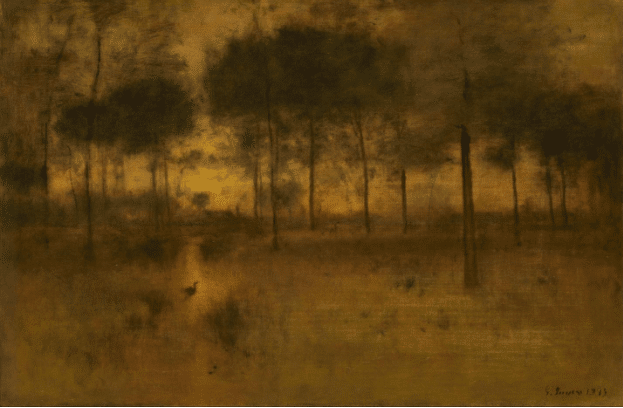
George Inness, “The Home of the Heron,” 1893, oil, height: 762 mm (30 in); width: 1,152 mm (45.35 in)
By the time he had reached his final decade, when he painted The Home of the Heron (above) and the other canvases in this post, he was using landscape as a vehicle for expressing his spirituality, which is why these late paintings are revered as so mystical and poetic. He used his own form of “sacred geometry” to structure these works to further illustrate his belief that there is a supreme organizing force at work in nature.
Inness’ trees (an artist friend calls them “spirit trees”) seem like fountains, showering mystery over the half-lit foregrounds, figures or barns beneath them. The way he painted them, they seem to waver between material reality and a porous, immaterial world open to spiritual and artistic vision.

Harvest Moon, 1891
The American Elm appears quite frequently in Inness’s landscapes. This tree was used everywhere then for shade trees, from pastures to cities and towns all over America. When planted on either side of a street, their crowns grew together, forming a tunnel-like canopy resembling the aisles of a Gothic cathedral. Sadly. they were wiped out en masse in the 1950s by Dutch Elm Disease.
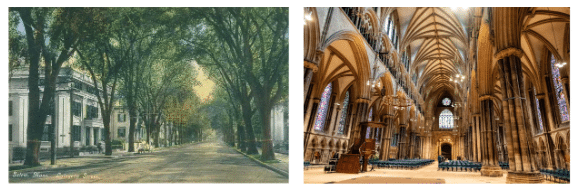
American Gothic: Once a hallmark of Main Street, USA, American Elm trees (left) resembled the aisles of a gothic cathedral (right).
Not coincidentally perhaps, the image of the fountain was basic to the mystical philosophy of Inness’s spiritual mentor, Swedish philosopher Emmanuel Swedenborg, who taught the interconnectedness of the spiritual and the physical.
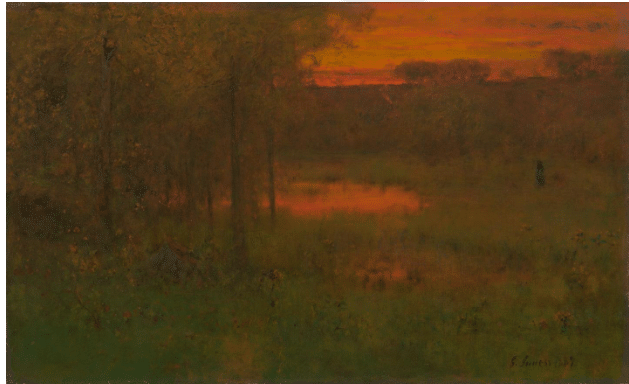
Landscape, sunset 1887-89.
Swedenborg believed that all life participates in a “fountain” of light and energy, and that this fountain is well known in Heaven. “All lives are like streams,” he wrote, springing “from one only and perpetual fountain of life.”
Swedenborg emphasized that we are more than our physical bodies. He taught that just as our physical bodies are only a temporary outer covering for our real selves, the same is true for the physical world and everything in it.
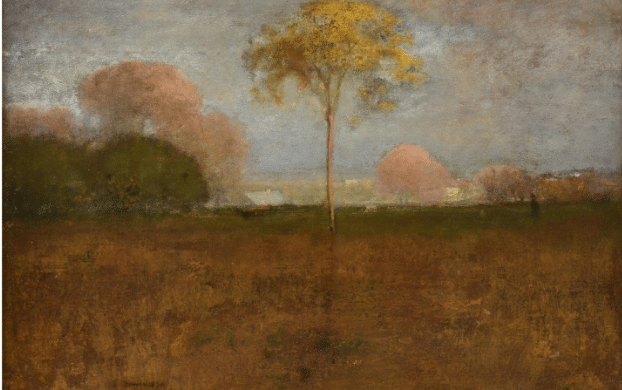
George Inness, Young Elm, Montclair, c. 1888.
While not a major canvas, Innes’s picture (above) of an isolated elm tree allows us to zoom in for a good look at Inness’s technique. Below is a close-up of the tree’s canopy. You can see that Inness made the bunches of foliage (not individual leaves!) by dabbing on bits of foliage color using a large or medium brush, held lightly and twisted this way and that to randomize the marks, with the brush tip barely touching the canvas. He did this twice – first he put in a medium tone and then he went over top of that with a lighter, highlight tone for the outer, sunlit foliage.
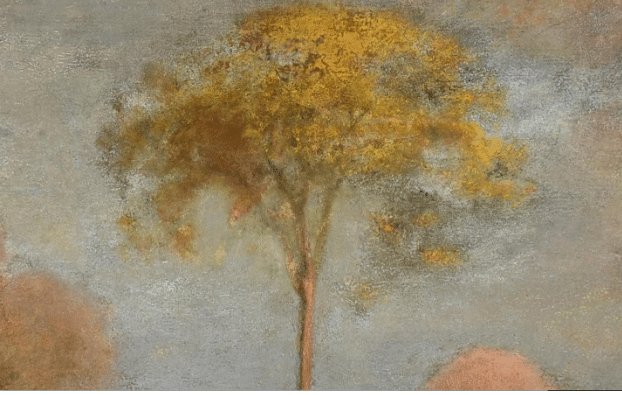
You can also tell that he went back in with sky color and painted out some of the “leaves,” creating sky holes via negative space. This is evident by examining the edges of some of the foliage clusters and by noting where he left blends of sky and tree (notably at the top of the trunk, where the branches split). You can also see that he went back in with sky bits because he didn’t always bother to get the value just right in the sky holes, some of which are brighter (higher in value) than the part of the sky around the rest of the branches (where the opposite would be true if the intention was to replicate reality).
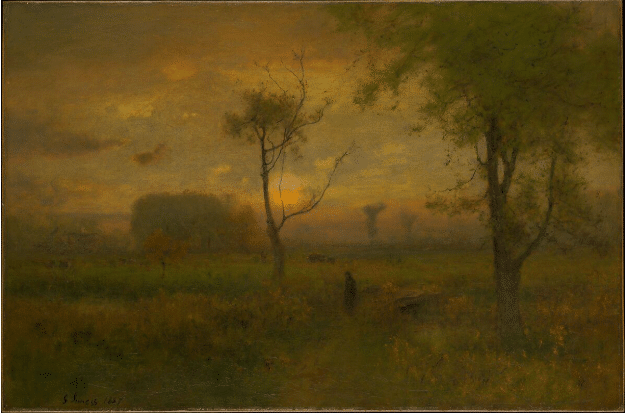
George Inness, Sunrise, 1887, 30 x 45 1/4 in. (76.2 x 114.9 cm)
Studying Inness can help you learn how to infuse a painting with meaning beyond the mere representation of a place and time. We’ve featured Inness and his philosophy of painting before, so if you’re go here. As we noted then:
By using semi-abstract, indistinct forms over conventions of realism, Inness metaphorically destabilizes the physical world (which he, like Plato, believed to be merely an artificial projection of eternal truth). In Inness’s late work, matter and the immaterial oscillate; the image flickers between the earthly and the spiritual. In Sunrise, 1887 (above), Inness has given us the dawn not just of a new day but of a new world, and to our surprise, it’s the one we already know.
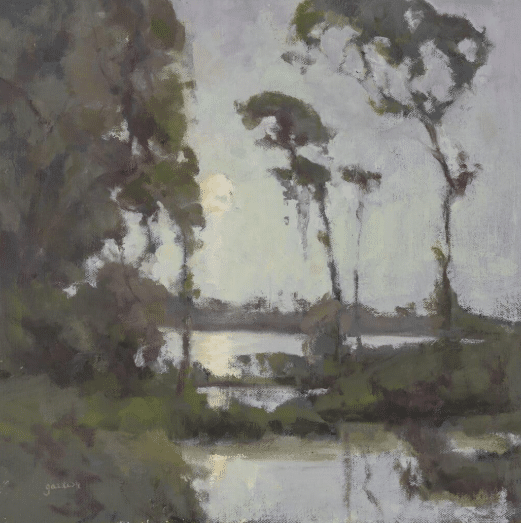
Mary Garrish, “Quiet,” oil on linen, 16×16 inches
If you are interested in the Tonalist style of painting that Inness’s work gave birth to, check out Mary Garrish’s Tonalism. This video contains everything you need to know about Tonalism and how to paint in that style. Tonalism has tons of benefits for any artist because it can help you improve your understanding of values and colors, two key elements in any successful painting. You’ll also discover how Tonalism can enhance emotions in your paintings, and how you can do it too using simple techniques that Mary will share in this video.