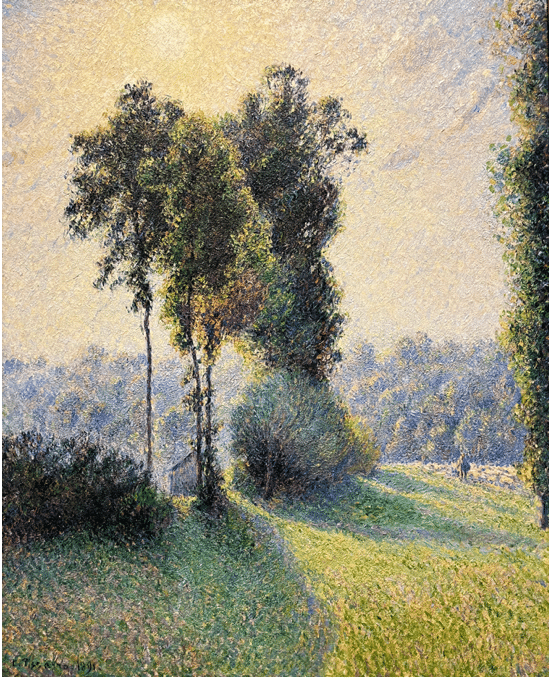
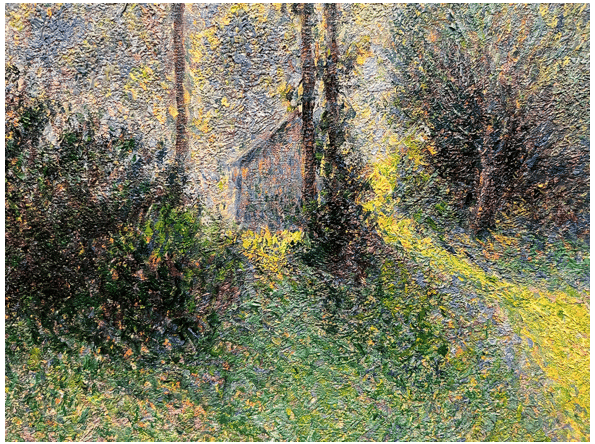
When Camile Pissarro painting this landscape of the Normandy countryside about 40 miles north of Paris, he was briefly yet deeply under the spell of pointillism.
Pissarro is most often associated with the fluid Impressionism of Monet and Degas. Pointillism, also called divisionism, developed from Impressionism in the 1880s. The Divisionists used a technique of placing small, distinct dots of color next to one another on the canvas, rather than mixing the colors either on the palette or on the canvas itself. Pissarro adopted pointillism in 1886 after meeting Georges Seurat and Paul Signac at Impressionist events. He was impressed by their scientific approach to color and light.
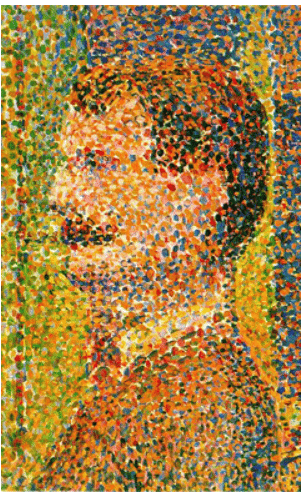
Self-portrait of Georges Seurat, inventor of pointillism.
A fascinating study in technique, “Landscape at Saint-Charles”(above) takes his own synthesis of Impressionist/Pointillist techniques to an extreme. The premise was not to paint the things in the landscape but to paint the light as it falls upon and reveals them.
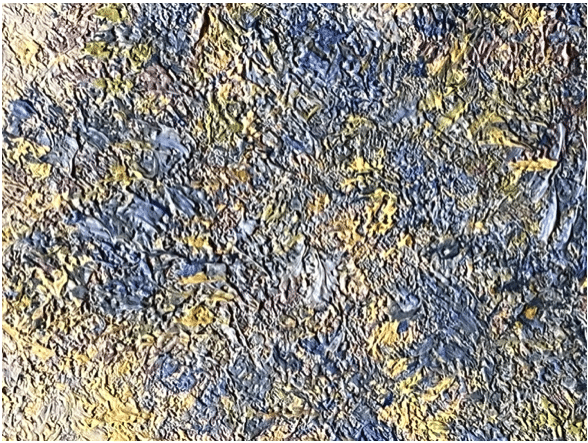
Detail of the paint that makes up the atmospheric middle-ground.
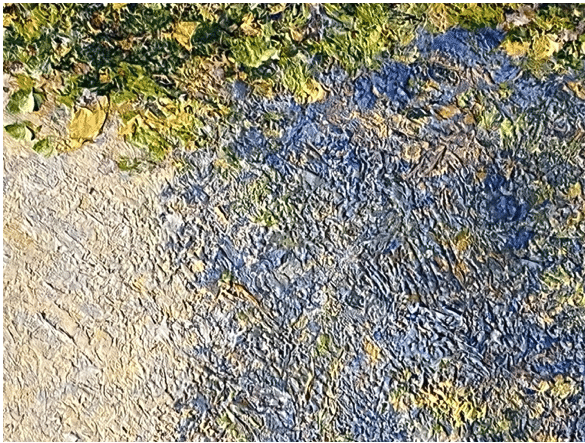
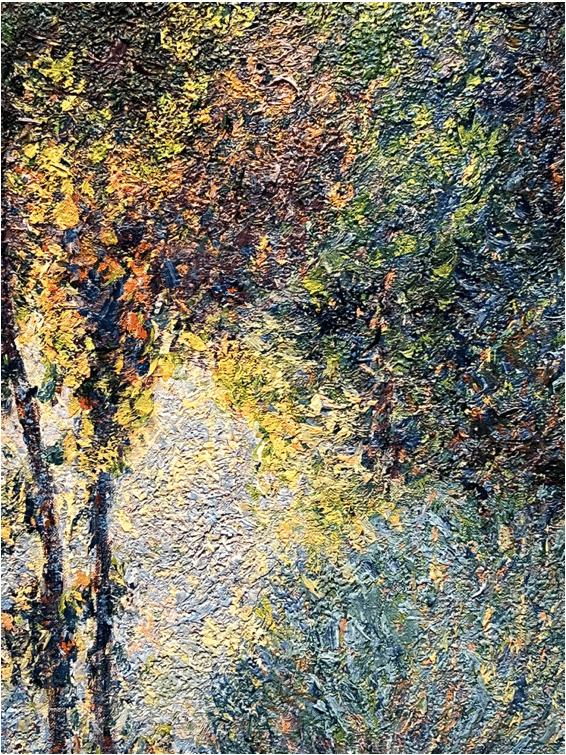
Detail of foliage in Pissarro’s “Landscape at Saint-Charles, near Gisors, Sunset” He didn’t paint the leaves – he painted the light bouncing off them.

What is Broken Color?
Seizing upon the new science of optics, these artists believed their colors would look more vibrant and true to experience if they allowed them to mix “optically,” in the viewer’s eye, rather than chromatically on the palette.
Championed by younger artists such as Seurat, the technique involved applying small touches of two different colors side by side, which were intended to produce a third, more luminous color for the viewer. (Their deconstruction and manipulation of color and the picture plane led steadily to abstraction.)
Pissarro’s version of the technique used slightly broader brushstrokes to suggest the glowing late-day light in the countryside. The result is a shimmering, kaleidoscopic breakdown of form and space into thousands of discrete spots of color coming together, like pixels, to create the image – or, rather, to render the light in a way new to painting.
Pissarro’s sky flows with gorgeous passages of peach, lavender, apricot and rose pigments applied to the canvas in “put it on and leave it on” taps using a small stiff brush.
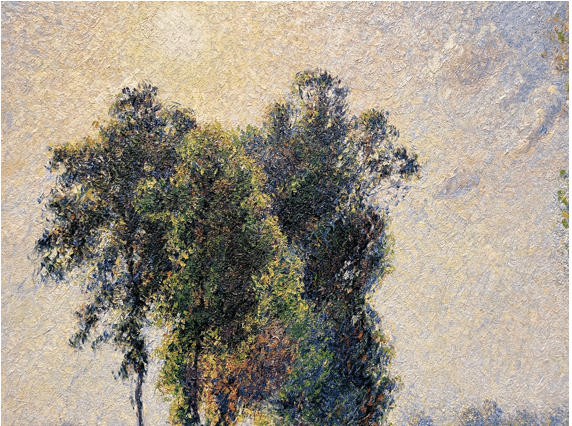
But even a painter as radical as Pissarro wasn’t interested in technique for its own sake. His choice of optical color-mixing enhances this painting’s true subject – the intangible and beautiful spectacle of late afternoon light spilling over trees and warming the grass as the sun begins to go down. The lone figure he includes allows us to picture ourselves inside the atmosphere created here, and to experience the painting as a comment on how visually beautiful the world can appear to a simple yet sensitive soul.

Detail of sunset light and shadows and the figure in Pissarro’s “Landscape at Saint-Charles, near Gisors, Sunset”
As in a later painting by Van Gogh, the technique can sometimes result in a surface seemingly seething and alive with paint in motion conveying a heightened perception of the everyday world. In the words of James Douglas Morrison, “Everything is broken up and dances.”
Pissarro’s experiments with Pointillism lasted less than four years, after which he returned to Impressionism’s looser, brushier style to express his feelings for life. He wrote about the genesis of this discovery to his niece Esther Isaacson: “I began to understand my sensations and to know what it was that I wanted to do when I was about 40 years old [in the 1870s]—but vaguely.”
By the end of his life, Pissarro’s art was making money and winning critical recognition. Critics and scholars today acknowledge his place as a key figure in Impressionism, but Pissarro really bridged the 19th and 20th centuries, both in his art and life.
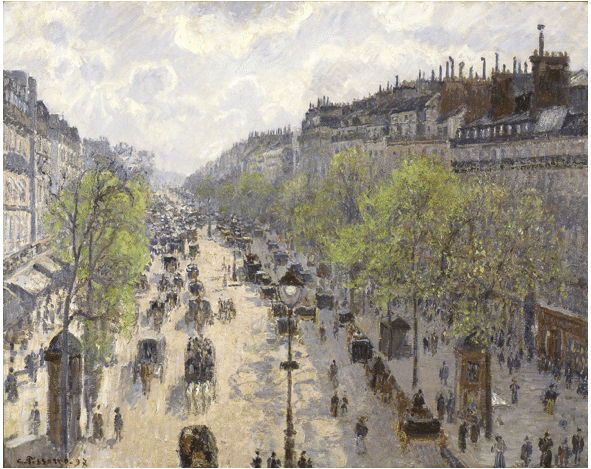
Camille Pissarro, “The Boulevard Montmartre on a Winter Morning,” oil on canvas (1897) in the Metropolitan Museum of Art, New York City. 64.8 × 81.3 cm.
Despite a humble nature, Pissarro’s legacy—his unrelenting interest in change, his influence, alongside Seurat and the pointillists, on very influential artists such as Cézanne, Gauguin and Van Gogh, and a steadfast opposition to the artistic establishment – all powerfully shaped the development of the early 20th-century avant-garde.
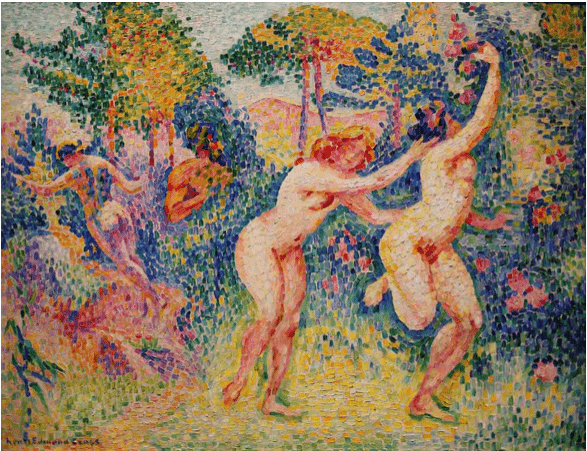
Henri-Edmond Cross, “La Fuite des Nymphes” (1906). Musée d’Orsay, Paris.
Pointillist Henri-Edmond’s work dovetailed with the modernism of Matisse…

Henri Matisse, “The Joy of Life,” (1905) oil on canvas, 6 feet x 8 feet.
….and which led directly to Picasso’s invention of geometric abstraction one later year in 1907.
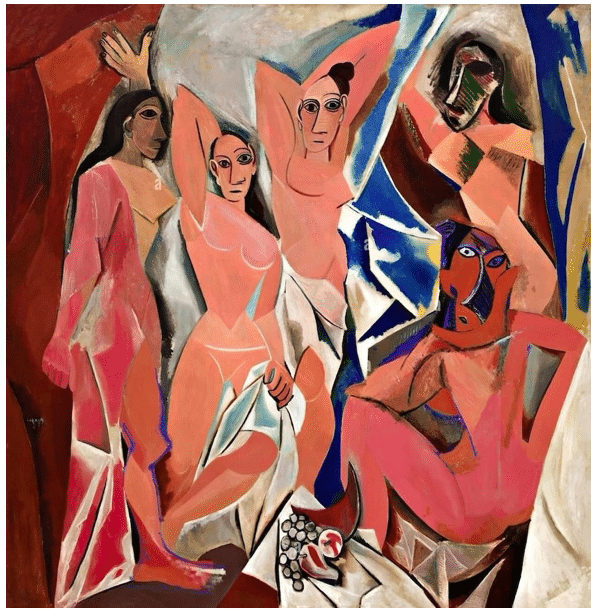
Pablo Picasso, Les Demoiselles d’Avignon, 1907
Prefer Impressionism to the big color, wildness, and abstraction that came after? There are ways to combine both! One such artist who does just that is Cynthia Rosen.
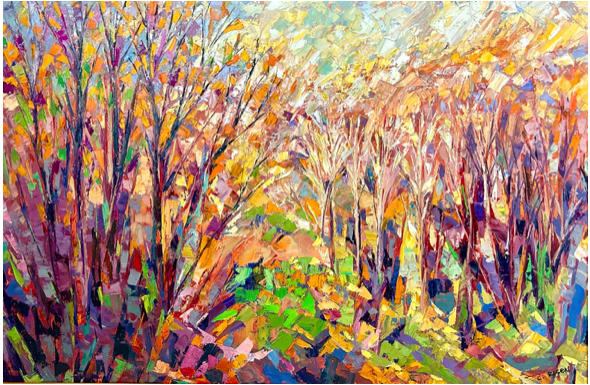
Exuberant color and life! A palette-knife landscape by Cynthia Rosen.
“My artistic voice has found its place painting both outside (en plein air) and in the studio with limitless color, reflecting the ever changing light and sounds of the spinning world around me,” she says. “This engages and challenges both perceptions and expression. The use of the palette knife affords pushing heightened broken colors with which to capture but the essence of the subject without providing defined parameters.”
Cynthia teaches her palette-knife blend of Post-Impressionism and Contemporary Practice in two videos available here.