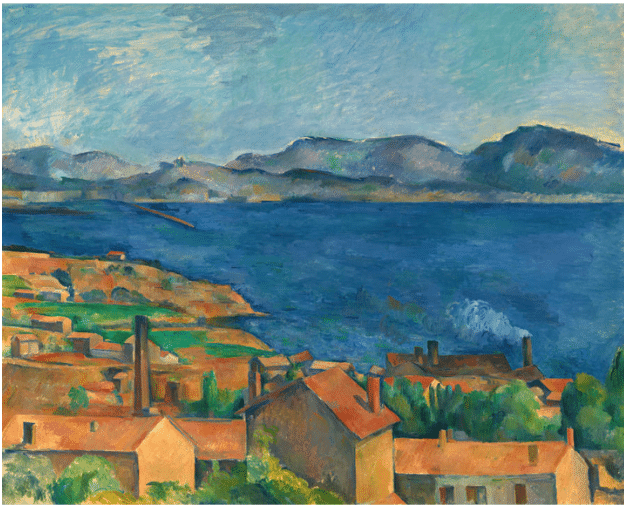
On trip to the warmer Mediterranean coast, French painter Paul Cézanne fell in love with the little fishing village of L’Estaque on the bay of the city of Marseilles. It was the color, made brilliant by the light. “”It is like a playing card. Red roofs over the blue sea,” he wrote to his friend and fellow artist Camille Pissarro in 1876. “The sun is so terrific here that it seems to me as if the objects were silhouetted not only in black and white, but in blue, red, brown, and violet.”
Cézanne painted some 20 views of this bay and the village of L’Estaque over the next decade, a dozen of them facing toward or across the bay. In the version from 1883 above, atop the distant hill just left of center, to the right of the narrow jetty, the towers of Notre-Dame de la Garde stand watch over Marseille.
Cezanne throughout this series replaces fine-grained realistic details with relationships between colors, bold geometric shapes, and visible brushwork. In the 1883 “View” below, we have what nearly amounts to an abstract landscape. Such paintings of Cezanne feel in person as though they are vibrating so intensely with life and energy that they almost seem to fly apart and rearrange themselves again before our eyes.
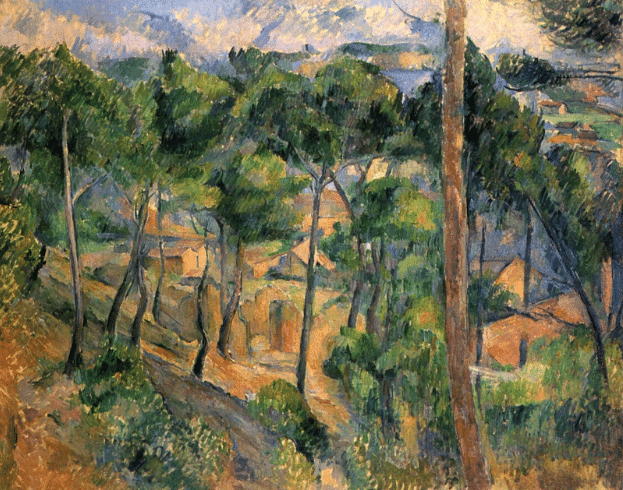
Paul Cezanne, L’Estaque View Through the Pines (1883)
Cezanne experimented with a wide range of painterly options, from the intense and near-abstract landscape such as the above to quieter versions of the location, such as the one from 1885 below.
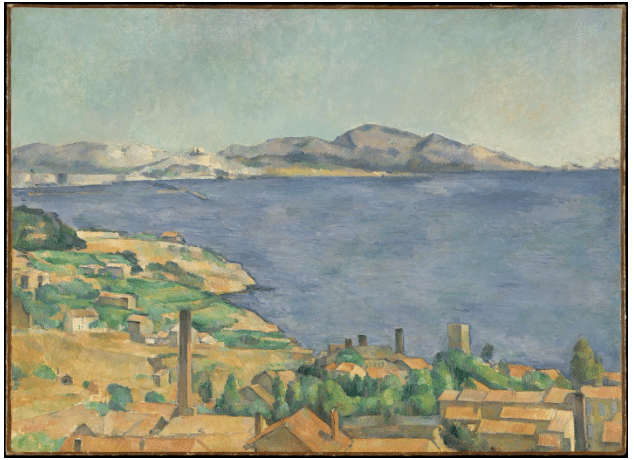
Paul Cezanne, “The Gulf of Marseille Seen from L’Estaque,” oil, 1885
In this version, as in the version at the top of the page, the two shores narrow on the left side but only meet somewhere we don’t see, outside of the frame. This detail had special significance for the poet Allen Ginsberg, who wrote about what does and does not appear in this painting.
In true poetry fashion, in his poem titled “Cezanne’s Ports,” American poet Allen Ginsberg focuses on the transcendent reality that “doesn’t occur on the canvas.” The poem’s speaker freely allows his own poetic train of thought to emerge from his experience of the image, “For the other side of the bay,” he writes, “is Heaven and Eternity.”
On any big shoreline, one can stand where the human ends and the transcendent – eternity – begins. Ginsberg’s inspired reaction to Cezanne has something of this feeling. The resulting poem, “Cezanne’s Ports,” creates something new from groundbreaking work in two different mediums.
CÉZANNE’S PORTS
By Allen Ginsberg
In the foreground we see time and life
swept in a race
toward the left hand side of the picture
where shore meets shore.
But that meeting place
isn’t represented;
it doesn’t occur on the canvas.
For the other side of the bay
is Heaven and Eternity,
with a bleak white haze over its mountains.
And the immense water of L’Estaque is a go-between
for minute rowboats.
On the scale of “heaven and eternity,” our lives are like “minute” boats on their way to the other side. Ginsburg leaves us neither here nor there but between time (represented by the city) and eternity (the white and hazy opposite shore). The water of L’Estaque, in the poem, forms a “go-between,” where for better or worse, we get each get the chance to sail our “minute rowboats” and pass the time doing such things such as writing poems and making paintings – small gestures that say, “I too can create! – I live! – I am!”
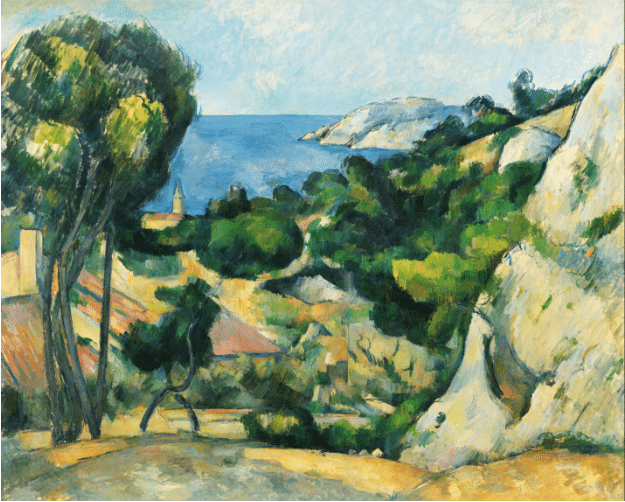
Paul Cezanne, “L’Estaque,” oil, 1879-83
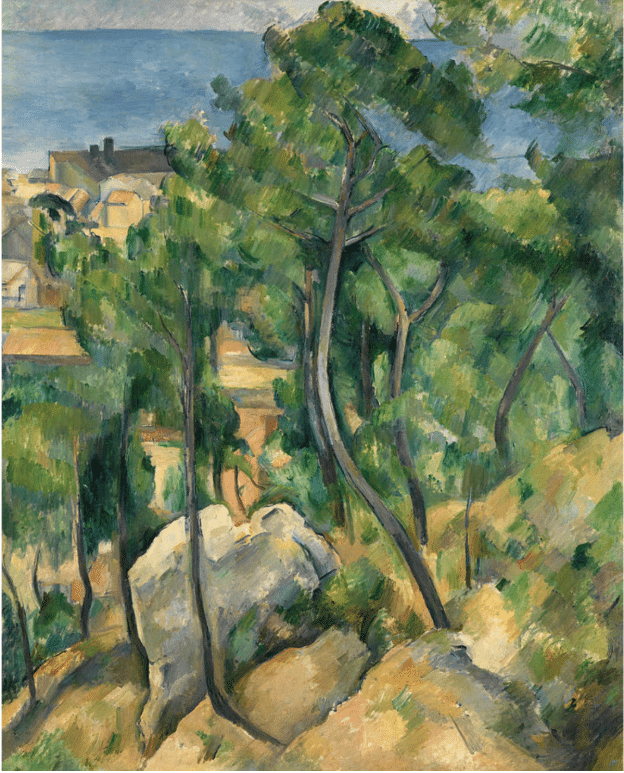
Paul Cezanne, “View of the Sea at L’Estaque,” oil, c. 1883
Cezanne originated the abstract landscape as a stylistic choice. However, his paintings are still beloved not because of how he made them but because of what he got into them: as Ginsberg’s poem attests, it’s the sense of humanity, energy, and nature in time that keeps us coming back. It was his free use of color, geometric form, abstract composition, and paint handling that enabled him to perform such magic.
Should you wish to explore the techniques of abstract landscape painting, you could do much worse than to invest in a professional teaching video. Check out the available videos by Charlie Hunter, Douglas Freyer, Sydney Rosen, and Cheng-Khee Chee over here and Robert Burridge’s video on Paining Abstract Landscapes & Trees.