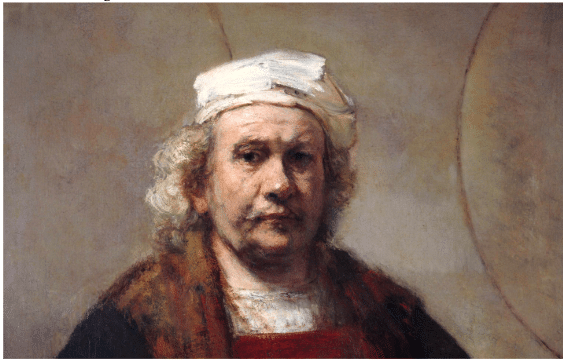
Who, with any feeling for the depths of humanity, can resist that bottomless gaze peering across the centuries from the self-portraits Rembrandt painted in old age?
Great works of art, according to Susan Sontag, provide “an experience of the qualities or forms of human consciousness” of vital import to ourselves. So the late portraits of Rembrandt van Rijn (1605-1669) hold portrait painters everywhere to a very high standard.

“Self-Portrait at the Easel,” Rembrandt van Rijn, 1660, Louvre, Paris
“The deep humanity conveyed by the Rembrandt self-portrait,” writes Richard Etlin in his 1996 book In Defense of Humanism: Value in the Arts and Letters (referring to “Self-Portrait with Easel, 1660,” above), “where everything about the depiction of the face and body, the atmospheric effects of the coloring and shading, the uncanny look suggesting wisdom about life and mortality, that pensive reflection which speaks through the eyes, the suggestion about the poignancy of the painter’s task through the parallel created by the dead matter of paint – shown as mere paint – on the palette used to portray a timeless image of a man or woman with time-bounded life, all of these thoughts and sentiments combine to move us with the sort of deep spiritual insight” that only great art can offer.
That’s the poetry of painting and what sets it apart from decoration, Etlin says – its concern with “the deepest interests of mankind and the most comprehensive truths of the spirit.”
Look closely at the eyes! They’re different: in “Self-Portrait at the Easel,” as in many of the late self-portraits, one eye, here the one on the right, is blurred, in shadow, drooping as if weary or sad though still alert – the other, the left, is wide open, focused, piercing and direct. The round nub of the painter’s mahl stick (a tool for steadying the hand) calls the eye next and makes a triad with the eyes; our gaze connects the dots between the face, the painter’s tools, and finally the palette and canvas-back, emphasizing that this is as much a painting about the art of painting as it is a portrait of the artist.
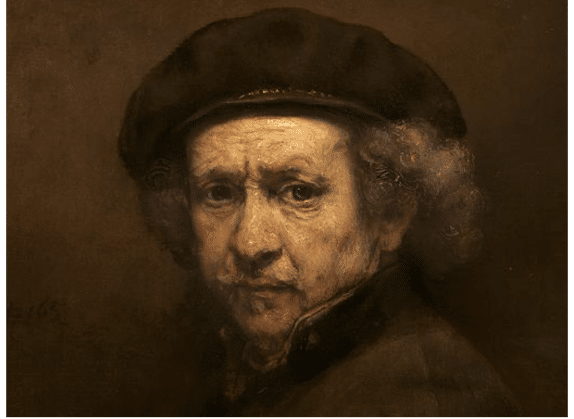
Although they seem so familiar to us, these were experimental at the time. The artist was pushing paint, color, light and shadow into new and unfamiliar realms in search of something very like Truth. No other made as many self-portraits, and certainly not with anything like the honesty and philosophical resolve as Rembrandt did, right up until the end of his life.
Rembrandt’s Late Self-Portraits
You are confronted with yourself. Each year
The pouches fill, the skin is uglier.
You give it all unflinchingly. You stare
Into yourself, beyond. Your brush’s care
Runs with self-knowledge. Here
Is a humility at one with craft.
There is no arrogance. Pride is apart
From this self-scrutiny. You make light drift
The way you want. Your face is bruised and hurt
But there is still love left.
Love of the art and others. To the last
Experiment went on. You stared beyond
Your age, the times. You also plucked the past
And tempered it. Self-portraits understand,
And old age can divest,
With truthful changes, us of fear of death.
Look, a new anguish. There, the bloated nose,
The sadness and the joy. To paint’s to breathe,
And all the darknesses are dared. You chose
What each must reckon with.
- Elizabeth Jennings (1975)

Rembrandt, Artist in His Studio, oil on panel, 1628, 9 ¾ x 12 ½ in. MFA Boston.
If you are interested in learning the time-honored old master techniques to create your own original portraits or self-portraits, check out one of these videos on old master portrait painting and drawing.
Contemporary artist Eric Johnson unfolds the technique in his video, Rembrandt Secrets Revealed, on sale here.