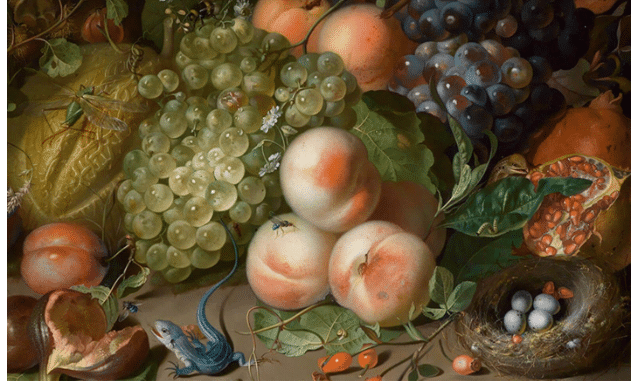
Rachel Ruysch (1664–1750) stormed the art world of 17th century Amsterdam with talent and passion that would not be suppressed. She was the oldest of seven children, and during her long professional painting career (60 years! – She lived until the age of 85) she made a fortune creating immortal still life paintings and still married (keeping her own name) and gave birth to 10 children of her own.
“Rachel Ruysch: Artist, Naturalist, and Pioneer” is the first comprehensive solo exhibition dedicated to the artist. Currently at Boston’s Museum of Fine Arts, it brings together 35 of her finest paintings from museums and private lenders across the United States and Europe alongside plant and insect specimens as well as work by other female artists, including her younger sister Anna Ruysch, Maria Sibylla Merian, and Alida Withoos. Seeing side by side these artists’ works and the specimens they would have used as references, offers insight into the central role women played in the production and dissemination of scientific knowledge in Europe during the 17th and 18th centuries.
“In the still life paintings of Dutch artist Rachel Ruysch, floral bouquets appear alive and rich with movement: petals and stems droop and rise and colorful lizards crawl across stone ledges set against dark backgrounds,” says the MFA.
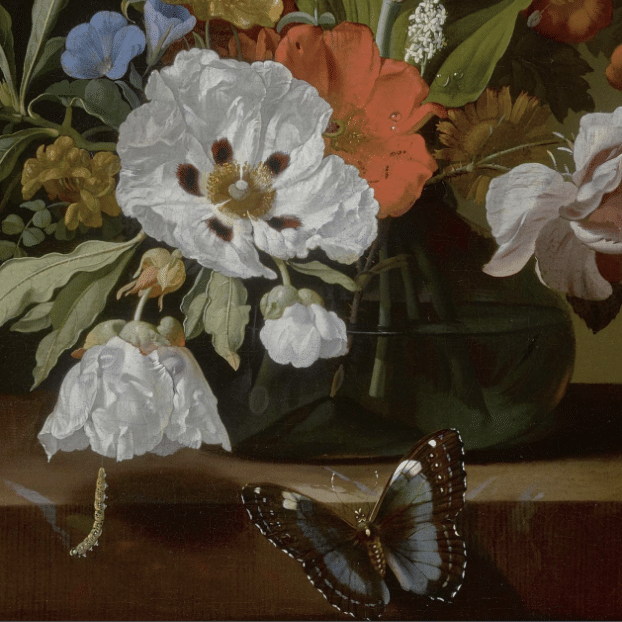
Detail, Rachel Ruysch, Still Life with Flower in a Vase on a Ledge, 1698
“These astonishing displays, rendered with a skill that eclipsed many of her male contemporaries, earned Ruysch fame across Europe in her lifetime—an era when few women attained artistic prominence.” At the time, her paintings, constantly in demand, fetched eye-watering sums.
Ruysch had access to Amsterdam’s botanical gardens and their specimens through her botanist father and her paintings reflect – and sometimes play with – contemporary developments in botanical research.
However, these works are neither solely documentary botanical illustrations nor “just” beautiful paintings of beautiful things. Ruysch’s floral arrangements, as is the rule with Dutch painting, contain far more meaning than a 21st century viewer, unfamiliar with the role of symbolism in 17th century European art, might immediately suppose. They’re complex riddles that tell us about the society she lived in and the role of art in the history of the world.
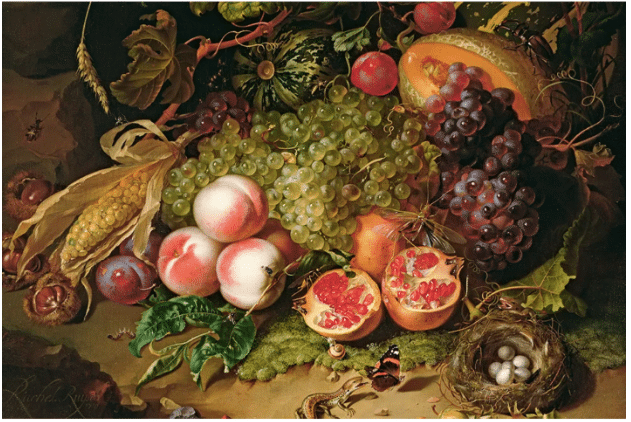
Rachel Ruysch, “Still Life with Vegetables and Fruit,” c. 1700
Traditional “Golden Age” Dutch still life paintings generally constitute visual sermons on the vanity of wealth and the transience of life. The genre known as “vanitas” paintings often hinted at a message along the lines of look to your soul because “memento mori” (remember we all die). It’s conveyed in overabundance and symbols of greed and excess, overripe or decaying fruit, damaging insects such as worms, snails and flies, and predatory spectacles (such as the lizard about to make a meal of the painted lady butterfly in the foreground of the painting above).
Furthermore, as the MFA’s exhibition notes, Ruysch’s flowers aren’t here just because they’re novel or pretty. During the 17th and 18th centuries the Dutch ruled a wealthy trade empire, and artists traveled abroad with colonial expeditions, documenting thousands of “discoveries” of “exotic” flora and fauna. Ruysch was one of the first to “feature these exotic imports in still-life paintings.” As such, notes the museum, “each specimen is rooted in histories of colonialism, power, and environmental disruption.”
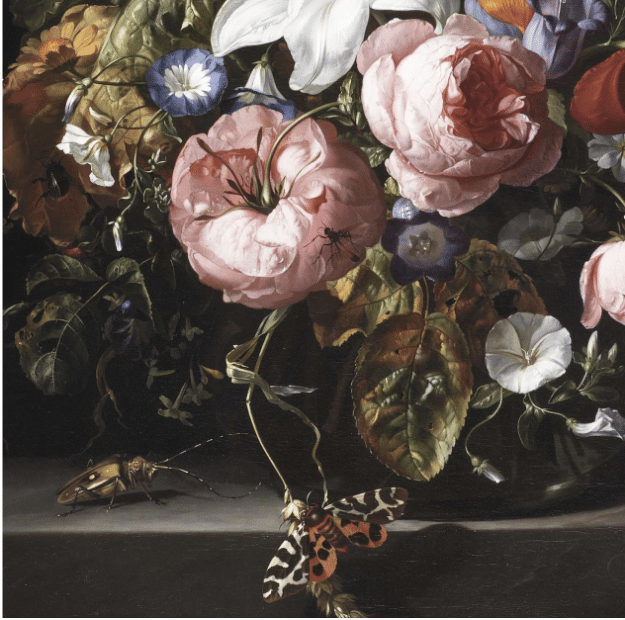
(Detail) Rachel Ruysch, “Flowers in a Glass Vase, 1704
As global trade routes expanded in the 17th century, thousands of new plant specimens arrived in the Netherlands for cultivation in greenhouses and botanical gardens. Ruysch was among the first artists to introduce new species, from passionflowers to cacti, into her flower still lifes.
“Among her sumptuous bouquets, viewers will find toxic devil’s trumpets, pungent carrion flowers, and prickly cacti,” not to mention the beetles, moths, venomous wasps, and signs of decay among the leaves, fruit, and flowers. “Was Ruysch marveling at the wonders of a rapidly changing world,” asks the curators, “celebrating Dutch global reach, or hinting at the vanity of colonial ambition?”
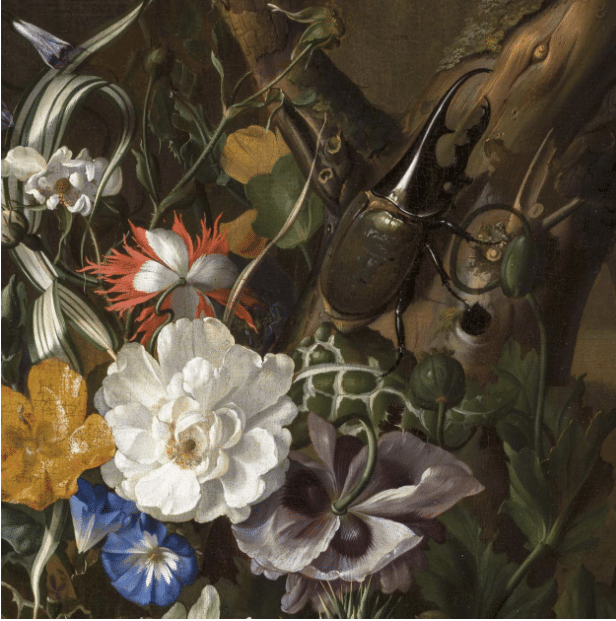
(Detail) Rachel Ruysch, “Forest Recess with Flowers, 1686
“Merging art and science, these paintings,” says the museum, “speak of survival and loss, the delicate balance between beauty and violence, and the deeper narratives of colonial expansion unfolding beneath the surface. Visitors are invited to celebrate the beauty of Ruysch’s work while discovering the hidden stories woven within.”
There’s still time to catch the show should you find yourself in Boston in the next few weeks. The exhibition is organized by the Museum of Fine Arts, Boston, the Alte Pinakothek, Munich, and the Toledo Museum of Art. Scientific content was developed in collaboration with Charles Davis, professor of Organismic and Evolutionary Biology, Harvard University. It will close December 7, 2025
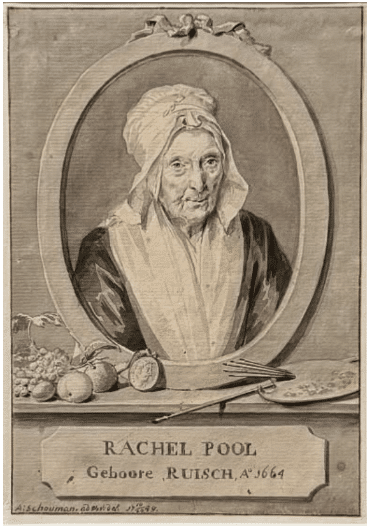
A portrait of Ruysch at the age of 85, depicted with “a blend of honesty and admiration, capturing the lines of her aged face and the intelligence in her eyes.”
BONUS SQUIREL!
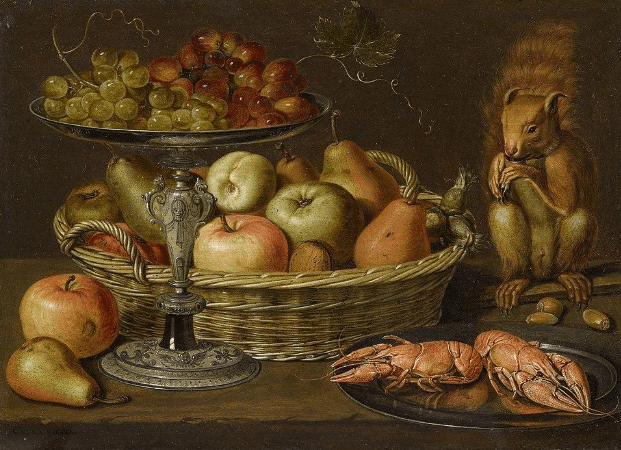
Clara Peeters, ‘Still Life with Fruits, Langoustines, and a Squirrel’ (detail), c.1612-1615 height: 34.1 cm (13.4 in) ; width: 46.8 cm (18.4 in)
Squirrels made an appearance in Dutch still life painting with the work of Frans Snyder, who spawned a whole subgenre that several well-known painters of the time took up. Among those jumping on the Squirrel bandwagon was a contemporary of Rachel Ryuesch, the equally famous and respected “vanitas” still life painter, Clara Peeters. The squirrel in the above painting is way cuter up close. As you can see in the detail below, he appears pretty content with life just licking the inside of an acorn.
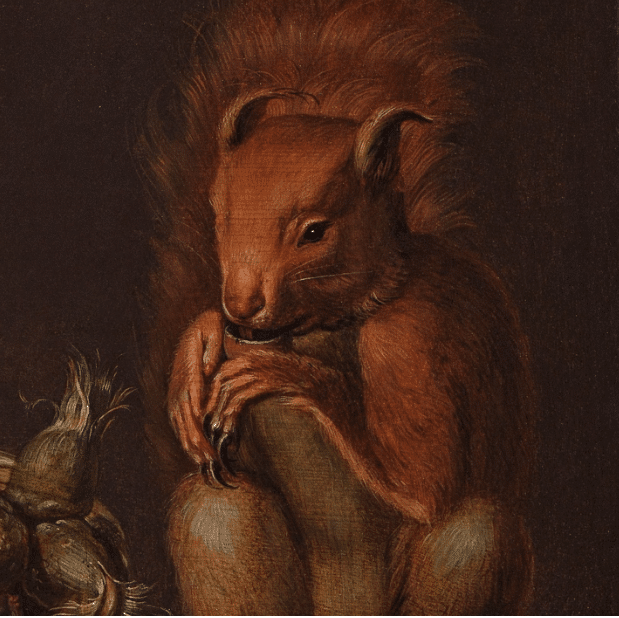
Clara Peeters, ‘Still Life with Fruits, Langoustines, and a Squirrel’ (detail), c.1612-1615 height: 34.1 cm (13.4 in) ; width: 46.8 cm (18.4 in)
If you’re interested in learning to create your own representational still life paintings, you might want to check out on of a several high-quality professional teaching video, available here.