Icon of 19th century American painting Thomas Cole often found himself disillusioned with the very public he’d helped create for his work. Though he touched off the historically important Hudson River School style, by the time Thomas Cole, “the father of American landscape painting” was nearing 40, he confessed to his journal his frustration with an art buying public that favored the common “leaf painter” without supporting more ambitious artists like himself, with “loftier conceptions than any mere combination of inanimate and uninformed Nature.” A devotee of Romantic art and literature, Cole wanted his paintings to mean something.
In the spring of 1838, Cole was struggling with a commission to paint a ruined tower as described in a poem by Byron. The subject was perfect; Cole was fascinated with the passing of time and cycles of life. His several paintings of the ruined tower motif allude to the poetic push and pull between nature and history. But he couldn’t help thinking they fell short of the poetry’s magic
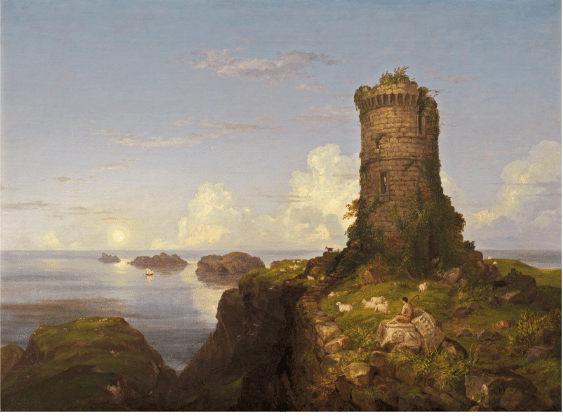
So finally he gave up and painted the thing in his own way, producing a lovely and now beloved painting, for which he left an interesting record of his thought process in his journals. But even though he felt he’d captured “The mellow subdued tone of Evening Twilight—the silvery lustre of the rising moon, the glassy ocean which mirrors all upon its bosom—the Ivy-mantled Ruin..” he felt he’d never sell it.
“But this picture will probably remain on my hands,” Cole thought – “it is not the kind of work to sell—it would appear empty and vague to the multitude — those who purchase pictures, alas! are like those who purchase merchandise – they want quantity, material. They want something to show, something palpable—things, not thoughts.”
But how wrong he was! Although the large (36 x 48 in.) painting was unknown to modern scholarship on Cole until its acquisition by the National Gallery in 1993, it’s now got pride of place, and hundreds of people admire it daily.
The following are excerpts from his journal with closeups of the painting:
“I am now engaged in painting a picture representing a solitary and ruined tower that stands on a craggy promontory whose base is laved by a calm, unruffled ocean….The spectator is supposed to be looking east just after sunset. The moon is just ascending from the ocean like a silver vapor, around her are towering clouds still lighted by the sun. The moon, the clouds, the islets are all reflected in the tranquil water.”
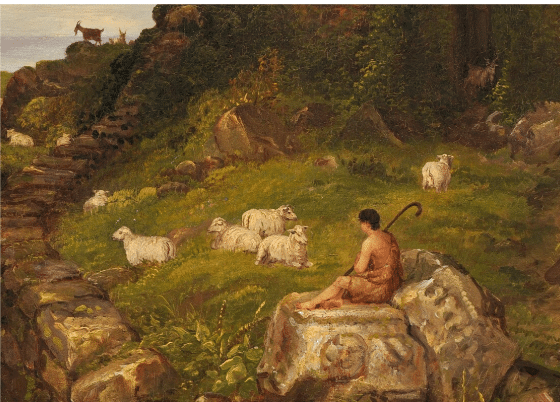
“On the summit of the cliff around the ruin and on the grassy steeps below are seen sheep and goats-and in the foreground seated on some fragments of the ruin is a lonely shepherd. He appears to be gazing intently on a distant vessel that lies becalmed on the deep.”
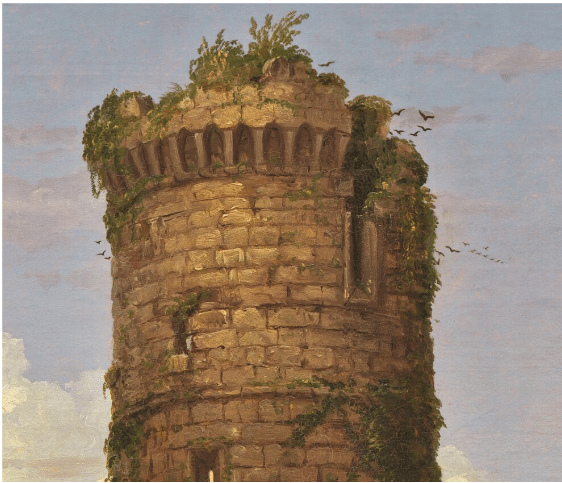
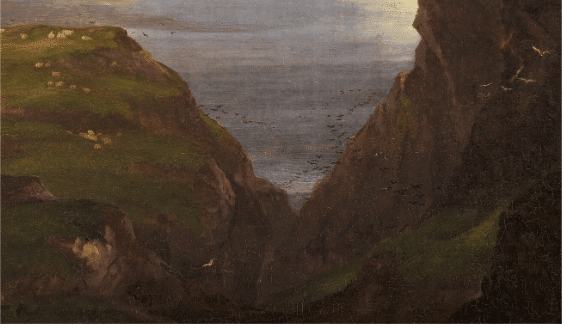
“Sea birds are flying round the tower and afar, till almost invisible through the distance, below his feet. This picture will not be painted in my most finished style; but I think it will be poetical; there is a stillness, a loneliness about it that may reach the imagination. “
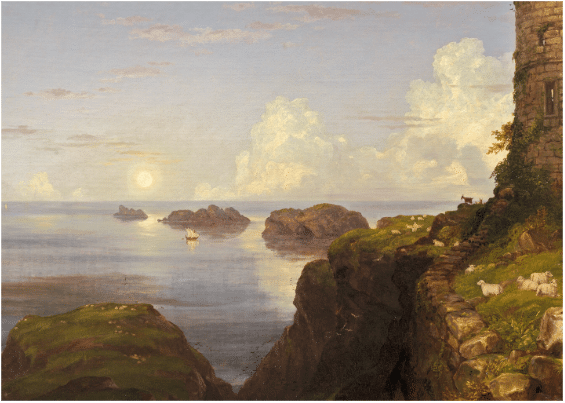
“The mellow subdued tone of evening twilight, the silvery luster of the rising moon, the glassy ocean which mirrors all upon its bosom, the ivy-mantled ruin, the distant bark, the solitary shepherd boy – who apparently in dreams of distant lands suggested by the lagging sail, has forgotten that night approaches and his flocks are yet straggling among the rocks and precipices round.”
“These objects combined must surely, if executed with ordinary skill, produce in a mind capable of feeling, a pleasing and poetical effect – a sentiment of tranquility and solitude. “
“But this picture will probably remain on my hands. It is not the kind of work to sell – it would appear empty and vague to the multitude. Those who purchase pictures, alas! Are like those who purchase merchandise – they want quantity, material. They want something to show, something palpable – things, not thoughts.”
Not insignificantly the shepherd figure’s pose, suggesting he is lost in thought, as he “dreams of distant lands” seems to embody the mood Cole wished to instill within the painting as a whole.
As one of Cole’s major statements on the theme of the mutability of man’s creations and the transience of life, Cole’s ruined tower motif may be seen as a pictorial version of ideas he also expressed in poetry:
Or is it that the fading light reminds
That we are mortal and the latter day
Steals onward swiftly, like unseen winds,
And all our years are clouds that pass quickly away.
Cole’s description and his resignation at the It shows how much the father of American landscape painting cared about content in his paintings, rather than just artful representation.
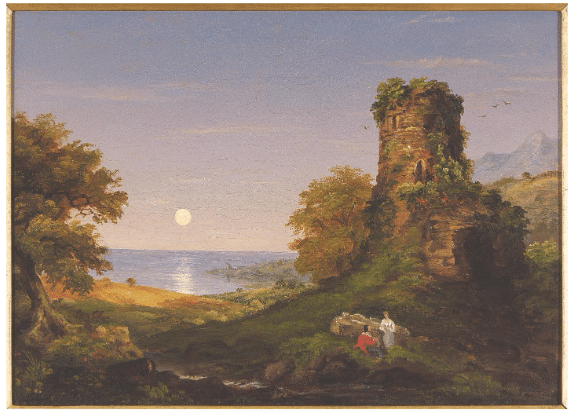
One of Cole’s attempts to capture the Byronic essence in his ruined tower commission, Tower by Moonlight, 1838, Oil on canvas, 16¾ × 20½ × 3 in
In the foreground of this elegiac scene, young lovers meet under the full moon. Behind them, an ancient tomb and the ruined tower, both long overtaken by natural elements. Here, the past is as much a part of the present moment as this couple, whose lives, we’re reminded, are also subject to the inevitable passing of time.
If you’re interested in reading Cole’s journal, you can do so online thanks to the Thomas Cole National Historic Site, which commissioned a transcription of it and has made it freely available here. You can also purchase a beautiful printed copy for not much money at the “shop” link on their website.