
A pioneering study commissioned by the Mauritshuis museum in the Netherlands used brain scanning and eye-tracking technology to test how our brains react when seeing a great painting in person versus in a photo.
The scientists, the first to use certain brain scanning machines to measure how we respond to artwork, found people had ten times more of an emotional response when looking at Vermeer’s famous 1665 painting “Girl with the Pearl Earring” than they did viewing a full-scale color poster of the work.
Measuring brainwaves also revealed that the part of the brain in charge of consciousness and personal identity was the most active during the experience.
Of special interest to artists, the study inadvertently confirmed a long-held truism of compositional technique – “keep the eye moving within the painting.” The scientists found Vermeer’s painting keeps the viewer’s attention as they look at different parts of it in a continuously circulating loop.

Eye-movement imaging captures just how important that famous pearl earring is to the composition of Vermeer’s masterpiece. IMAGE SOURCE, MAURITSHUIS
The researchers discovered that a person looking at the painting is affected by a special brain phenomenon they called “Sustained Attentional Loop.” In the case of the famous Vermeer, they discovered, the viewer’s eye is drawn first to the girl’s eye, then to her mouth, then across to the pearl, then back to the eye repeatedly.
Martin de Munnik, from the organization that did the study, said this makes you look at the painting for longer. “You have to pay attention whether you want to or not,” he joked.
The study backed up similar research from 2021 on the unique physiological and psychological chain reactions we experience when we appreciate art in person.
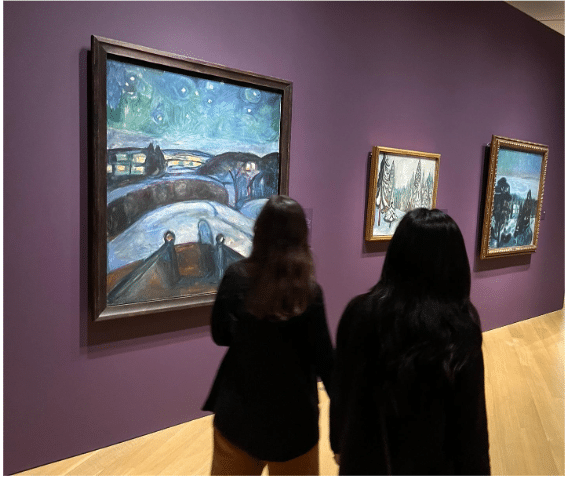
Museum-goers step into the presence of Edvard Munch’s landscapes at an exhibition at the Clark Institute of Art in Massachusetts.
Researchers have called this “embodied cognition” –our tendency, when we’re engaged with a piece of art or music or performance, to see ourselves in the work and to “follow along” with the artist. That is, seeing the actual piece allows us to apprehend the premise and execution of the work, as if we ourselves are creating it – swirling the yellow stars in Van Gogh’s night sky, dabbing tender bits of flower-color into Monet’s water lily blooms, or draping energetic arcs and loops of paint in complex layers like Jackson Pollock.
It’s been found that looking at a beautiful piece of art can increase blood flow to the brain by up to 10 percent. There’s also a hit of dopamine that comes when we see something beautiful, a tiny dose of the pleasure hormone that accompanies the feeling of falling in love.
Of course, part of looking at art in real life is being challenged by something unfamiliar, perhaps a work of art we don’t understand. Staying with such a work can lead us into a “flow state,” where we’re highly focused and mentally all in. When we enter more deeply and try to make sense of the why, how, and wherefores, it’s like a workout for our brain that results in physical changes and new neural abilities (it’s almost like appreciating art can make us smarter).
Incredibly High-Res Image of “Girl with a Pearl Earring” Online
What? You say you don’t have a visit to the Hague to view a painting by Vermeer in person on this week’s to-do list? While we now know for a scientific fact that there is no substitute for experiencing the real thing, the Internet occasionally gives us the ability to see something in a way that not even being there in person can provide.
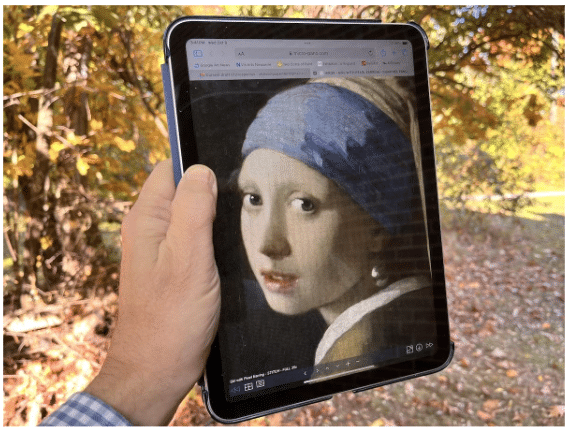
So, just how closely would you like to look at one of the most famous paintings in history?
Artists curious about Old Master paint application can literally pore over a fully explorable, hyper high-resolution image of “Girl with a Pearl Earring” online. Posted to the Internet four years ago as a publicity stunt for a digital imaging company, the huge, massively high-resolution (93,205 x 108,565 pixels) image lives online here. I can guarantee you’ll be surprised by what you see.
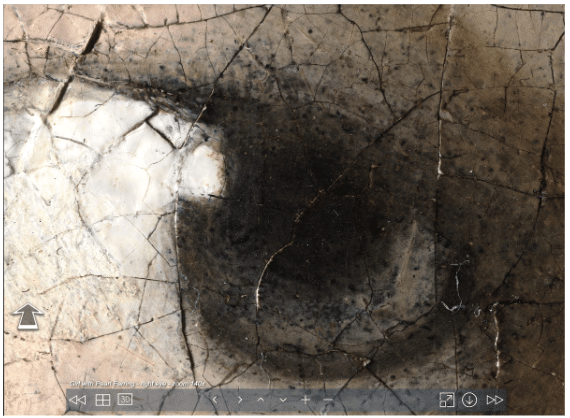
The image reaches your screen and responds to adjustments with amazing speed given its mammoth size. Navigation works best on a tablet, smartphone, or a computer with a trackpad, which allows you to bypass the clickable “buttons.”
However you access it, you would be able to examine the grains of dust and grit at the bottom of the surface cracks if there were any. (You may be shocked, as I was, to discover just how cracked the painting’s surface is. Those cracks are called “craquelure” in Fancy Art History Talk.)
Said viewer settionwheels on Reddit: “just realized this is a 3D scan, you can look at the surface of the painting in 3D. This was Salvador Dali’s favorite painter – VERMEER. The white highlights are actually white paint piles just as Dali recommends in his books. What a delight.” As Boogertwilliams rejoins, “Any more and you would see the individual atoms :)”
Happy scrutinizing!
And if you’ve an interest in learning the techniques that Vermeer and other great masters used to create their paintings, check out the video (and book) by Virgil Elliott, Traditional Oil Painting, which is on sale for a limited time right now.