Artists have delighted, over the years, in giving visual form to imaginative ideas and passages from literature, doubly so when the source itself is straight out of imagination.
Perhaps you’ve heard the phrase, “double, double, toil and trouble” associated with Halloween witches stirring cauldrons of questionable contents… In addition, perhaps you know the source was William Shakespeare’s play, Macbeth.
The rest of the creepy lyrics to the “Song of the Witches,” or “Weird Sisters” as Shakespeare calls the three characters, goes like this:
(from Macbeth)
Double, double toil and trouble;
Fire burn and caldron bubble.
Fillet of a fenny snake,
In the caldron boil and bake;
Eye of newt and toe of frog,
Wool of bat and tongue of dog,
Adder’s fork and blind-worm’s sting,
Lizard’s leg and howlet’s wing,
For a charm of powerful trouble,
Like a hell-broth boil and bubble.
Double, double toil and trouble;
Fire burn and caldron bubble.
Cool it with a baboon’s blood,
Then the charm is firm and good.
(A “howlet” by the way, is a bat).
Those lines have inspired many wild paintings, engravings, and pen-and-ink illustrations.
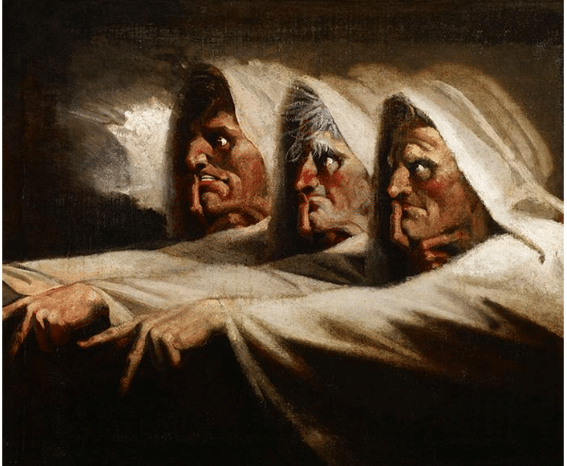
Swiss-English artist Henry Fuseli painted several renditions of the scene in 1785, where the two main characters. Macbeth and Banquo, come across the prophesying Weird Sisters.
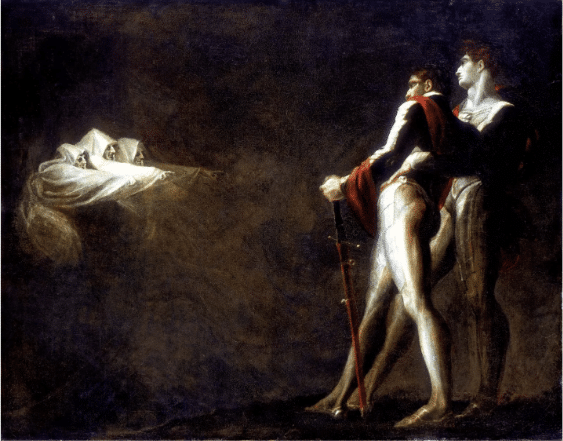
Henry Fuseli, ‘The Three Witches Appearing to Macbeth & Banquo’ Oil on canvas. 34 3/8 x 44″ c, 1785

Henry Fuseli, ‘The Three Witches Appearing to Macbeth & Banquo’ Oil on canvas. 34 3/8 x 44″ c. 1785
Swiss-born Fuseli is famous for his 1781 painting The Nightmare, out of which looms a literal “night mare,” that is, a black, wild-eyed horse (emerging from the shadows to the left), believed in folklore to be ridden by night-hags and witches.

Henry Fuseli, The Nightmare 1781. Detroit Institute of Arts. Founders Society Purchase with funds from Mr. and Mrs. Bert L. Smokler and Mr. and Mrs. Lawrence A. Fleischman, 55.5.A
Critics have pointed to Fuseli’s Nightmare as among the earliest paintings to successfully depict an intangible idea, rather than an event, person, or story. While there’s no doubt it’s unforgettably spooky, there’s some disagreement about what exactly Fuseli meant by the image. Assuming the woman is dreaming (which isn’t certain), is it the horse or the little ghost-story demon-thing sitting on her chest (identified as an incubus) causing the nightmare? If the woman isn’t just dreaming but rather possessed,, it would explain why Fuseli painted her so limp and pale.
Fuseli’s painting of the Weird Sisters from Macbeth became quite famous after it was made into a reproduceable engraving by J.R. Smith.

Here’s the exact “Three Witches” painting Smith based his engraving on:

Henry Fuseli, The Three Witches, 1783, oil on canvas, 25 1/2 x 36 in. The Kunsthaus Zürich.
The witches will foretell Macbeth’s death. The following is from the website of the Huntington Museum:
“Look closely at the upper left corner of the Kunsthaus Zürich painting (the one above this one). What is that winged-skull-demon thing haunting the upper left?! Hint: It’s on the movie poster for the 1991 thriller “Silence of the Lambs.”
Well, it’s a Death’s-head Hawkmoth, a real insect with markings uncannily similar to a human skull. As an element of the painting, it serves as a portentous symbol of the fate awaiting Macbeth.

Death’s-head Hawkmoth (Image from Wikimedia Commons. Acherontia atropos MHNT by Didier Descouens. File is licensed under the Creative Commons Attribution-Share Alike 3.0 Unported license.)
Thankfully, we don’t have any Death’s-head Hawkmoths in North America. Happy Halloween! May the season bring blue skies and maybe even a little magic – just the good kind! – into your creative life.
Magic in the Air – and on Your Palette
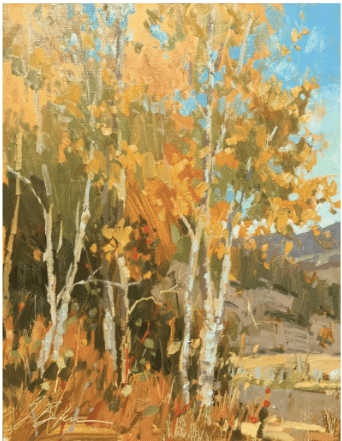
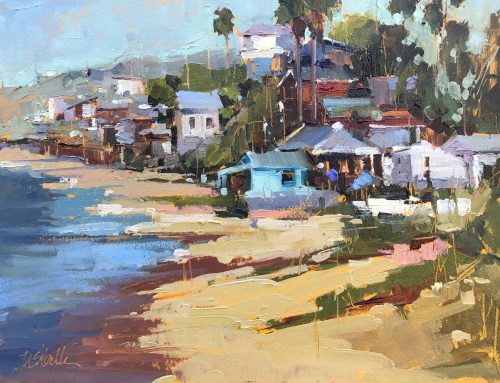
Suzie Baker, All that Glitters is Not Gold, 14″ x 11”, plein air oil on linen panel, 2019
Speaking of magic, there’s great instruction on using color effectively in Suzi Baker’s Color Magic for Stronger Paintings.
How a Starving Artist became a Disney Illustrator

Glenn Vilpuu teaches traditional Renaissance drawing and worked for many years as a principle illustrator/animator for Walt Disney in the 1970s.
A painter first and always, Vispuu didn’t start in animation until he was 40. He taught painting and drawing at ArtCenter for more thanb a dozen years and eventually opened his own atelier, which he ran for another five. “About that time [in the late 1970s], I said, you know, I need somebody to give me a check,” he’s been quoted as saying. Tired of seeing his students ease into lucrative positions at Disney, he called them up and found out they already knew about him.
They called him in during the creation go The Fox and the Hound, and off he went. He also found a place for teaching there, because Disney ran its own in-house figure drawing classes. “So I was teaching figure drawing classes, too,” he’s said.
Visppu still teaches drawing the figure. He will be teaching online during Streamline Publishing’s Realism Live event, beginning November 8th and 9th. For more information, check it out here.