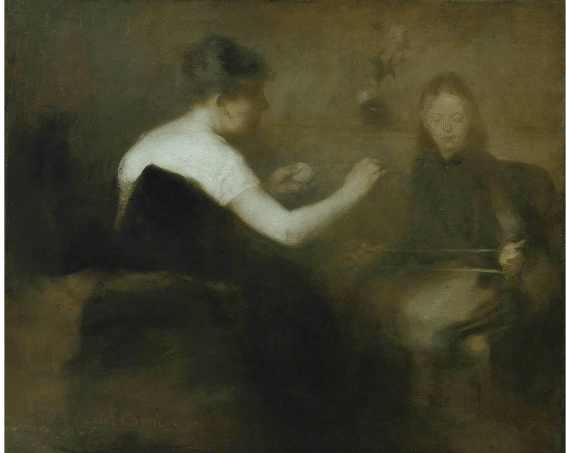
An important but largely overlooked figure in the history of painting is Eugène Carrière. He was a Parisian oil painter and print-engraver whose work resonates with tonalistic poetry in abundance. No less a talent than the young Pablo Picasso found in Carrière’s work inspiration for the mysterious and poetic figures that appear in the famous modernist’s own early work, particularly that of his famous Blue Period.
Like those more famous paintings, Carrière’s work is saturated in melancholy; it is full of chiaroscuro (dark-light contrast) and is often nearly monochromatic. The ethereal, dreamlike figures Carrière creates seem more like spectral visions of humanity than real people. Most of his pale mothers, ailing children, and introspective women emerge phantom-like from dark shadowy backgrounds to which they threaten at the next moment to return. It wasn’t likeness but something else the artist was after.
By “extinguishing the light of the sun and the colors and forms it could illuminate,” as one critic quote, Carrière sought to make visible “nature’s unseen universal animating force.” Carrière sought spirit rather than substance.
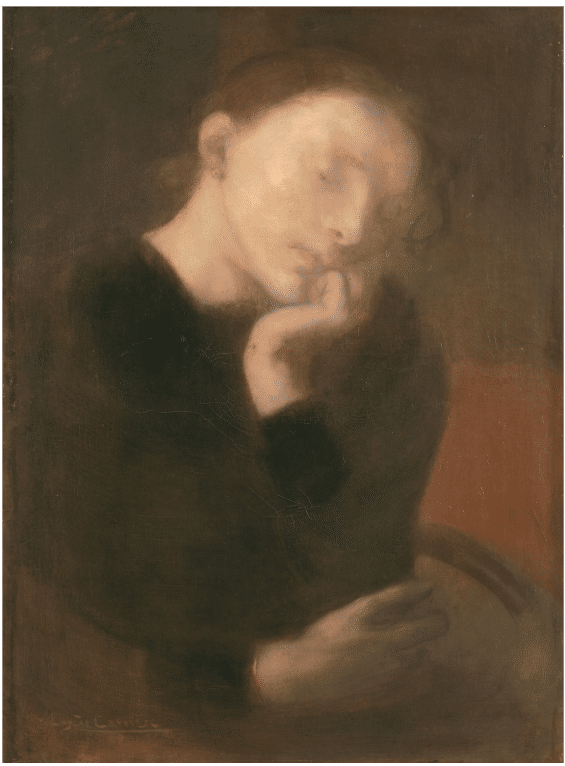
Eugène Carrière, Meditation, 1890, oil
Picasso first found his creative authenticity in his Blue Period paintings, which he started making in 1901, shortly after his hometown companion and roommate, who was a poet, unexpectedly committed suicide shortly after the two first arrived in Paris from Spain.

Picasso, “Crouching Woman,” oil, 1902. 90 x 71 cm.
If he painted nothing else, Picasso’s “Crouching Woman” would have made him famous. Picasso, like Munch and Carriere, alludes to life-in-death and death-in-life; the light on the emaciated face makes it look like bone with a deeply shadowed eye socket. The bare feet, beggars’ clothes and abject pose, protectively withdrawn, emphasizes the figure’s pared-down essential humanity.
Carrière’s mysterious figures’ expressions, like those of Picasso but especially like Edvard Munch’s, are sometimes marked by sunken eyes, protruding bone structures and hard-to-read mouths. Like Munch’s figures, they partake of both life and death at the same time.
“Everywhere the unity of the universe is affirmed,” Carrière said in a lecture on art. “All elements of the world are joined in its equilibrium. All humanity must reunite according to the law of harmony. The history of human evolution would be incomprehensible without this law through which our being senses absolute truth.”
The artist, then, is not a seeker images (however beautiful) but a seeker of truth. In Symbolist art, visual content embodies and pulls up deeper ideas, often of a mystical, dreamlike nature. Symbolist art favors mystical intuition and emotion over observational reality. It’s not surprising then that the young, grieving Picasso responded to the work of the Symbolists, considering the entire movement’s focus was on inner emotional and psychological states at the threshold of life and death, expressed in otherworldly themes and imagery.
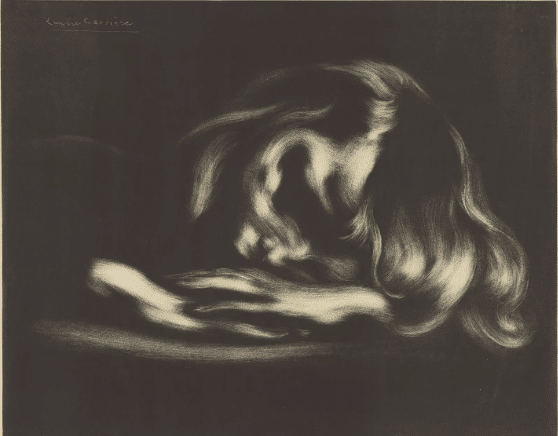
Eugène Carrière, Sleep, 1887, lithograph. At first surreal, this lithograph gradually resolves itself into the head of a child sleeping to one side with folded hands – though some scholars have seen in it “a skeletal face drawn tight with exhaustion.”
To know Carrière’s work is to gain insight into the European fin-de-siecle movement known as Symbolism, a convergence of art and mysticism, most famously exemplified by Gustav Moreau, Franz Stuck, and Odilon Redon. Symbolist art lives in the threshold places, the spaces between childhood and “skeletal exhaustion,” at the intersection of life and death, resting in uncertainty instead of choosing one over the other.
The movement deeply influenced important artists such as Munch, Gustav Klimt, and giant of modern sculpture, Auguste Rodin. Later, in the early decades of the 20th century, the first Surrealists would hail them as prophets of their own artistic revolution.
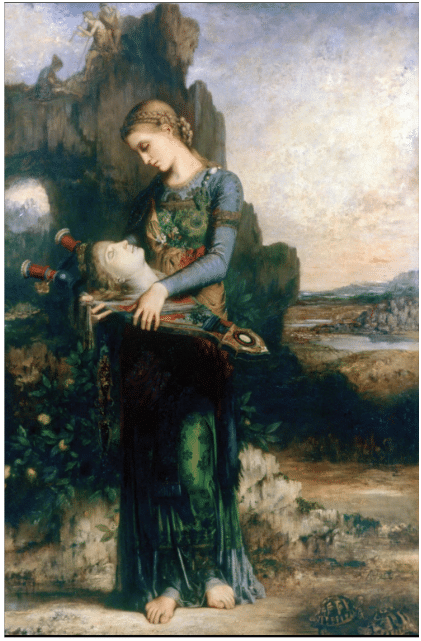
Gustave Moreau, Orpheus, oil on wood 1865; Musée d’Orsay, Paris. 155 × 99.5 cm.
Like the surrealists that revered them, the Symbolists believed that channeling dreams and harnessing the subconscious offered not just wholly new subject matter for art but entirely new truths about the nature of the human mind and spirit. A new approach to art, they felt, was needed to breathe new life into a cultural landscape lacking imagination. “Every manifestation of art meets with fatal impoverishment and exhaustion,” Moréau complained of his time, “then follow copies of copies, imitations of imitations; what was new and spontaneous becomes cliché and commonplace.”
Carrière’s original fusion of figures and other forms with atmospheric chiaroscuro has its material equivalent in sculptor Rodin’s merging of rough, unhewn stone with the emergent human form.


Eugène Carrière, Mother and Child Sleeping, oil. c. 188-
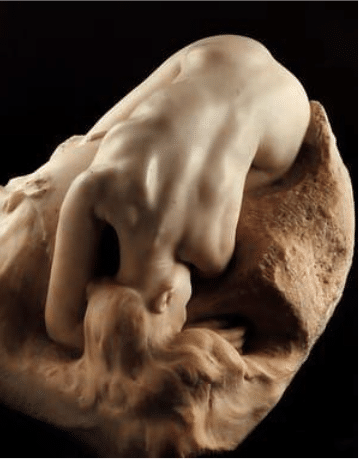
Auguste Rodin, immaterial flowing into and out of the material

Eugène Carrière, Motherhood, 1899, engraving. National Gallery, Washington D.C.
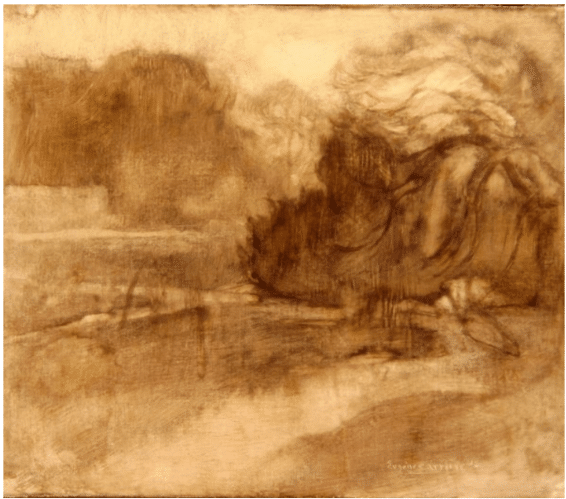

Spirit world or our world? Two near-abstract and totally phantasmal tonalist landscapes by Carrière.
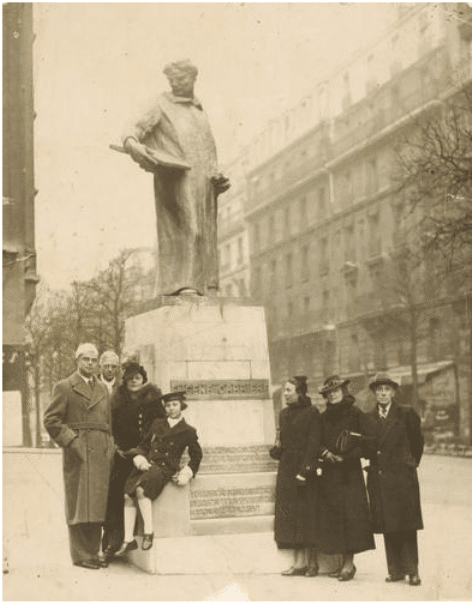
“C’est l’art qui renouvelle le verbe en découvrant toujours a nouveau les origines de nos emotions,” reads the base of the statue of Carriere that stands in Paris to his memory. “It is art that renews the word by always discovering anew the origins of our emotions.”

If you’d like to explore the quality of poetry in your own painting, have a look at the video “Poetic Landscapes” by John MacDonald
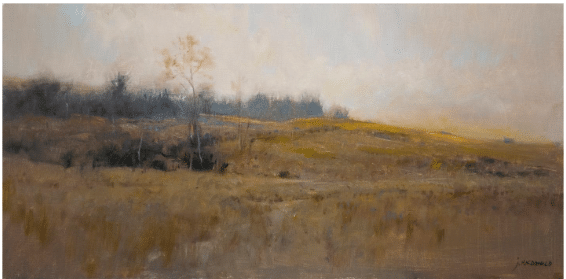
John MacDonald, October Dusk • 12″ x 24″ • oil on linen • Private collection