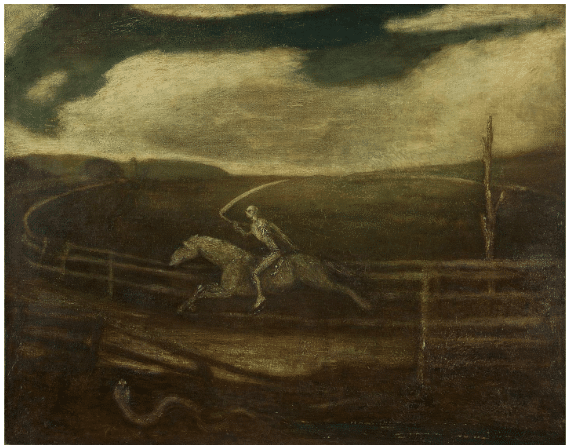
One of the “spookier” American paintings must be Albert Pinkham Ryder’s “The Race Track,” popularly known as “Death on a Pale Horse.”
Like many a Ryder painting, it’s a strange, stricken-looking gem created at the turn of the 20th century. Ryder (1847-1917) was an experimentalist with zero regard for sound oil painting technique; many of his paintings have deteriorated and often look darker and gloomier than they did in his time. Still, the image of the scythe-wielding skeleton urging the horse faster despite the circular “nowhere to get to” track, remains in the memory long after you’ve seen it.
“The sky, a curious mélange of dense cloud and open darkness,” writes art historian and critic Sebastian Smee, “has a flat, graphic quality that lures us into looking for signs in its shapes. The whole painting is mysterious and penumbral. But parts of it — the white cloud, the patch of light on the track in front of the horse, and the horse and rider themselves — glow with furious luminosity.
Ryder is considered not only a “visionary” artist but one of the first modern American painters. At one point, influential American modernist Marsden Hartley as well as Jackson Pollock considered Ryder “the only American master” of interest to them.
Ryder believed that “the artist has only to remain true to his dream and it will possess his work in such a manner that it will resemble the work of no other man.” This sense of creative independence, the experimental attitude toward materials, and the commitment to authentic self-expression resulted in a uniquely imaginative body of work with many of the hallmarks that would define American art throughout the 20th century.
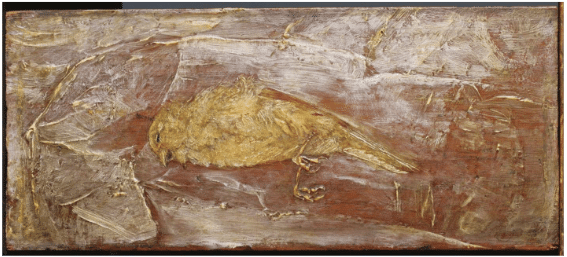
Albert Pinkham Ryder, “The Dead Bird,” 1890-1900, oil on wood, 4.75 x 10 in. Phillips Collection, Washington, D.C.
There’s nothing really “spooky” about Ryder’s depiction of a bird with its talons curled in death (“The Dead Bird,” above), but the unusual image has inspired countless imitations by contemporary artists fascinated with the motif. This despite Ryder’s admonition that “imitation is not inspiration,” and only inspiration can result in truly great art. For Ryder, even if in practice an artist rarely ever attains such a height, it’s a worthy, even necessary, goal. “The least of man’s original emanation,” he maintained, “is better than the best of borrowed thought.”
Toward the end of his life, Ryder mostly lost interest in exhibiting. Instead, he lived as a recluse in a decrepit New York apartment coated in dust, the floors littered with piles of papers and unwashed dinner plates, obsessively reworking his paintings for as long as 10 years, using odd mediums (alcohol, varnish, tobacco juice), indiscriminately applying layer upon layer. It’s said that, possibly due to an eye condition, he went outside mostly after dark, vampire-like, to haunt the waterfront on misty, moon-lit nights.
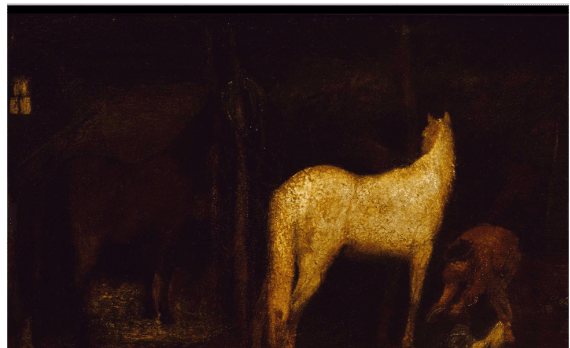
In the Stable (early to mid 1870s) oil on canvas, 21 x32 in. Smithsonian American Art Museum
The painting titled “In the Stable,” (above) might strike one at first as another ghostly “pale horse.” It’s not though, or else an ordinary groom wouldn’t be attending to the animal. More likely, we’re seeing the light-reflective underpainting from which the well-intentioned, but sadly not lightfast, color-glazing has faded.
Ryder’s work has a dreamlike, quasi-symbolic quality that comes from relying on imagination more than observation. Ryder is modern, too, in that he was more concerned with what he put into his paintings than their surface attractiveness – not what they look like but what they make the viewer think and feel. “The artist should fear to become the slave of detail,” he said. “He should strive to express his thought and not the surface of it. What avails a storm cloud accurate in form and color if the storm is not therein?”
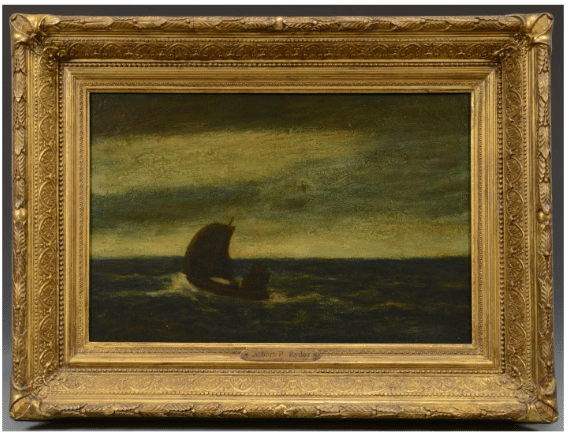
His most famous paintings are of solitary ships on dark waters under restless, moonlit skies. His striking, nearly abstract painting (below) of the ghost ship known as the Flying Dutchman resides in Washington D.C.’s Smithsonian American Art Museum, where the largest collection of Ryder’s fragile work is exhibited under protective glass.
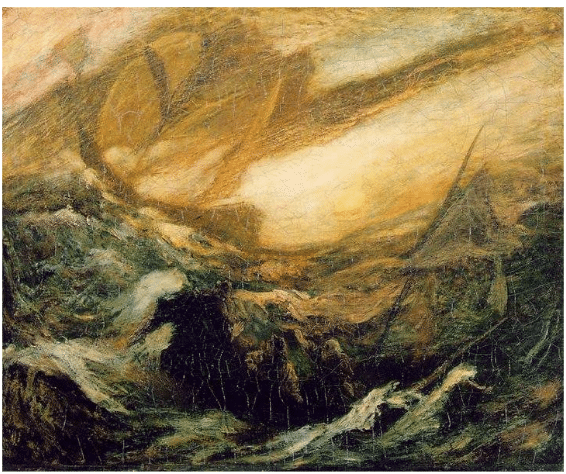
Albert Pinkham Ryder, The Flying Dutchman, (1895) 36.1 cm (14.2 in) ; width: 43.8 cm (17.2 in)
Ryder’s “The Flying Dutchman” resembles very little in 19th century American art. At first it looks like pandemonium, “chaos bewitched” perhaps, or “the unnatural combat of the four primal elements” as Melville wrote about a similar painting that appears in Moby-Dick.
In the legend of the Flying Dutchman, the dreaded ghost ship captained by no living man appears as an omen of doom during perilous storms at sea. Though it appears as an apparition in the moonlit sky, the ghost ship in the painting above looms gigantically over the nearly swamped boat. Ryder accompanied this painting with a poem:
“Who hath seen the Phantom Ship,
Her lordly rise and lowly dip,
Careering o’er the lonesome main,
No port shall know her keel again…
Ah, woe is in the awful sight,
The sailor finds there eternal night,
‘Neath the waters he shall ever sleep,
And Ocean will the secret keep”
― Albert Pinkham Ryder
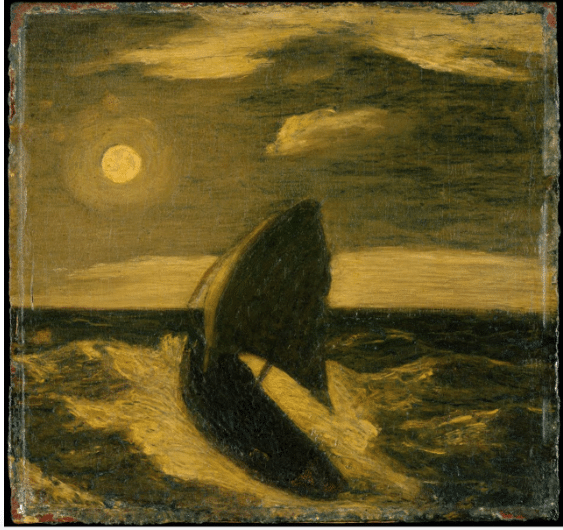
Albert Pinkham Ryder, The Toilers of the Sea, 1880-85, 29.2 x 30.5cm, oil on wood