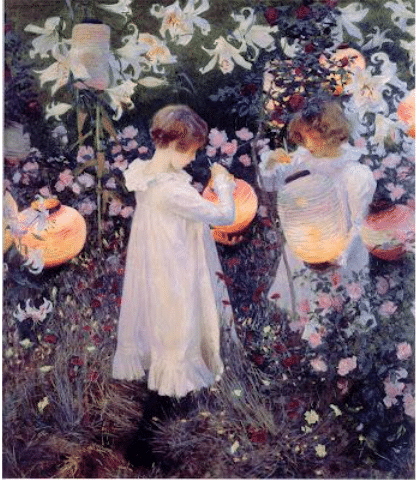
Reeling from a front-page scandal threatening to derail his career, the American painter John Singer Sargent spent the summer of 1885 healing his emotional wounds at a country estate in England. Though he was fantasizing about starting a new life in music or business, he saw a vision that ignited every fiber of his creative being: a child’s face lit by a paper lantern in a garden at dusk.

Back in Paris, Sargent had touched off the firestorm that almost torched his career with his notorious “Portrait of Madame X.” It’s hard to believe that a lady’s evening-gown with a loose shoulder strap could so infuriate the French; in reality, the scandal had more to do with the opulence, the haughty indifference, and the corpse-like pallor of the model. Sargent’s brush had said the one thing that everyone knew but that no one wanted said: high-society Paris wallowed in decadence and malaise.
Across the channel, where society routinely shrugged off Parisian scandals-du-jour, Sargent picked up a string of tame portrait commissions and fretted about how he was going to pay the Paris studio’s rent. Visiting a friend’s enclave of well-to-do Bohemians in the country, Sargent soothed his nerves playing lawn games with his guests and their children amid herb-scented twilights in wild gardens filled with giant lilies, roses, and poppies, all bathed in a soft golden light. At evening gatherings he played popular songs on the piano, including a favorite that year with a lyric that went “Carnation, Lily, Lily, Rose.”
According to Deborah Davis’s Strapless, an entertaining non-fiction account of Sargent’s life during this period, “this song, the sight of the children playing in the garden, and the memory of Chinese lanterns along the Thames at twilight inspired a painting” that Sargent would only paint from life, working every evening only for the two or three (no more than 20) minutes when the light was just right. It was the only larger painting he ever completed in the Impressionist serial plein-air manner established by Monet.
“Every day for weeks,” Davis writes, “just before sunset, Sargent would drop his tennis racket, gather his canvas, paints, and young models, and head for the garden. He would work for [between two and 20] minutes – the brief period of perfect light – to catch the magic transition of late afternoon into evening. When the sun had set, Sargent and his friends would carry the oversized canvas to its resting place to await the next twilight.”
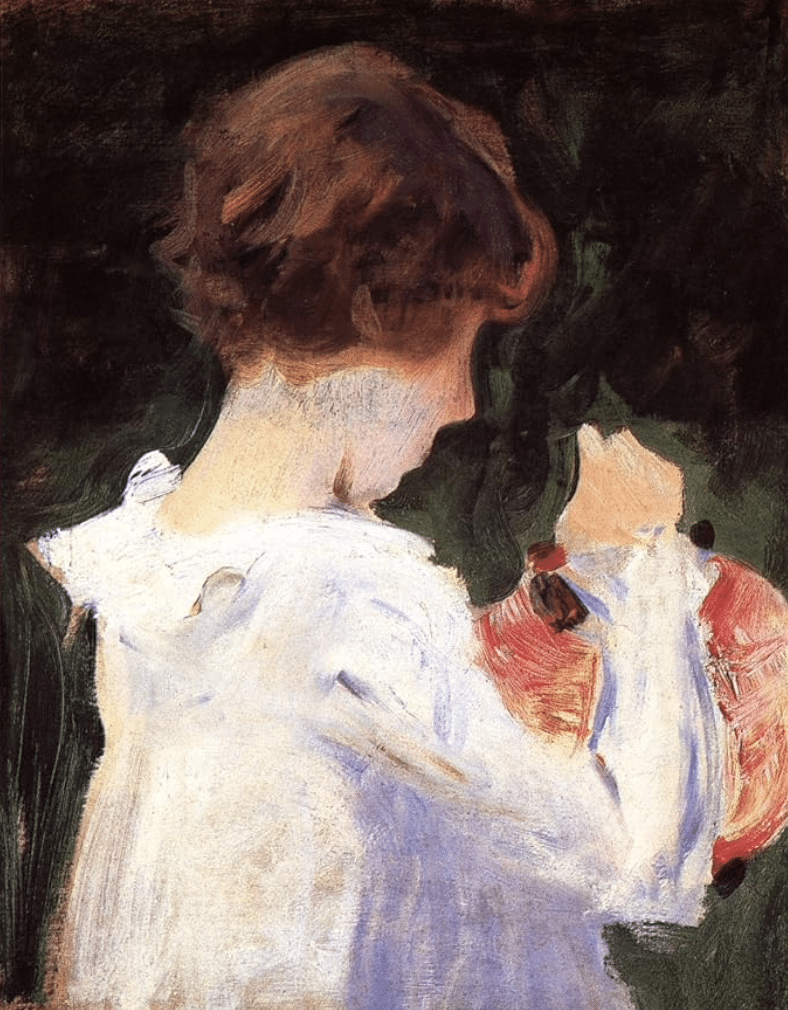
Perhaps unwilling to let go of his lifeline to paradise, Sargent took two years to complete the painting that he would title Carnation, Lily, Lily, Rose, storing the unfinished canvas in his host’s barn for the winter.
A good part of its magic resides in the illumination of the two girls standing quietly side by side, each absorbed in the process of lighting her lantern with a long wax taper. Once upon a time I watched my five-year-old and his friends play like that – “together” but also solitary and apart, lost in their own private world.
It’s the orange light reflected on the faces that one remembers most about this image after not seeing it for a while. Amid the cool colors of the garden, the warm glow of the firelight tints their faces, and we feel as though we’re being admitted to a secret world of innocence and enchantment. It’s the very antithesis of the clamor of fashion and the arrogant demimondes of Parisian society. The painting was an instant hit in London (it’s still there, by the way, at the Tate), and Sargent’s career as a painter was saved.
The John Singer Sargent online gallery has this to say:
“The idea (a purely fanciful one to be sure) was to capture, not the most perfect sunset, but the effect the most perfect sunset has, in terms of color, shadows and light on a scene. But it was more than that. How about the artificial light of Chinese lanterns at the precise moment of twilight when lanterns and sun are at perfect equilibrium! — Could he paint that magical transient moment that lasts no more than a couple of minutes most — capture that most perfect color of mauve when the sun is still flush in the sky and the lanterns glowing equally? Not create the scene from his mind or memory of what it would or should look like, but actually capture it — could he paint the exquisite beauty between those two minutes?”
Of course not. No one could paint in two minutes and even come close to a faithful adaptation no matter how prepared he or she was prior. But what if he painted only for those magical minutes every day for the foreseeable future? If he was faithful, if he kept true to the principles of Impressionism — painting only what he saw and not what he thought he saw or wanted to see, if he did it every day for two minutes for however long it took – could he capture that lightning in a bottle?
It was on some level a lark, but the idea was hatched in a community of people that weren’t constrained by the blinders of convention. These were people who could see things that weren’t and then ask why not? Sargent was going to do the impossible and they were all going to help.
He started off by using Mrs. Millet’s young daughter who was only 5 at the time. They put a wig on her to lighten her hair and then propped her up as if she were lighting a Chinese lantern. Everyone in the community took an interest, but the demands of maintaining an exact pose every day proved to be too much; so in her place Mrs. Barnard’s two girls of the presumably hardier ages of seven and eleven stepped in.
Edmund Grosse, who was there, described the great fun Sargent was stirring up:
“The progress of the picture, when once it began to advance, was a matter of excited interest to the whole of our little artist-colony. Everything was used to be placed in readiness, the easel, the canvas, the flowers, the demure little girls in their white dresses, before we began our daily afternoon lawn tennis, in which Sargent took his share. But at the exact moment, which of course came a minute or two earlier each evening, the game was stopped, and the painter was accompanied to the scene of his labors.
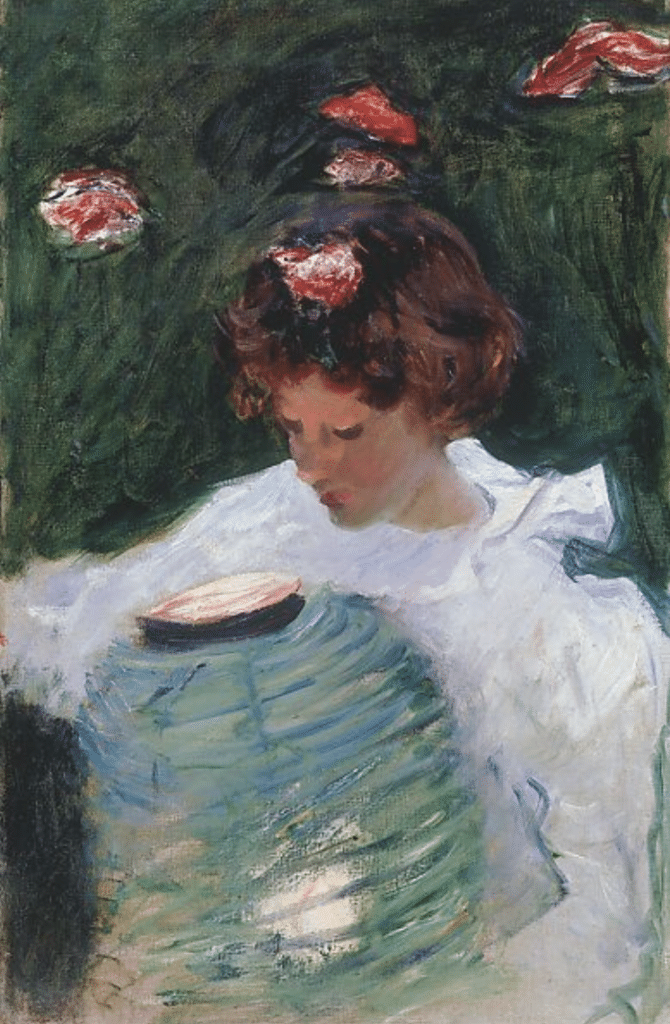
“Instantly, he took up his place at a distance from the canvas, and at a certain notation of the light ran forward over the lawn with the action of a wag-tail, planting at the same time rapid dabs of paint on the picture, and then retiring again, only with equal suddenness to repeat the wag-tail action.
“All this occupied but two or three minutes, the light rapidly declining, and then while he left the young ladies to remove his machinery, Sargent would join us again, so long as the twilight permitted, in a last turn at lawn tennis.”
“The seasons went from August till the beginning of November. Sargent would dress the children in white sweaters which came down to their ankles, over which he pulled the dresses that appeared in the picture. He himself would be muffled up like an Artic explorer.”
Of course, by then, the flowers had faded and died, so artificial roses were ordered and wired to the withered branches. But who would suspect such time and effort? At its heart Carnation, Lily, Lily, Rose is very much a moment only – a rare and perfect one, with every hallmark of happenstance. It’s as if we too had been invited to enjoy those lovely evenings in that fairytale garden and had happened to glance over a shoulder at the chance moment that distilled its full store of sweetness and spontaneity.
All this, and it is for everyone, and it lasts for all time.
Sargent is truly a painter’s painter. No one appreciates the magnitude of his achievement better than fellow artists who know what went into it. The good news is that other artists also stand to gain the most from studying him. If your work would benefit from studying Sargent’s techniques, check out contemporary painter Thomas Jefferson Kitts’ video, Sargent, Techniques of a Master.
The Music of Sargent’s “Carnation, Lily, Lily, Rose”
Sargent titled his garden painting Carnation, Lily, Lily, Rose after a popular song of the time, one that he and his companions played and sang around the piano for fun.
Closing the circle in a way, London’s Tate museum in 2013 commissioned a young musician to compose a contemporary classical piece based on the painting.

The piece that musician Meilyr Jones composed for Carnation, Lily, Lily, Rose was not only inspired by but also performed for the first time in front of the painting. The musician first noticed the painting as a postcard in his sister-in-law’s home, commenting that “the more I have seen it, the more I love it.” This was the first time Jones had composed a piece of contemporary classical music at all, and he worked closely with collaborator Joseph Davies. The piece, captured on video, was performed by a group of 12 musicians conducted by Davies and featuring clarinet and harp.
The composer was particularly interested, he said, in the children’s ability to forget the rest of the world and to become engrossed in some activity. It’s a central aspect of the painting, something Sargent reinforces by placing the figures in the center of a kind of private bower or “secret garden” of surrounding flowers and greens.
Translating the painting into classical instrumentation, Davies composed a piece for a chamber orchestra, such as “would have been around at the time.” Watch and listen to an excerpt of the piece and check out the Tate’s short documentary on the commission here.