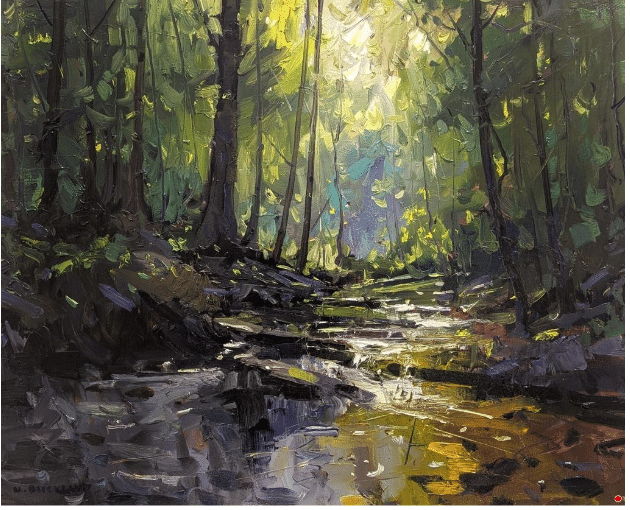
Painters Kyle Buckland and Mark Fehlman have very different styles and both create impactful paintings. Not coincidentally, they both place design and composition firmly at the center of their painting and teaching practices.
“Successful designs aren’t arbitrary,” Buckland says.” They either work or they don’t.” It’s necessary to learn the whys and wherefores, Buckland says. Using big shapes that fit together like puzzle pieces is one of those basic building blocks of composition that painters learn along the way.
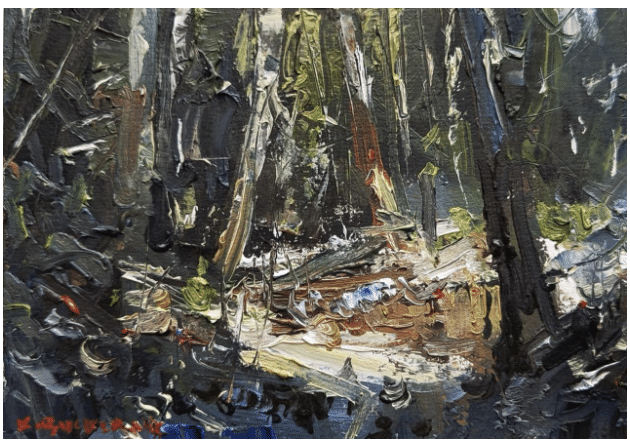
Kyle Buckland, “Forest Glow,” oil, 5×7 in. Kyle teaches his technique for composition and designing with the brush in his video, Courageous Design: Unleashing Creativity with Bold Brushwork
In Buckland’s small but dynamic plein air study above, at first you might not see the forest for the trees. (A-hem.) I mean, there’s a lot of energy and juicy painterly action going in all those verticals and diagonals shooting this way and that seemingly at random. But the big shapes are there too.

he big shapes underlying the painterly design in the plein air sketch by Kyle Buckland above. There’s a horizontal, overlapping oval nestled in the center, marked in orange, that creates a surprising counterpoint, in terms of visual weight, to all those angular upright lines of the trunks.
Beneath Buckland’s seeming complexity is a solid geometric arrangement of shapes that keeps everything nicely in order. This strong underlying abstract design (strong because of the way its 3-5 big shapes fit together) produces the necessary balance and stability. And that’s what makes it work.
In Buckland’s case, in addition to the composition, the raised brushwork enhances and emphasizes the design. Those thick ribbons and rods of impasto verticals make the design, and the painting as a whole, even more impactful.
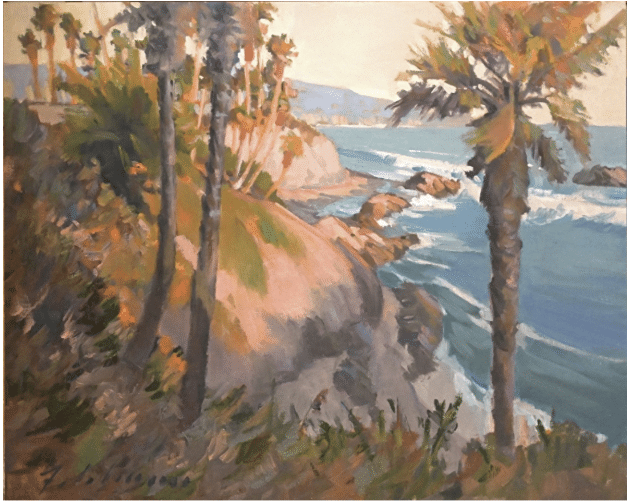
Mark Fehlman, “Sunset Glow,” 16×20 in., oil on linen Mark Fehlman has a teaching video titled “Design Strategies for Powerful Paintings”
Fehlman takes a radical approach to putting design and composition first when he approaches any painting. “A powerful painting is 75 percent preparation and 25 percent painting,” Fehlman says. (That’s only 25 percent of his time doing the actual painting!) “A great painting usually is based on a strong compositional diagram. The diagram is like the backbone…. the underlying structure that holds everything together.”

Mark Fehlman, “Torre Vista,” Oil, 16 x 20 in.
In Fehlman’s “Torre Vista” (above), there’s a lot of careful, almost intricate design throughout. But the overall composition can still be broken down into a few simple varied, interlocking shapes.
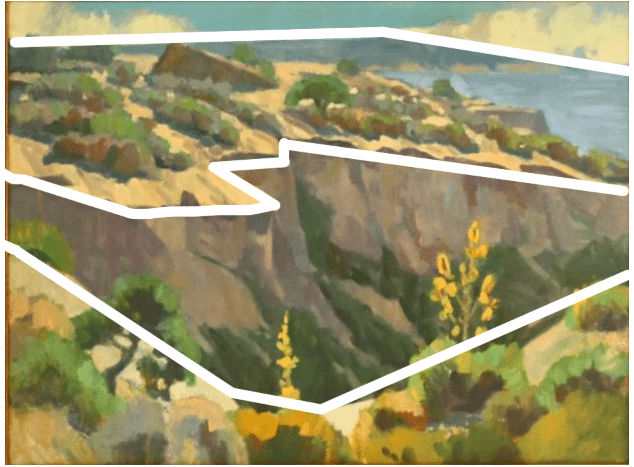
All that minute and varied design work would become overwhelmingly chaotic without that underlying abstract “backbone” of simple, big shapes.
“Without a basic structure or organizing idea, the painted image will feel weak and unorganized,” Fehlman says. “Also, the use of shape, value, editing, and dominant color selection are all a part of the planning process. Once all this planning has taken place, the painting is effortless.”
Who Cares?
Why these shapes, with these particular edges and angles, you ask? What’s so great about big shapes? Good questions. Note in the diagram below that the big shapes hold everything together AND ALSO create a nearly circular circuit for the eye to follow without being led outside of the painting. And that’s the goal – keep the eye moving within the painting by not allowing the edges to point the gaze toward (and inevitably out of) the painting’s boundaries. Below, the big shapes as previously outlined are in white; the large circular path for the eye is in red; there are two smaller circuits enclosed within the larger too. Each interlocking shape has an organic self-containing quality, as does the whole.
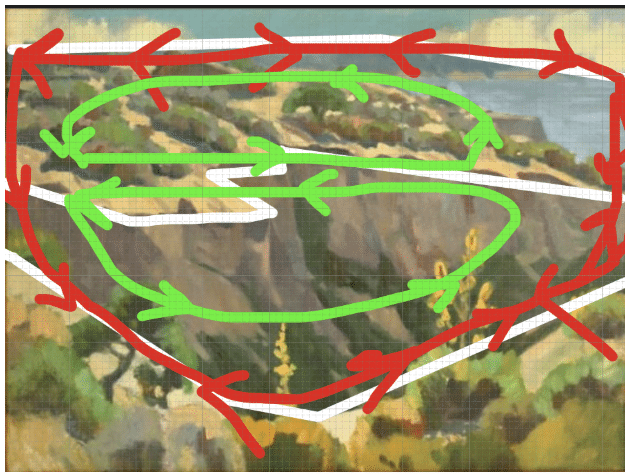
All this is to say, getting the “big picture” in place right from the start goes a long way toward ensuring a strong painting makes it off the easel.
Listen to an episode of the PleinAir Podcast with Eric Rhoads, featuring guest artist Mark Fehlman:

“Great work is designed and built using sophisticated tools like value, shape, color, and painted surface. These all go together to become a puzzle, skillfully created to become a visual delight for the viewer.”