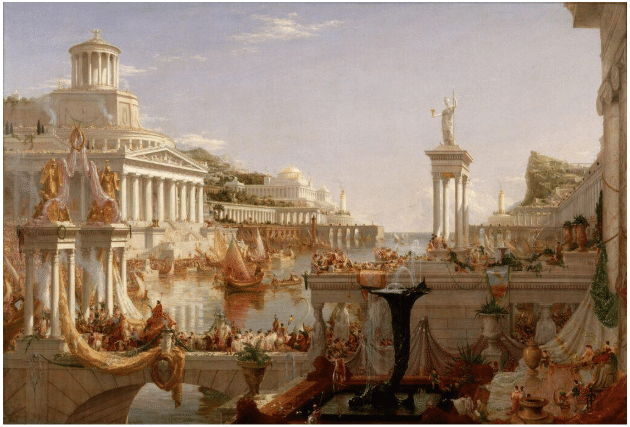
We continue our series on “The Course of Empire,” Thomas Cole’s epic series of five paintings charting the rise and fall of an imaginary Empire.
As previously introduced, we follow the story Cole’s paintings tell, from pre-civilization hunter-gatherer tribes to utopian vision (and nest time, on to desolate ruins to be reclaimed by the cyclic tide of nature).
This is the kingpin painting of the series. Titled The Consummation of Empire, it shows civilization at its height. We’ve come from sparsely populated nature to stand at the summit of cultural and civic achievement, well before decline, collapse, or decay. We’re standing on the plain where the nature-worshippers’ temple used to be – we can still see the mountain peak with the boulder on its height but from a different angle, only now it’s got a walled roads leading to it and stone buildings, causeways, and aqueducts built into its side.
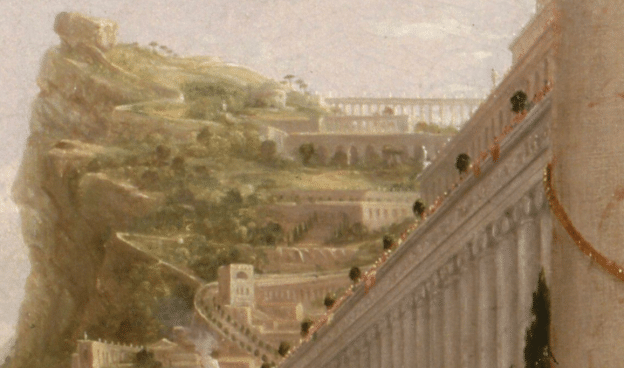
Detail of Thomas Cole’s The Consummation of Empire.
In the center foreground, the city’s Emperor appears, visible in the detail below, riding an elephant at the head of a long celebratory procession. In front of it, there appears to be a giant mirror (see detail below). A mirror would be an emblem of the vanity and self-absorption of the Empire’s power structure at the expense of the good of the public – the Achilles heel that eventually leads to the civilization’s collapse.
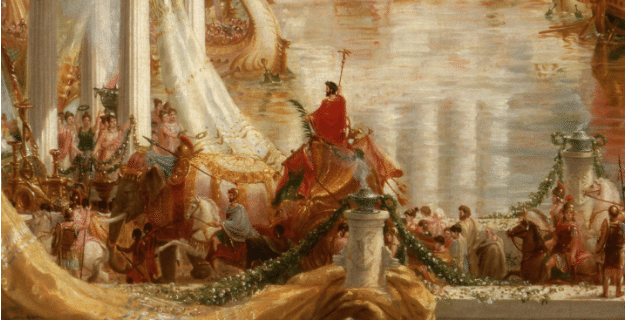
Detail of Thomas Cole’s The Consummation of Empire.
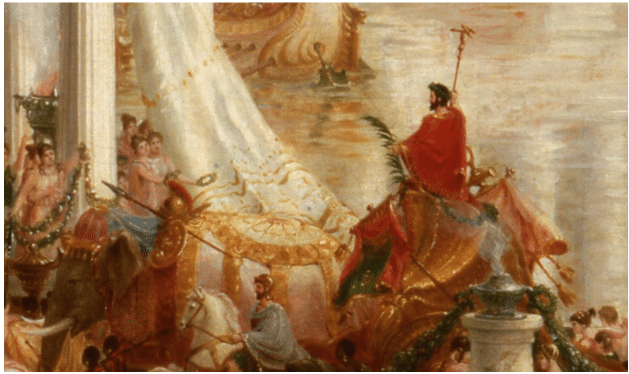
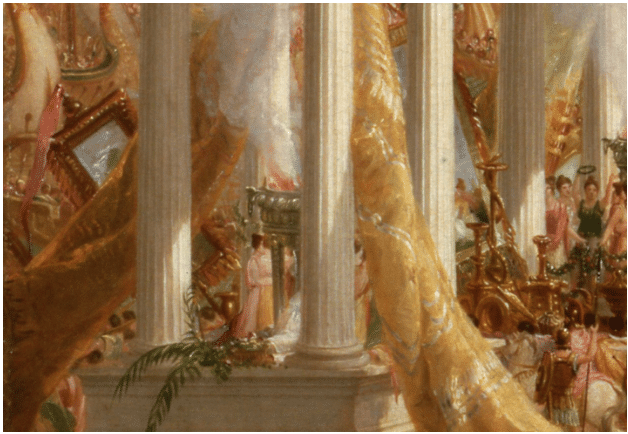
Detail of The Consummation of Empire showing the giant, half-hidden mirror (far left) in front of the Imperial procession.
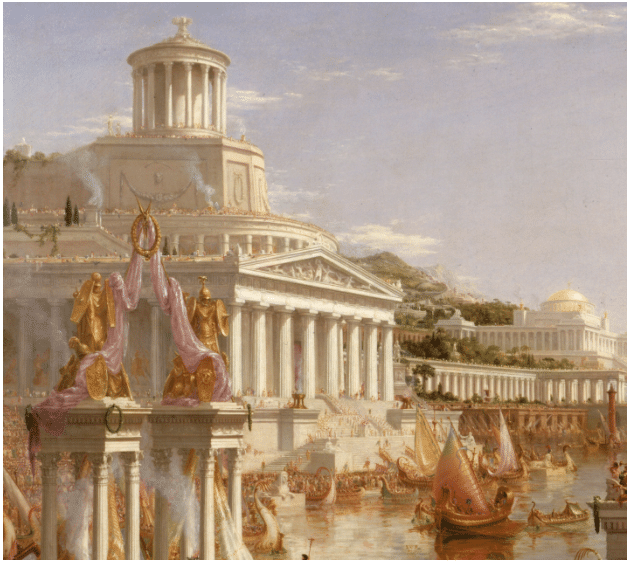
Detail of Thomas Cole’s The Consummation of Empire.
An even closer look (below) reveals the temple’s decorative sculpture to depict Diana and her retinue hunting deer. Cole based the goddess’s image on the “Diana of Versailles,” a 2nd century AD Roman Imperial copy of an ancient Greek sculpture of Artemis, the huntress.
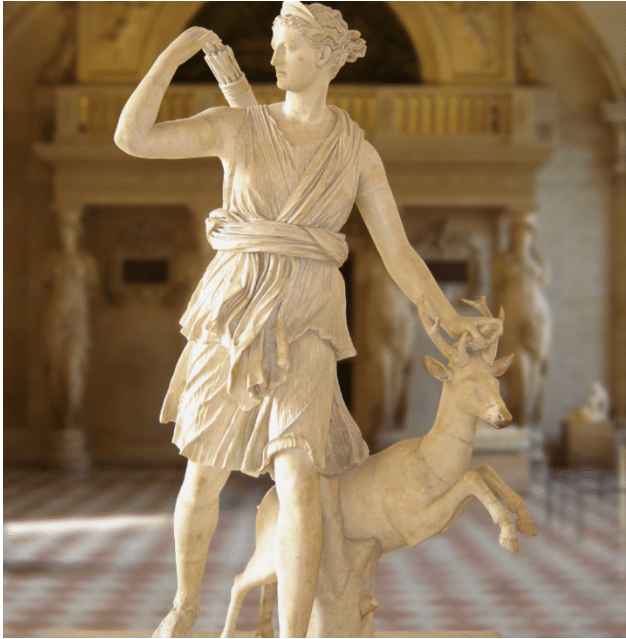
Cole’s selection of the Diana the Huntress motif represents another peak moment in this imaginary history – earlier in the series we encountered a very real deer hunt on which human survival depended. Here, the hunt has been lifted from the realm of necessity and transformed into an elegant symbol, a decorative motif enshrined in the rarefied realm of beauty and the arts.
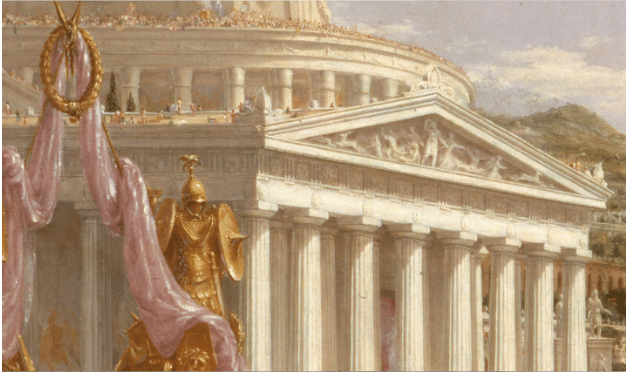
Detail of Thomas Cole’s The Consummation of Empire.
The next and fourth painting in the series, Destruction, shows the Empire during its collapse. As Cole described it: “The picture represents the Vicious State, or State of Destruction. Ages may have passed since the scene of glory — though the decline of nations is generally more rapid than their rise. Luxury has weakened and debased. A savage enemy has entered the city. A fierce tempest is raging. Walls and colonnades have been thrown down. Temples and palaces are burning.”
We’ll plan on visiting that painting in detail in the next installment of this series.
Love the Hudson River School? Contemporary artist Erik Koeppel has reverse engineered everything from the colors they used to the way they depicted rocks, trees, clouds, and skies. His works have been avidly collected over the years, during which Erik has carved out the time to make two professional quality videos teaching what he knows. Check out his video Techniques of the Hudson River School Masters Volume 1 and Volume 2