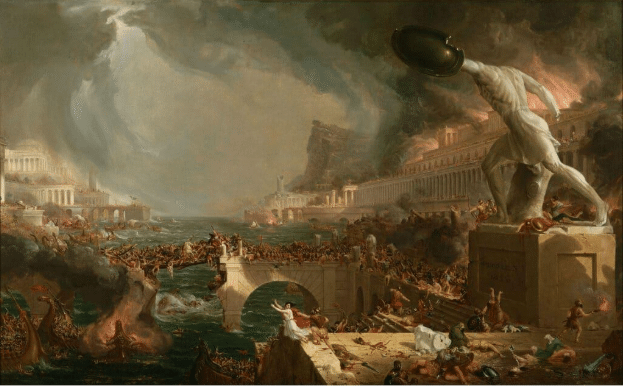
We arrive at the final two paintings in Thomas Cole’s epic cycle, The Course of Empire. The progression has been from early and more natural lifestyles to the Empire’s decadence and decline. The message is clear: unchecked, continuous American expansion would lead inevitably to destruction and collapse and the irrevocable loss of a pastoral way of life that was more harmonious and sustainable.
In the “Savage State” it was early morning (before dawn). By “Consummation of Empire” it was noon, and now dusk has fallen – “Destruction” and “Desolation” reign. Storm-clouds arch over a scene of warfare: The stage-curtains begin to draw, plunging Cole’s “drame humaine” into nightfall.
Destruction, shows the Empire during its collapse. As Cole described it: “The picture represents the Vicious State, or State of Destruction.”
“Ages may have passed since the scene of glory — though the decline of nations is generally more rapid than their rise. Luxury has weakened and debased. A savage enemy has entered the city. A fierce tempest is raging in the distance. Walls and colonnades have been thrown down. Temples and palaces are burning.”
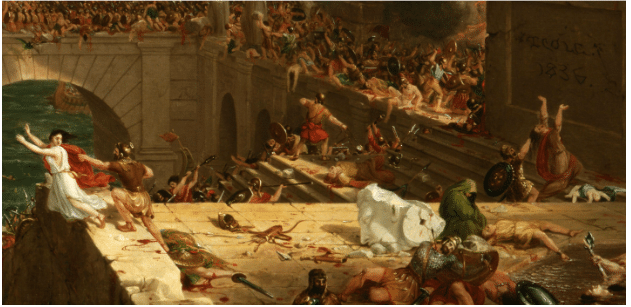
Detail from Thomas Cole’s “The Course of Empire, Destruction”
In the detail above, a marauding soldier grasps the garment of a young woman who is willing to jump to her death from a blood-spattered battlement rather than fall victim to his assault. Cole adds, “another soldier drags a woman by the hair down the steps that form part of the pedestal of a mutilated colossal statue, whose shattered head lies on the pavement below. A barbarous and destroying enemy conquers and sacks the city. Description of this picture is perhaps needless; carnage and destruction are its elements.”
The fifth and final painting, Desolation, shows the same location decades later. As one 19th century writer described it: “The remains of the city are highlighted in the livid light of a dying day. The landscape has begun to return to wilderness and no humans are to be seen; but the remnants of their architecture emerge from beneath a mantle of trees, ivy, and other overgrowth.”
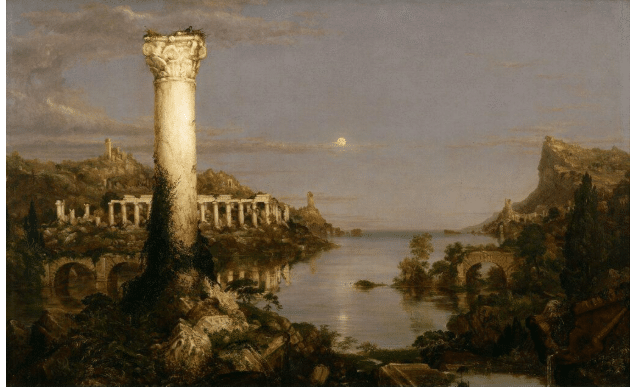
Thomas Cole, The Course of Empire, Desolation, 1836
“The sunrise of the first painting is mirrored here by a moonrise, a pale light reflecting in the ruin-choked river while the standing pillar reflects the last rays of sunset. This gloomy picture suggests how all empires could be after their fall. It is a harsh possible future in which humanity has been destroyed by its own hand.”
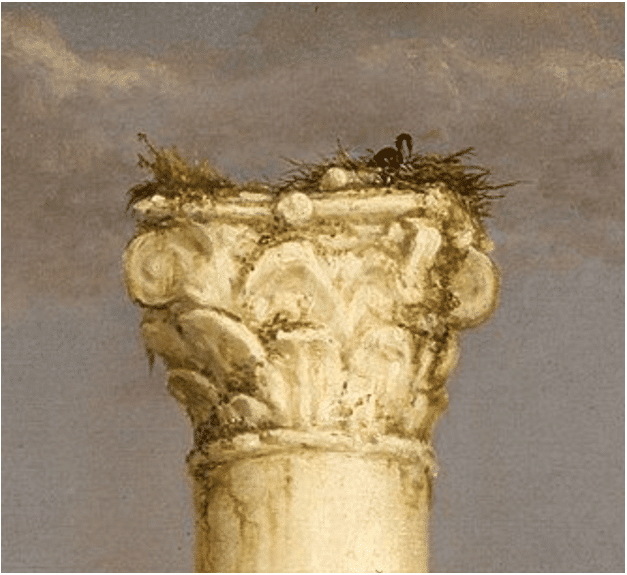
However, the scene is not without flickers of life and hope. Nature, the only constant, begins the cycle anew, for signs of life’s regeneration appear. Most noticeably, atop a single, ruined pillar, the sculptural stonework worn down by time, lichens and mosses seem to be growing, and a great blue heron sits upon its nest, neck bent in the attitude of feeding her young.
If you’re ever in D.C., they’re wonderful to see in person at the Smithsonian Museum of American Art. They occupy one side of a specially made octagon, the other side of which contains Cole’s other major series, “The Voyage of Life.” We’ll look at that in detail next, for these are often overlooked treasures of historical American art. They should probably be taught in every schoolroom in America.
Light Curves: the Masterful and Stylish Realism of Jeannette Passin Sloan
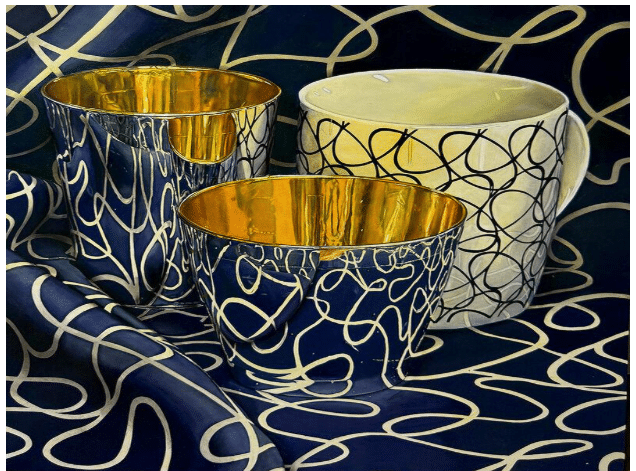
Jeannette Passin Sloan, oil on panel, 30 × 30 × 1 1/2 in | 76.2 × 76.2 × 3.8 cm
Jeannette Passin Sloan’s work intertwines the intimate details of domestic life with a strong drive for artistic innovation. Her photorealistic prints and paintings sell for five figures in major galleries in New York and elsewhere.
As a young mother in a small apartment the 1970s, Sloan put her children to bed early so she could paint at her kitchen table “studio.” Her work took a significant turn when she noticed a reflection in a toaster that she was painting. It was the age of photorealism, with paintings like Ralph Goings’s, in which ordinary (and immanently American) objects are portrayed in an ultra-real manner, accomplished by faithfulness to the complexity of their light-infused urban settings.
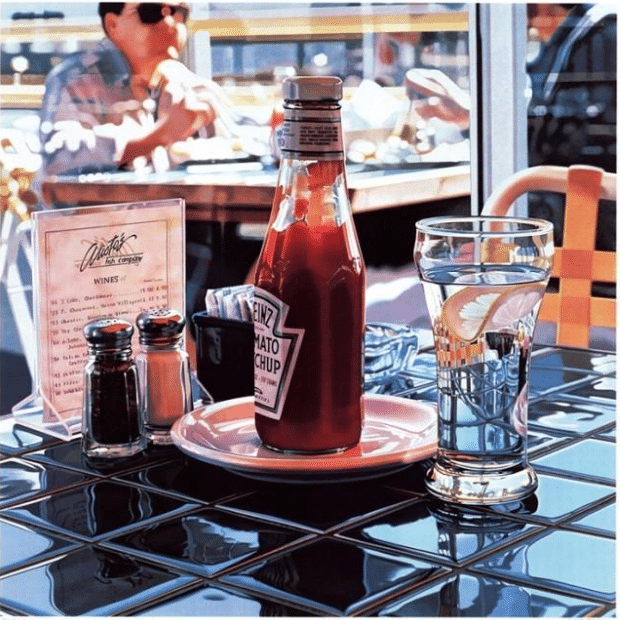
Ralph Goings, “Dinner Still Life with Ketchup Bottle,” c. 1979, lithograph, 34×33 in.
Sloan earned an MFA from the University of Chicago, where she studied art history. Sloan’s father was an Italian immigrant who founded Radio Flyer wagons in the United States. He often took her back to Europe to see the great artworks of history.
She was particularly enamored with works of the masters and studied closely her perceived “competition,” including the photorealists, dreaming of being able to paint like them or better.
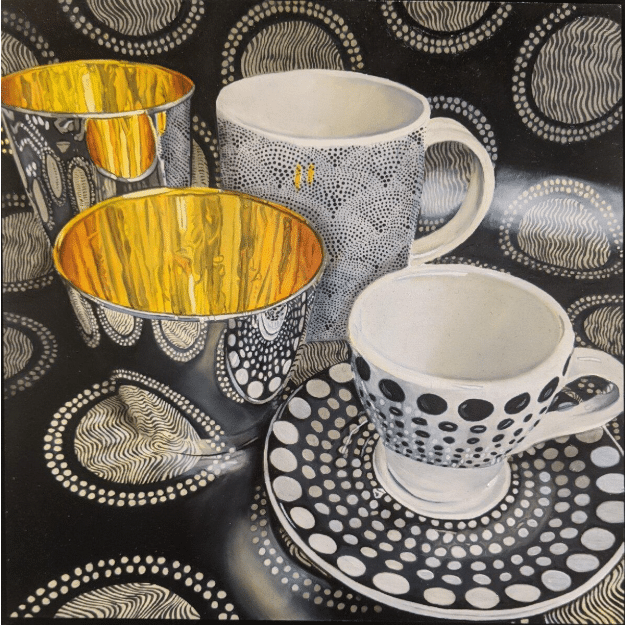
Jeannette Passin Sloan, “Café,” oil on panel, 12 × 12 × 1 1/2 in.
Traditional gender roles often limited women’s creative pursuits – but she took a hint from prevailing trends. She found meaning in the reflective surfaces of her kitchen—her chrome toaster and silver teacups. She sees these everyday objects as something we all share and know intimately. She aims to create the most precise compositions from these objects, analogous to striving for possibility and excellence in our own daily lives.
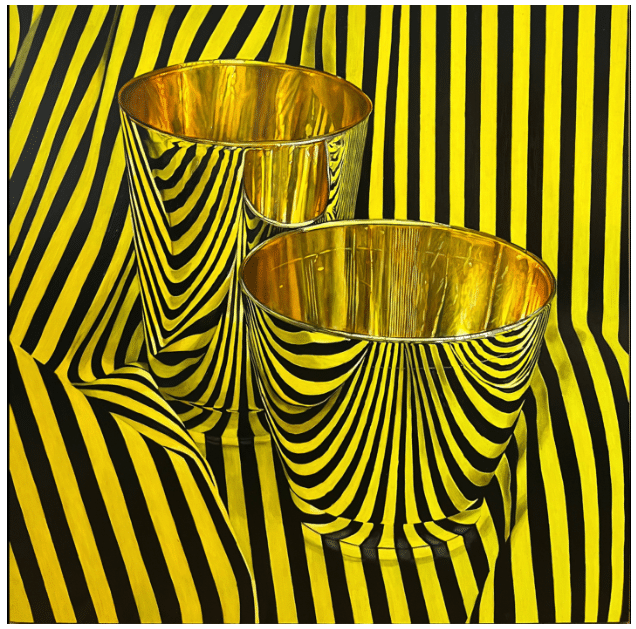
Jeannette Passin Sloan, “Light,” 2025, oil on panel, 30 × 30 in.
Her work melds the spirit and optical pyrotechnics of Pop Art and Hyperrealism with the traditional still life concept and subtle commentary of the domestic and the history of the position women have occupied both inside and outside of painting and other visual media.
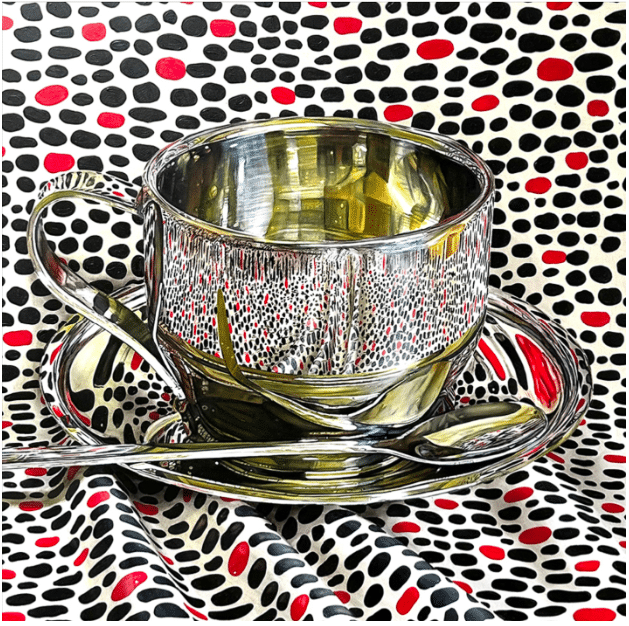
Jeannette Passin Sloan, oil on panel, 30 × 30 × 1 1/2 in | 76.2 × 76.2 × 3.8 cm
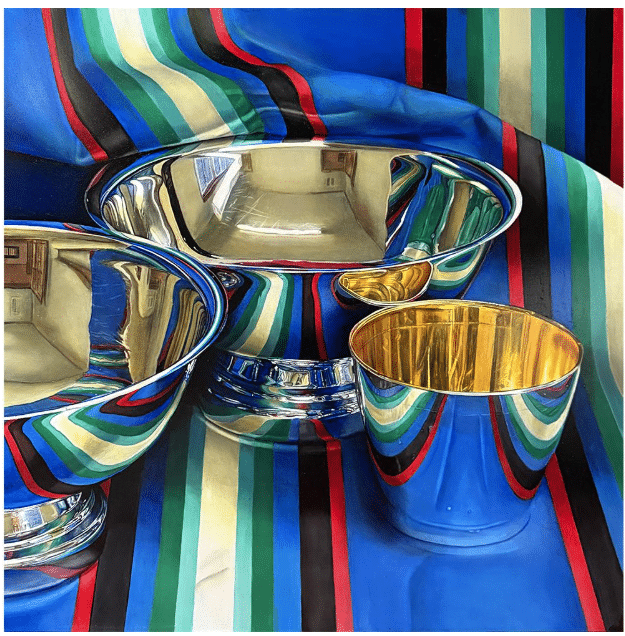
Jeannette Passin Sloan, Silver Bowls II, oil on panel, 30 × 30 × 1 1/2 in | 76.2 × 76.2 × 3.8 cm
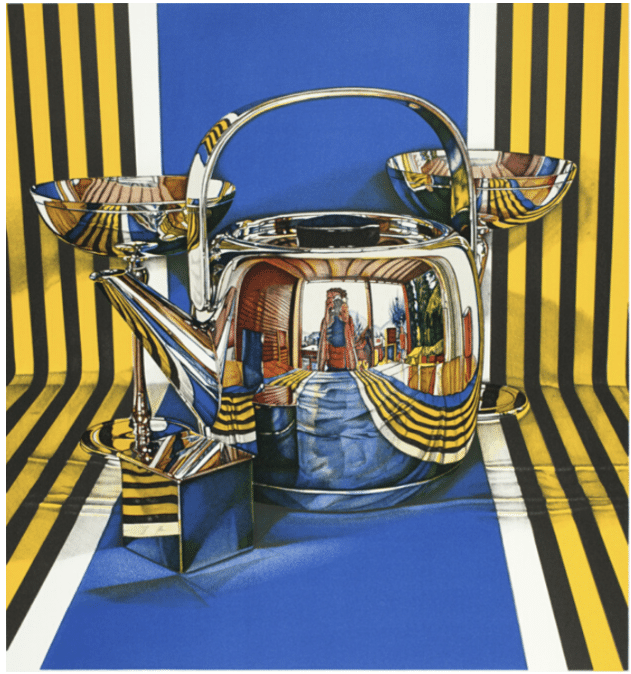
Jeannette Passin Sloan, “Sargent, First Class,” 1986, color lithograph on white wove paper, 22 × 21 in.
If paint glass and textured surfaces seems daunting, let Lauren McCracken crack the code for you in his teaching video, Watercolor Realism, Glass & Wood.