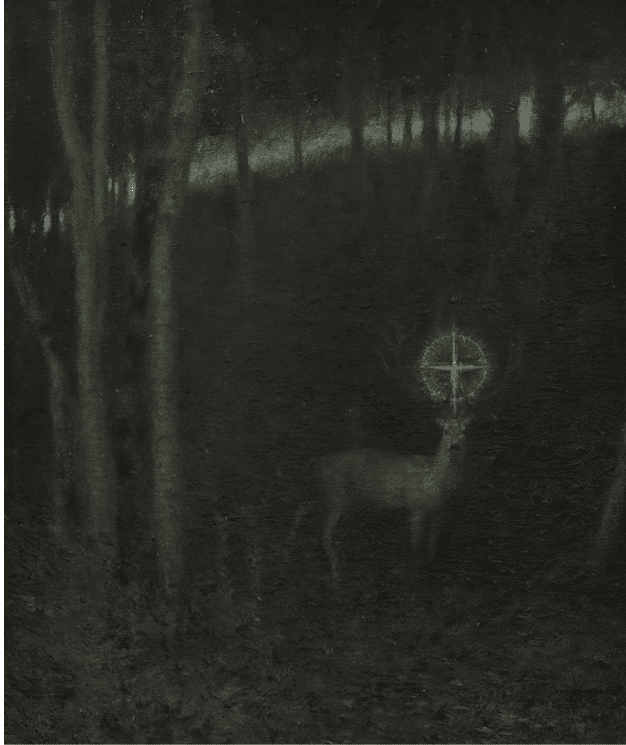
It’s a dark, Symbolist masterpiece depicting the legendary moment when a hunter sees a glowing crucifix between a stag’s antlers, symbolizing a divine calling.
Franz von Stuck’s “The Vision of Saint Hubert” (1890) presents the legendary conversion of Saint Hubert with striking restraint and symbolic depth. With its atmospheric shadows, holy silvered lights, and cold Plutonic tones, it is a perfect painting for the winter solstice (December 21). The solstice is the shortest day and longest night of the year (in the Western Hemisphere that is), and it comes with the promise that each day after, the light will gain and the day last a little bit longer.
According to the medieval tale, Hubert encounters a stag bearing a glowing cross between its antlers while hunting. The encounter leads him to abandon his worldly pursuits and embrace a spiritual path. But Stuck goers far beyond illustrating the vision with divine radiance or dramatic action.
Stuck’s forest is dark and dense, the stag barely visible. Nature here is not just a backdrop but a vessel for the sacred. Nor is the stag simply a hunted animal. Stuck uses deep gloom, radiant light, and the mysterious forest clearing to create an intensely spiritual, dreamlike scene of introspective silence, putting us, the viewers, in the perspective of the Saint, as though experiencing the sacred revelation for ourselves, directly.
The faint light from the cross draws the viewer into the quiet intensity of this moment in which the boundary between the seen and the unseen, between the earthly or natural world and the divine, briefly dissolves. “The Vision of Saint Hubert” is housed today in the Museum Villa Stuck in Munich, Germany.
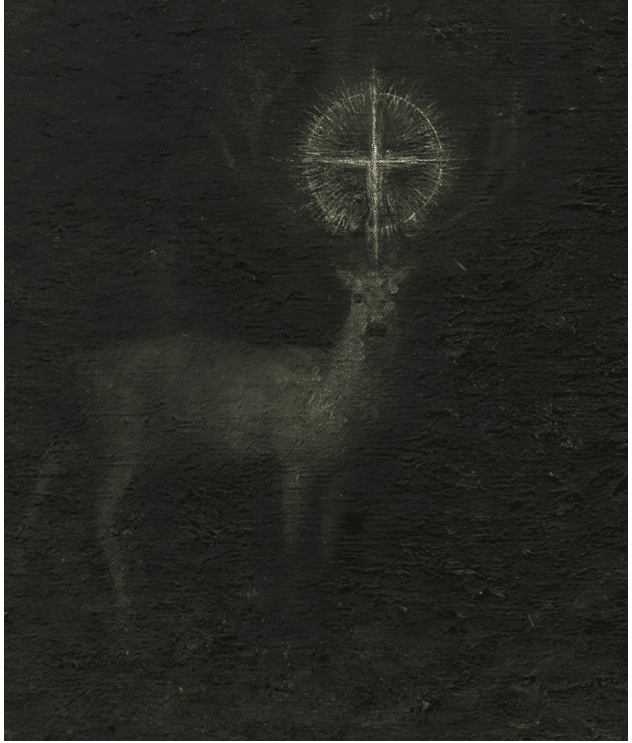
Detail: Franz von Stuck, “The Vision of Saint Hubert,” 1890.
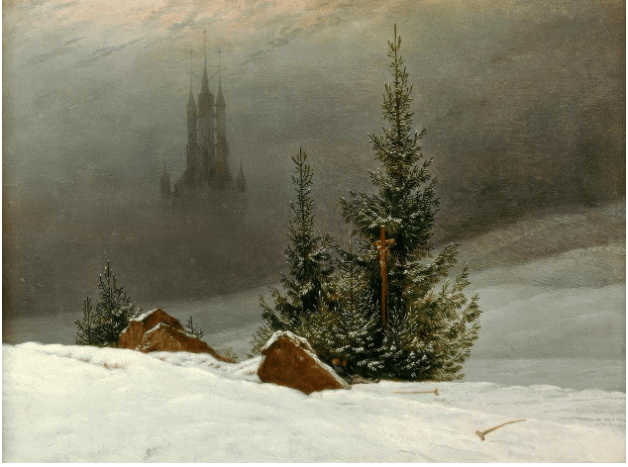
Casper David Friedrich, Winter Landscape with Church (and Cross in the Mountains)
Though very different, the painting “Winterlandschaft mit Kirche” by Caspar David Friedrich is full of its own mystical, gloomy scenery.
The sky is lit with yellowish-red and blue-gray hues, suggesting that the sun is setting early on this midwinter day. In the background, a gothic-inspired church looms eerily behind the scene. The deeply recessed church, its towers getting lost in snow and mist, is perhaps the first thing that attracts the eye; the figure leaning against a stone only emerges on closer inspection.
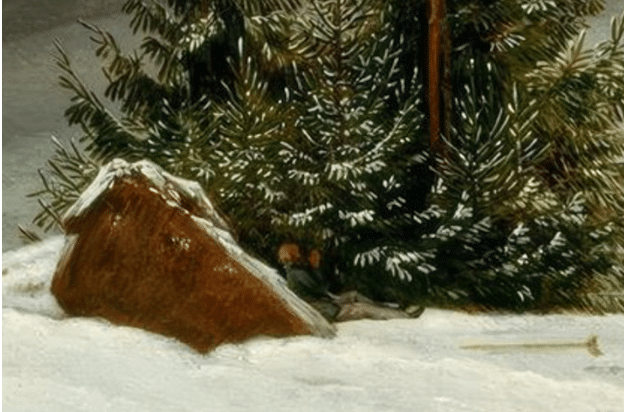
Detial: Casper David Fridrich, “Winter Landscape,” showing the man praying before the wooden cross, wearing only a thin coat, with inadequate boots, no hat and no backpack, sitting where he presumably staggered after discarding his remaining crutch.
The man sits with his pants probably getting cold and wet in snow, his hands folded in prayer. He has thrown aside his wooden crutches, unwilling or perhaps unable to continue. His gaze is fixed on a wooden crucifix standing between large and majestic firs.
Has the figure hiked to this lonely outpost just to pray, or is it to die? Was it to humbly seek salvation and to approach divinity in nature rather than in the extravagant edifice of the Church? As in von Stuck’s “Vision,” we have only a cluster of evocative images, a mystery rich with inconclusive clues. And that is perhaps the paintings’ greatest strength of all.