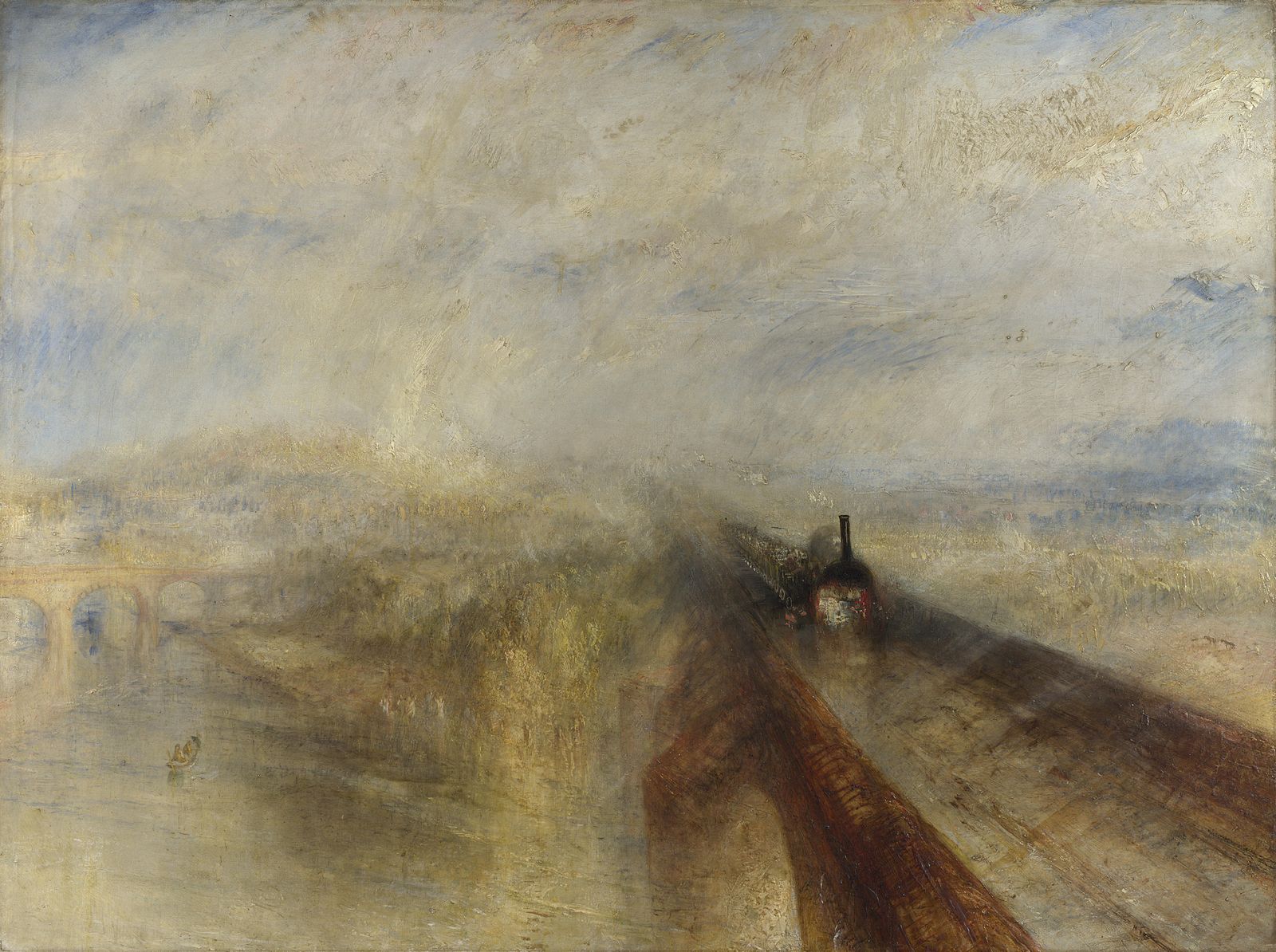
The greatest works of art both transcend and speak directly to the artist’s own time and to ours. JMW Turner’s Rain, Steam, and Speed – The Great Western Railway pictures the primal elements of nature in flux – earth, air, fire and water – in light, water, rain, clouds, vapor – and the furnace of modern industry in the form of a speeding train.
It all revolves around the central issue of Turner’s time, and our own: The passing away of a more idyllic, rural past as the new, urban, technological age barrels inexorably toward and past us, into the future.
Rain, Steam, and Speed – The Great Western Railway stunned the world when Turner exhibited it in 1844. Yet Turner’s work directly inspired far more radical forms including Impressionism, such as we meet it in Claude Monet’s St. Lazare Train Station (below).
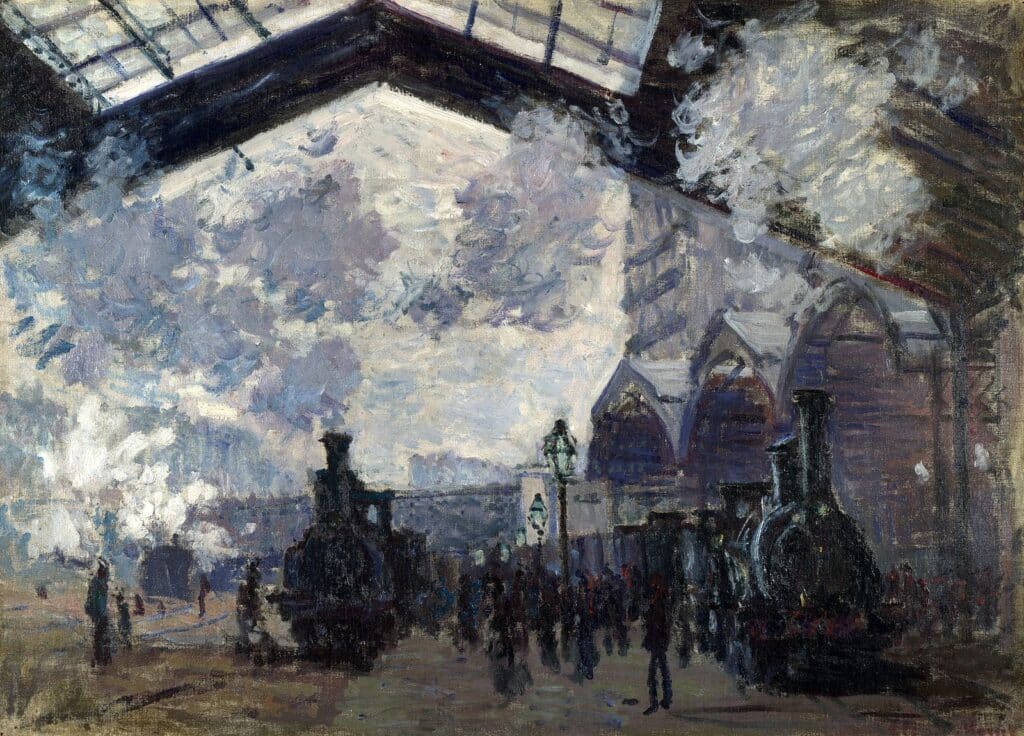
Claude Monet, The Gare St-Lazare, 1877
By comparison, Monet’s brand of “steam and speed” (above) has a more immediate and harsher impact – at the time, Monet’s dark engines and crowded platforms constituted a strong declaration that daily life in the modern world was now a subject worthy of serious art. By 1877, modern industrial life had arrived full force. Thirty-three years earlier, Turner saw it coming.
Turner too wanted to paint modernity rising, but he took a more philosophical, almost mystical approach. If we are willing to take the time to see all that he’s put into it, Turner’s “Rain, Steam and Speed” of 1844 reads like a sprawling epic poem, even a heartbreaking one.
First of all, it’s suffused with an atmospheric, light-filled mist; everything (except, that is, the oncoming train) seems about to dissipate into vapor. Both visually and symbolically, this painting is a kind of postcard from a world evaporating before our eyes.
We know this because Turner has tucked something very significant into the far lefthand corner of his painting, below the sooty bridge that thrusts itself into the viewer’s space. He’s depicted (so far to one side that it’s about to be left behind) a lyrical Golden Age dissolving in a honeyed mist. Look closely (see detail below) and you’ll see a couple enjoying a peaceful boat ride – the old technology of travel – dematerializing in a sun shower (one’s got an umbrella). There are also several allusions to the vanished ideal of the Classical Age, beginning with the Roman aqueduct and a silvery colonnaded palazzo (or temple?) just behind that:
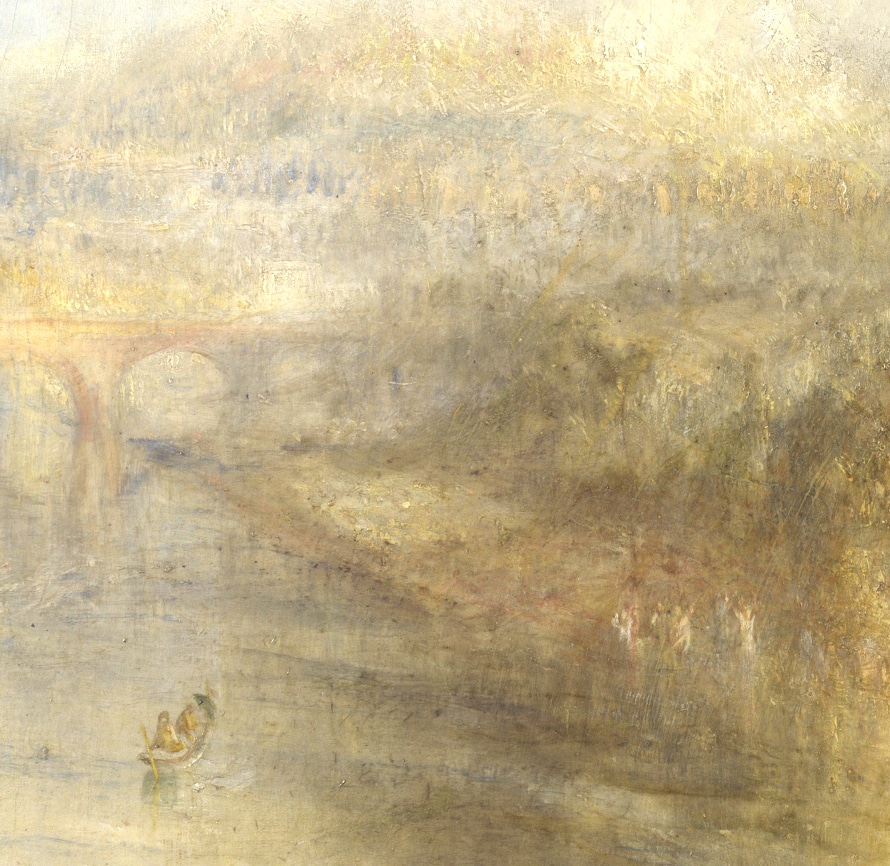
On the shore (off to the right of the boat), Turner has painted a group of dancing figures. They’re borrowed from the European tradition of Pastoral painting – which was all about idealized scenes of humanity in harmony in nature. Pastoral landscapes pictured a simpler time full of garlanded shepherds, maidens, and mythical figures such as nymphs and satyrs in imagined classical settings doing things like celebrating the rites of Pan (Bacchus) God of nature, wine, and liberty, as in this example (below) by Poussin from 1625. As Turner’s painted them, the figures are merely the fading ghosts of a fabled age gone by.

But the most poignant and telling detail in Turner’s painting is also the easiest to miss. Barely visible in front of the charging steam engine, a rabbit, trapped on the bridge, bounds forward, running for its life, as if trying to outrun the train (see the detail below, brown and white bounding rabbit with a shadow where the arrow’s pointing – hard to see in reproductions online but it’s there).
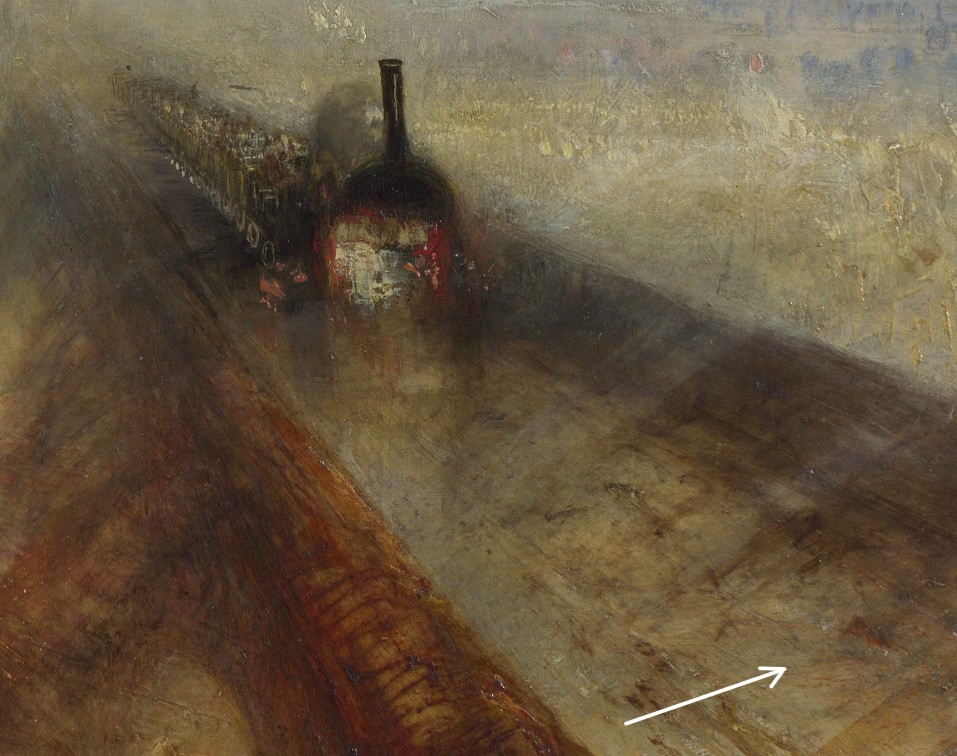
So there’s this tiny drama happening in this big painting of natural elements swirling and tumbling as epochs of civilization rise and pass and the new modern age looms, a direct, unstoppable threat to nature. And in that tiny, very understated drama, we have in miniature, in metaphor, the whole passion play of the agrarian Old World (“Mother Nature on the run” if you like, as Neil Young said), fading into a golden mist behind the relentless progress of Western civilization – of which you and I today are at once part, cause, and startled witness.
In terms of technique, Turner threw down a gauntlet that still taunts artists everywhere. His nebulous paintings of elemental nature in motion – canvases like “Rain, Steam, and Speed,” awash with light, water, clouds, vapor, and precipitation – have challenged painters since the 1840s to paint nature in flux without stopping it in its tracks. There are still challenges but a lot of “institutional knowledge” has accrued since then, and it’s available from the source – the pros – in an array of exceptional teaching videos. See some of what’s available right here.