During the first half of the nineteenth century, America’s first exciting period of “homegrown” art coalesced around what came to be known as the Hudson River School.
Painted during the halcyon period prior to the Civil War, canvases like Asher B. Durand’s “White Mountain Scenery, Franconia Notch, NH.” (below) threw an aura of beauty and serenity over the scenery of North America using techniques and compositions learned from the history of European landscape painting.

Asher B. Durand, White Mountain Scenery, Franconia Notch, NH., 1857. Approx. 40 x 60 in.
Their name was a tongue-in-cheek label coined by a wry critic (he wasn’t wrong though!), but their work was wildly popular. Dozens of painters created images of breathtaking vistas and views of abundant forests and pristine rivers, galvanized by Thomas Cole’s bravura paintings of the sublime mountain-scapes of New Hampshire and New York’s Hudson River Valley.
But this artistic celebration of the Western world’s “New Eden” would not remain in favor long past mid-century. Former rockstar artists like Asher Durand, Albert Bierstadt and Edwin Church found it harder and harder to find buyers for their majestic, cinematic canvases. Part of the reason their work lost its favor has to do with what was happening outside their studios, namely, the political equivalent of an expulsion from paradise.
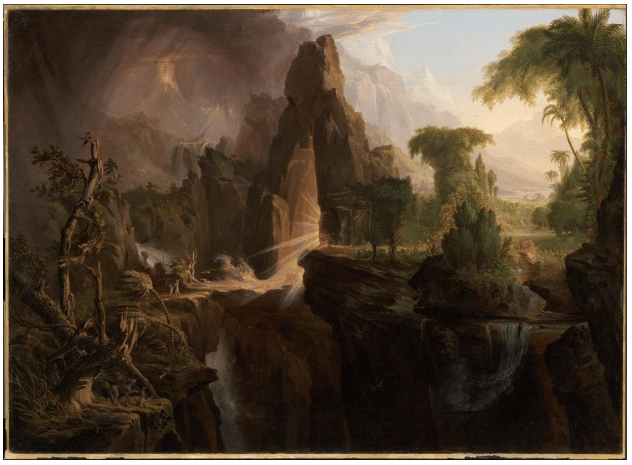
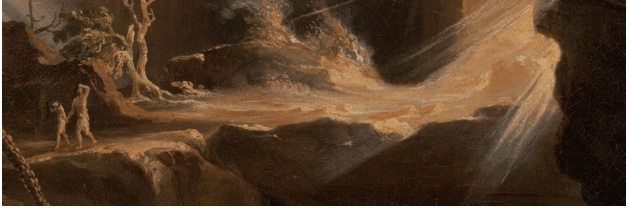
Thomas Cole, Expulsion from the Garden of Eden, 1828, oil on canvas, 39 3/4 x 54 1/2 in. In his 1835 Essay on American Scenery, Cole described the beauties – and the hostilities – of the American wilderness as a metaphoric Eden. Below: Detail of the figures of Adam and Eve being cast into the wilderness.
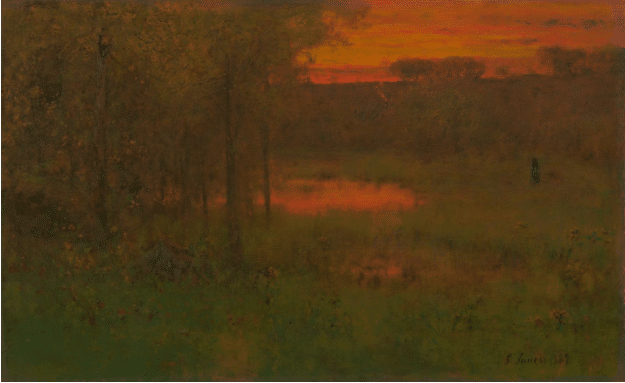
Art historians have pointed out that after the American Civil War (1861-1865), the mood in American landscape painting changed, just as it had for the country. Artistic subjects went from optimistic, sparkling clear celebrations of divine beauty to moody, dimly lit meditations depicting not wilderness but “inhabited” land. What’s now called Tonalism wasn’t “caused by” the Civil War, but it arrived at the right time to suit a mood and fill a void.
This it did with dusks and twilights that often cast a veil of something very much like melancholy or self-reflection across the picture plane. Some art historians correlate the change with the general shift of feeling that the country had lost some of its innocence; when “brother fought against brother” as a country irreconcilably partisan and divided spiraled into civil war.

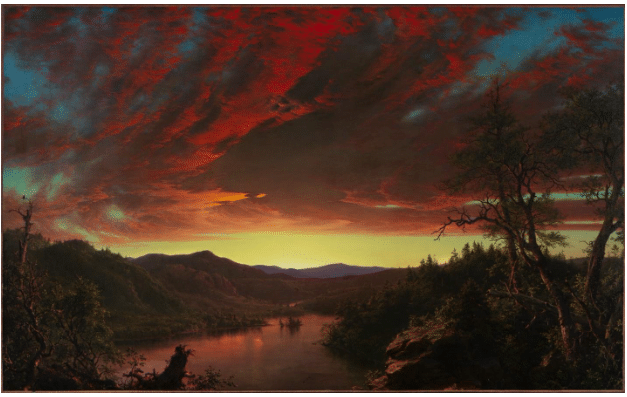
Frederic Edwin Church, Twilight in the Wilderness, 1860. Oil on canvas; framed: 124 x 185 x 13 cm (48 13/16 x 72 13/16 x 5 1/8 in.); unframed: 101.6 x 162.6 cm (40 x 64 in.). The Cleveland Museum of Art, Mr. and Mrs. William H. Marlatt Fund, 1965.233
On the eve of the Civil War, Frederic Edwin Church painted several dramatic sunsets. “Twilight in the Wilderness” has been seen as the turning point for Hudson River School painting. Church’s work in particular, much like the nation itself, had lost its “innocence” to visions of endings, nightfall, and bloodshed. The Wilderness itself was shrinking, being cleared by industrialization, the trans-continental railroad, but metaphorically, uncertainty had settled over the Republic.
We’ll look at the paintings and the changes they reflect in Part 2. Tonalism, check out these professional teaching videos.

Erik Koeppel, Lake George, NY, oil on panel, 10x 8 in.
And if you can’t get enough of the Hudson River School, contemporary artist Erik Koeppel has reverse-engineered everything from the colors they used to the way they depicted rocks, trees, mountains, clouds, and skies. His paintings have been avidly collected over the years, during which Erik has carved out the time to make two professional quality videos teaching what he knows. Check out his video Techniques of the Hudson River School Masters Volume 1 and Volume 2.