By Lori McNee
When I first started my journey as an oil painter, I found myself intimidated by color. Having spent years honing my drawing skills in black and white, the vast realm of hues and selecting the right colors proved to be confusing.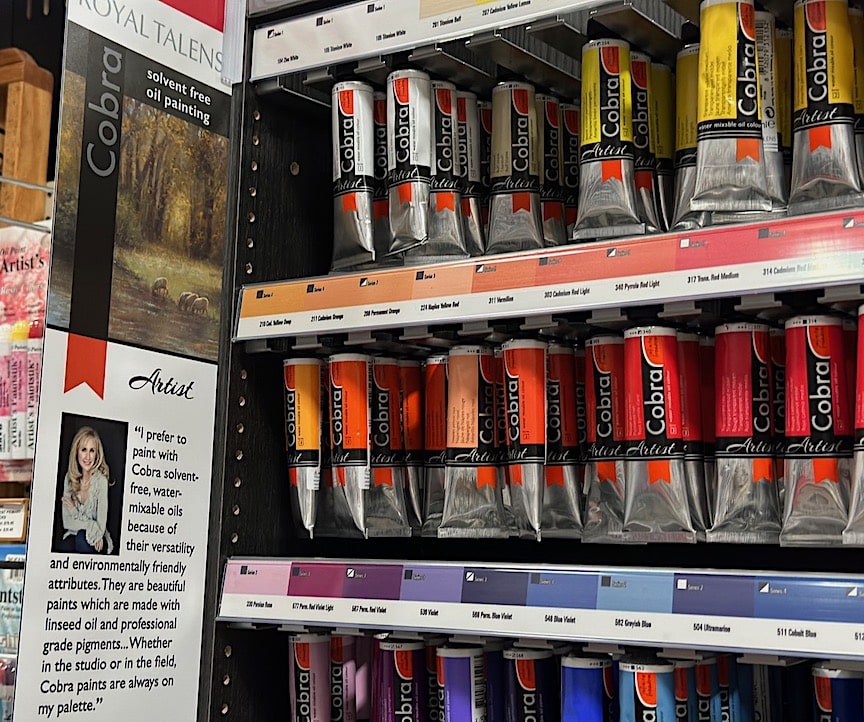
Without a clear understanding of color relationships, I assumed that using a broad spectrum of colors would automatically result in more visually appealing artwork. I hoped incorpor
ating many colors would make my paintings look more vibrant or realistic.
In hindsight, I wish I had been introduced to the concept of a limited palette much earlier. Little did I know that working with a restricted range of colors could unlock a world of artistic possibilities.

Lori McNee, “Rocky Mountain Alpenglow” 6×6, oil on linen. Painted with only four colors
A limited palette involves deliberately choosing a small, carefully selected set of colors for a painting, rather than being overwhelmed by the array available on a typical palette.
My first limited palette consisted of Cadmium Yellow Lemon, Ultramarine Blue, Permanent Green Deep, Madder Lake, and Titanium White. With just four colors, I was able to achieve beautiful color harmonies and values which led to many successful paintings.
Let’s explore some compelling reasons why embracing the power of painting with a limited palette can significantly enhance your artwork and artistic growth:
- Simplicity: A limited palette eliminates the overwhelming array of color options, allowing you to focus more on composition, value, and brushwork. Reducing the number of colors enables you to develop a clearer vision for your artwork, enabling you to express your ideas more effectively.
- Unity & Cohesiveness: Using a consistent set of colors throughout a painting creates visual cohesion that captivates viewers. The repetition of specific hues achieved with a limited palette results in a unified and coherent artwork.
- Color Harmony: A limited palette encourages a deeper understanding of color relationships and harmonies. Working with a restricted range of colors enhances your skills in color theory, enabling you to evoke specific moods and atmospheres through deliberate color choices.
- Improved Technical Skills: With fewer colors on your palette, you must rely on your ability to mix and manipulate pigments effectively. This process enhances your understanding of color mixing, tonal values, and the interplay between warm and cool colors. Working with a limited palette challenges your technical skills and encourages experimentation, leading to increased mastery and confidence in your artistic endeavors.
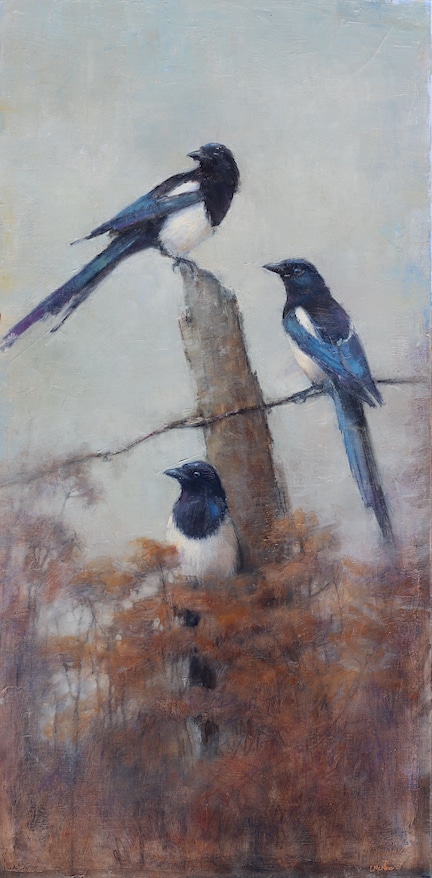
Lori McNee, Mid-Winter Magpies, 48×24, oil on canvas. Limited palette: Cad Orange, Ultramarine Blue, Permanent Green Deep, Madder Lake
These benefits inspired my evolution towards a Split Primary Palette, also known as a
Cool and Warm Palette. It consists of a cool and warm version of each primary color, along with white. My current palette (I use Cobra by Royal Talens) includes Cadmium Yellow Lemon, Cadmium Orange, Cadmium Red Light, Madder Lake, Ultramarine Blue, Cobalt Blue, Permanent Green Deep, Yellow Ocher, Transparent Oxide Red, and Titanium White. This versatile palette allows me to mix and match a variety of limited palettes, depending on the specific subject matter I’m working on.
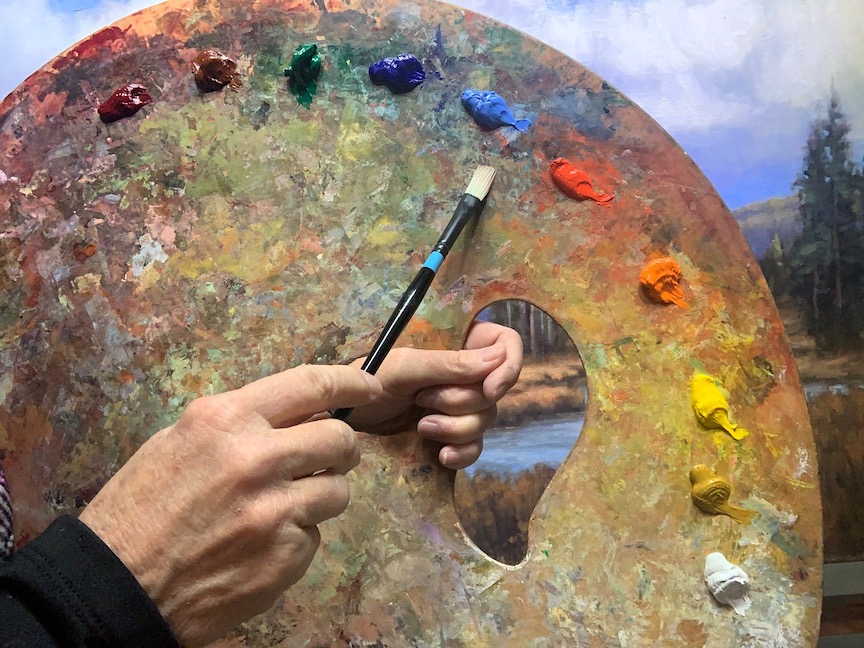
For instance, my recent painting titled “Midday Reflections” 30×30, oil on canvas was created using a double complementary palette of Cadmium Orange, Ultramarine Blue, Permanent Green Deep, Madder Lake, and Titanium White. This limited palette provided me with a great range of color and temperature to create beautiful harmonies. I was particularly surprised by the range of warm colors this palette achieved without the use of Yellow! In this case, less was more.
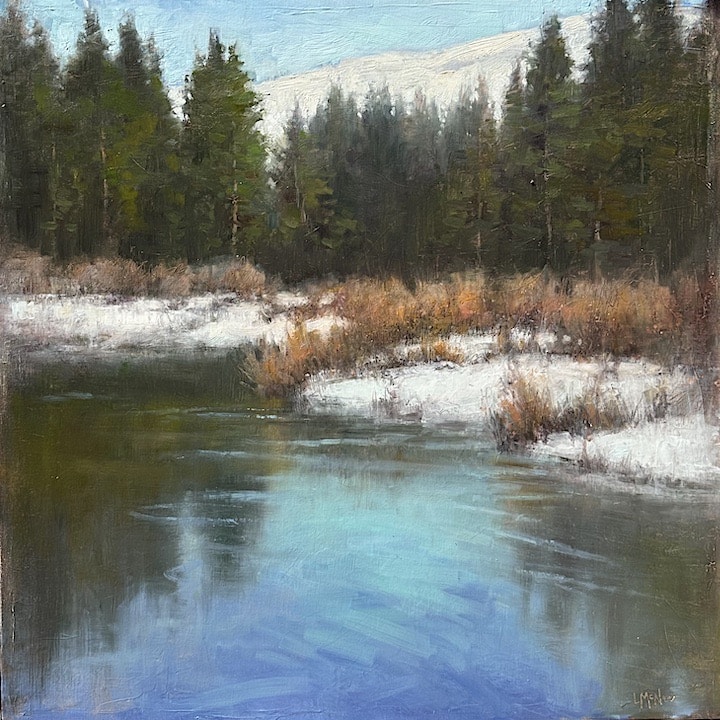
Lori McNee, “Midday Reflections” 30×30, oil on canvas. Limited palette: Cad Orange, Ultramarine Blue, Permanent Green Deep, Madder Lake
Embracing a limited palette has been a transformative experience in my artistic journey. It has allowed me to simplify my color choices, achieve visual harmony, deepen my understanding of color relationships, and enhance my technical skills.
I encourage fellow artists to explore the possibilities that a limited palette offers, to discover their own unique color harmonies, and to embark on a path of growth and artistic expression. By embracing the power of restraint, we can unlock a whole new world of possibilities on our canvases.
Lori McNee is a signature member of Oil Painters of America and The American Impressionist Society. She is an Ambassador Artist for Royal Talens and a certified Master Artist in Cobra Water-mixable Oil Paints. Website/blog: www.LoriMcNee.com and online art courses: https://art.lorimcnee.com/
Lori has a teaching video in which she demonstrates how to create beautiful landscape paintings full of mood and emotion in just a few hours. Check it out here.
Denver Show Traces Western Art to Eastern Allure
“Near East to Far West: Fictions of French and American Colonialism” on view through May 28, 2023

An Impressionistic landscape by Frederic Remington (after 1908). At this time he was exploring his own personal forms of the Impressionist vocabulary (this particular painting may not be part of the Denver exhibition).
The Denver Art Museum (DAM) is set to open “Near East to Far West: Fictions of French and American Colonialism,” a major exhibition of more than 80 paintings, sculptures, works on paper, and decorative arts that explore the many ways the style and substance of French Orientalism directly influenced American artists and their representations of the West.
France began its colonial expansion into Algeria in the 1830s, and its internationally admired artists’ scenes of what they saw there — and elsewhere in North Africa — soon presented a template for how American artists might depict the landscapes and people of the American West being transformed during the 1849 California Gold Rush and after. The Denver Museum show teases out how the styles, motifs, and meanings of both French Orientalism and Western artworks reflect their creators’ fears, desires, and curiosities about “unknown” lands during the process of colonization.
“In the 19th and early 20th centuries,” DAM director Christoph Heinrich says, “regions of the American West were as foreign and unfamiliar to many Americans as places like Morocco and Algeria were to Parisians. Through the paintings, this show begins to tease apart the facts and fictions presented in the art of the time.”
Artists in town for the Plein Air Convention & Expo (PACE) this week may want to take in the exhibition while visiting the city.
Every year, PACE brings the foremost artists in their fields to share their best practices and techniques for five days of high-impact art instruction. It’s a great chance to be part of a family of artists, to network, make friends, and celebrate everything plein air as you learn from the very top plein air painters in the world. Learn more here.