Johannes Vermeer’s The Art of Painting (c.1668) invites us to see in his work much more than consummate skill and flawless technique for capturing diffuse light from an unseen window (though … THERE’S THAT!).
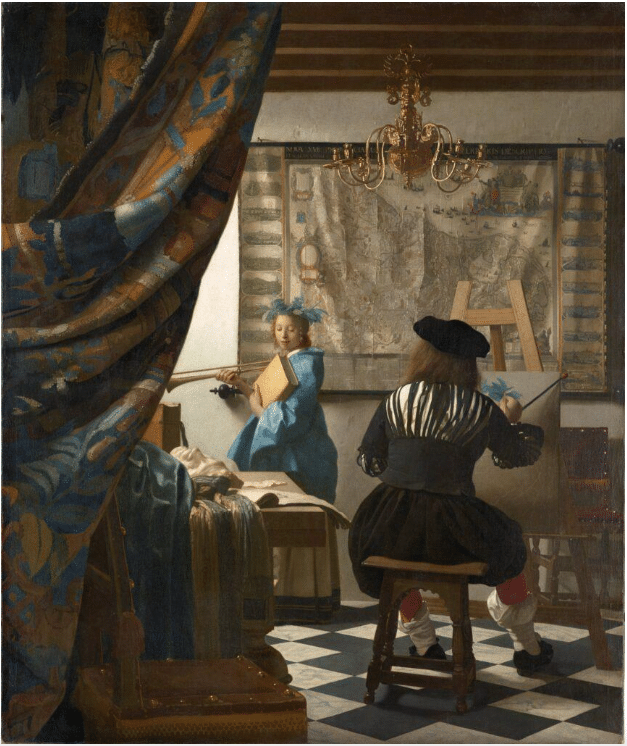
Johannes Vermeer, The Art of Painting
First, consider the composition and the setting. Check out the tapestry hanging along the left side of the painting. It’s been drawn aside like the curtain in a theater. This does more than beckon our attention into the work; its reference to theater and drama subtly announces that this is no randomly observed domestic setting but a carefully composed “stage,” a tableau laden with story and meaning(s). What’s more, the meaning relates to the creative arts, for this is The Art of Painting, also called The Allegory of Painting and The Painter in his Studio, and it is packed with carefully chosen evocative details.
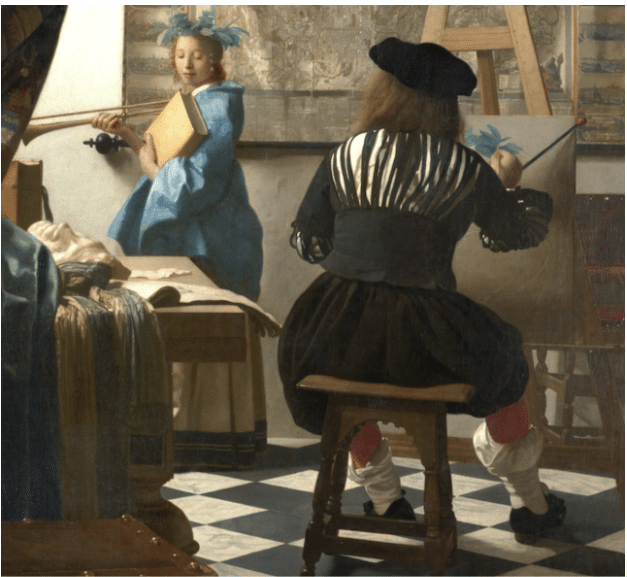
Vermeer shows us an artist (surely either himself or stand-in) painting a “muse,” a mythical goddess of creative inspiration, or perhaps an allegorical figure such as “Fame,” “Painting,” or “The Spirit of Art.” (Her eyes are closed probably to indicate that the model is not being painted for her personality – this is not a psychological portrait – but as a symbolic or allegorical figure who stands for something else.)
He’s outfitted the model with allegorical symbols – besides what I take to be the blue painter’s smock, she wears a crown of laurel leaves (classical symbol of valorous achievement). She holds a book in one hand and a brass instrument in the other, the former to indicate learning, the latter either in reference to music or to fame (that is if, as some do, we take the figure’s close resemblance to Clio, the Muse of History as described in a then-current manual for artists, as the actual motif).
There’s a plaster mask on the table, such as artists used for drawing, which alludes again to painting and might also point toward sculpture and the debate-of-the-day over which was the nobler art, the sculptor’s or the painter’s. In addition, the presence of a piece of cloth, a folio, and some leather on the table have been seen a more than just artist’s studio props; they’ve been linked to the symbols of the Liberal Arts, the ancient Greek and medieval branches of humanistic learning that included science, logic, and music,
On the wall hangs a large map of the Netherlands. Art historians have noted that a crease neatly divides the Seventeen Provinces into the north and south, likely to symbolize the division between the Dutch Republic to the north and the provinces to the south that were then under Austrian Habsburg rule. This interpretation might have appealed to Hitler, who owned the painting during World War II.
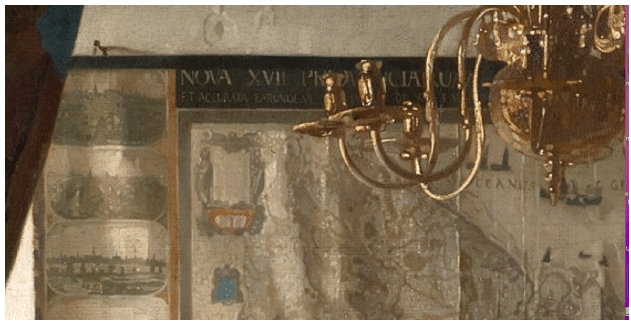
Detail of the map (barely) showing the allegorical figures in the upper left corner.
Throughout his work, Vermeer uses such intricate details not for their own sake but to carry suggestions of meaning. The map on the wall is even decorated with its own allegorical figures, including in the upper lefthand corner, one figure bearing a cross-staff and compass, the other a palette, brush, and a city view (so small they’re not even visible in this image online).
Adding all these elements up, the painting is about linking the virtues of painting to grander ideas of fame, nationalism, human achievement, and history. The Art of Painting then is an emphatic celebration of the nobility and worth of artistic achievement.
Vermeer never sold this work, so it’s thought he considered it a sort of record of his own achievement as well as a kind of showpiece of his sophistication and virtuosity as an artist – something that couldn’t fail to impress visiting patrons.
Art historian Walter Liedtke praised this painting “as a virtuoso display of the artist’s power of invention and execution, staged in an imaginary version of his studio …” and according to critic Albert Blankert, “No other painting so flawlessly integrates naturalistic technique, brightly illuminated space, and a complexly integrated composition….” – along with, I hasten to add, such a rich and mysterious poetry of potential meaning(s).
And so – hooray for the art of painting!
By the way, contemporary painter Virgil Eliott breaks down Vermeer’s style in his how-to video on traditional painting techniques.