
Johannes Vermeer’s The Art of Painting (c.1668) invites us to see in his work much more than consummate skill and flawless technique for capturing diffuse light from an unseen window (though … THERE’S THAT!). The more one looks, the more one discovers.
Some historical insight and some thoughtful analysis of this masterpiece can be a great way to brush up on your appreciation of the master as well as honing your ability to appreciate great paintings from the insider’s view – the way one artist understands another.
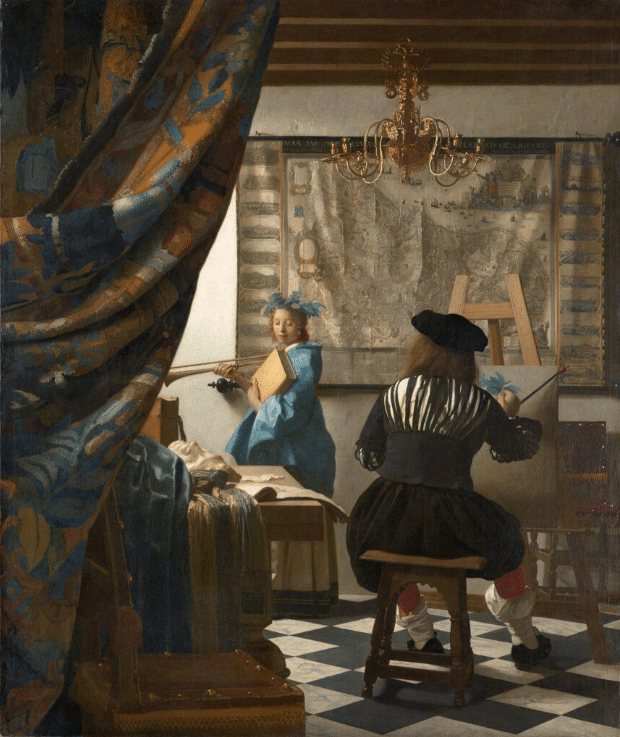
Johannes Vermeer, The Art of Painting
First, consider the composition and the setting. Check out the tapestry hanging along the left side of the painting. It’s been drawn aside like the curtain in a theater. Why? Are we getting a “behind the scenes” peek into the artist’s studio practice? This device certainly does more than beckon our attention into the work. At the very least, “raising the curtain” is a direct reference to theater and drama. Vermeer uses it to announce that this is no randomly observed domestic setting but a carefully staged “scene,” a tableau laden with story and meaning(s).
A little backstory (not to mention the title – titles are important!) tells us that the meaning relates specifically to the creative arts, for this is titled The Art of Painting, also known as The Allegory of Painting and The Painter in his Studio.
Vermeer shows us an artist painting not someone’s family member but an allegorical “muse” (a Greek spirit of inspiration), specifically Clio, the muse of history. (The way the girl is outfitted corresponds the directions given for representing Clio in a then-current handbook for artists). Her eyes are closed, further emphasizing that the model is not being painted for her personality – this is not a psychological portrait.
“He’s painting a model whom he’s going to transform into the muse of history,” says art historian Beth Harris. The idea of painting’s power to transform is central to this image.
There’s a plaster mask on the table, such as artists used for drawing, which alludes again to painting and might also point toward sculpture and the debate-of-the-day over which was the nobler art, the sculptor’s or the painter’s. The unusually sumptuous and fashionable outfit the artist wears suggests that Vermeer is raising the status of artists to a very high level of society at a time when artists were treated more like workmen than talented creatives with paints and chisels.
On the wall hangs a large map of the Netherlands. Art historians have noted that a crease neatly divides the Seventeen Provinces into the north and south, likely an allusion to the division between the Dutch Republic to the north and the provinces to the south that were then under Austrian Habsburg rule. (It’s thought that this interpretation might have had extra appeal to Hitler, who owned the painting during World War II.)
So while we’re lucky to have this painting at all, its sinister history only adds to its aura. “At the end of the war, the painting was recovered by the Allied forces and returned to the museum in Vienna,” says Harris. “It’s interesting to me that a painting that is about the role of art and history and the role of the artist in making history has such a complex and disturbing history itself.”
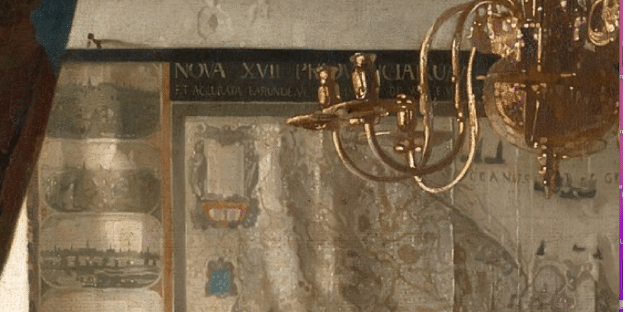
Detail of the map (barely) showing the allegorical figures in the left corner.
Throughout his work, Vermeer uses all kinds of intricate details not for their own sake (much less to prove his skill in painting them) but to carry suggestions of meaning. The map on the wall is even decorated with its own allegorical figures. In the map’s the upper lefthand corner, we see one figure bearing a cross-staff and compass (instruments of navigation, so alluding once again to world history), while the other figure holds a palette, brush, and a painting of a city view, pairing art with history once again. So the artist is being placed on the same level as the great explorers who altered world history, as if both are needed to run the world. The painting’s central theme is repeated here in miniature!
Adding all these elements up, the painting is about linking the virtues of painting to grander ideas of history, fame, nationalism, and human achievement on the world stage. The Art of Painting then is an emphatic celebration of the nobility and worth of artistic achievement.
Vermeer never sold this work, so it’s thought he considered it a sort of record of his own achievement as well as a kind of showpiece of his sophistication and virtuosity as an artist – something that couldn’t fail to impress visiting patrons.
Art historian Walter Liedtke praised this painting “as a virtuoso display of the artist’s power of invention and execution, staged in an imaginary version of his studio …” and according to critic Albert Blankert, “No other painting so flawlessly integrates naturalistic technique, brightly illuminated space, and a complexly integrated composition….” – along with, I hasten to add, AS WE HAVE SEEN, such a rich and mysterious poetry of potential meaning(s) – which art historians are notorious for failing to illuminate.
And so – hooray for the art of painting!
By the way, contemporary painter Virgil Eliott breaks down Vermeer’s style in his how-to video on traditional painting techniques.
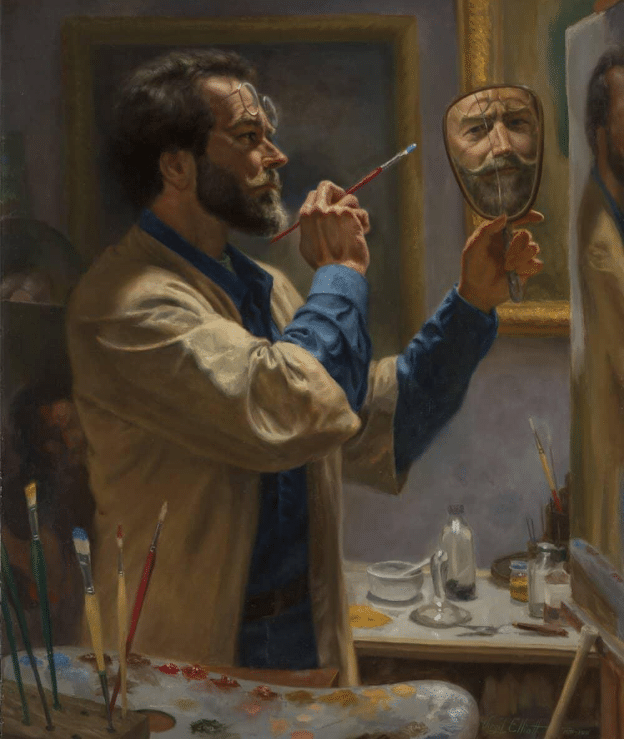
Virgil Elliott, “The Artist,” oil.
Virgil Elliott’s video, “Traditional Oil Painting – The Principles of Visual Reality” complements his bestselling book of the same title, which is available on its own and in combination with the video.