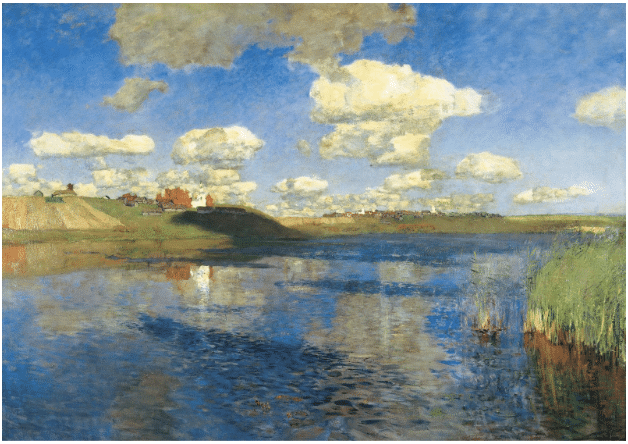
Lots of paintings are beautiful. Plenty elicit reactions like gorgeous, stunning, amazing! and whatnot. But when you stop to think about it, each “incredible” painting gets those accolades for reasons of its own – there is no universal formula or even a transferrable set of boxes to check for “wow”! So, what is it about THIS painting by Isaac Levitan that makes it such a knockout?
Sure, the colors sing in the “Russian Impressionist’s” Lake, and the value contrasts are more than enlivening – but that’s true of a thousand other, less out-of-the-park paintings. There’s more to the magic show here. Where color is concerned, look closely and you’ll see subtle integrations between the blues and related rusts, greens, ecrus, and golds – the warm rusts (could be Venetian red, raw Sienna, whatever, it doesn’t matter, there are dozens of ways to mix that color) stand out most on the buildings and rooftops of the towns but variants of that reddish earthtone weave through everything – the water, the grass and distant hilly shore, even the clouds. That’s not just a technical feature though – emotionally the result creates a strong sense of unifying wholeness and harmonious vibrancy.
Levitan is Russia’s greatest landscape painter, because he managed to portray the very character and strength of his native country. His largest mature works became national treasures almost as soon as they were dry. By the way, Levitan was born in 1918 in the village of Zherebets, which now in the Tokmak District of Zaporozhie Region in Ukraine, so technically, I guess it would be possible for Ukraine as well as Russia to lay claim to his “nationality.”
As for labels, it might seem strange at first to call him an Impressionist. His colors are deeply vibrant rather than suffused with air and light like Renoir’s or Monet’s. The overall feeling is crisp – his focus sharp, not softened. He does adopt Impressionism’s photography-influenced cropping and, more importantly perhaps, the movement’s emphasis on the physicality of paint itself.
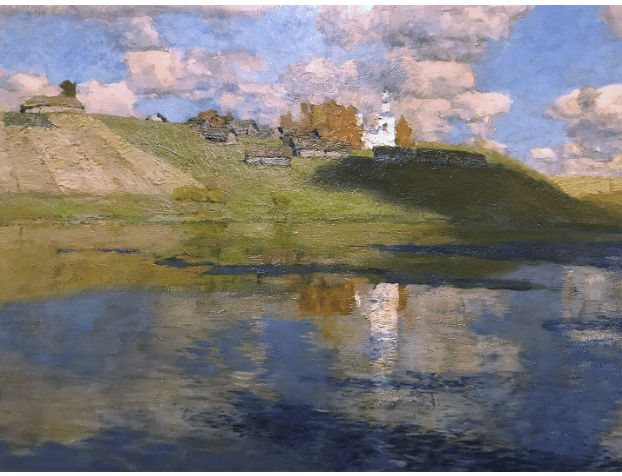
DETIAL of Isaac Levitan, Lake, (1899-1900), oil on canvas, 149 cm × 208 cm (59 in × 82 in). State Russian Museum, Saint Petersburg
As you can see that in the closeup above, large, broad strokes and expressive knifework emphasize the weight and materiality not just of the paint but of the subject – the land and the human relationship to it. Look how emphatically painted the church is – the paint handling emphasizes that it’s a made thing, a human-built house of worship, rendered with a rough, workmanlike quality, not delineated the way Vermeer would do it. I guarantee it wasn’t detailed with a Kolinsky sable brush.
Vibrant colors and strong tonal contrasts combine with the textured plains, mounds, and contours of the paint itself to say, “Look at me! I’m not just a picture, I’m a PAINTING that expresses one man’s sense of the relationships between man, God, and nature in the truth and beauty of our homeland!” All paintings, says art writer Lincoln Perry, “are human creations that are, in effect, self-portraits, either for the individual or as a species.” Levitan hands one in that’s both.
The sunlit clouds and white church and its reflection are “particularly massive and corpulent,” wrote a prominent Russian art historian of the 1940s. The result is a sense of the integration of the Heavenly <billowy clouds in the sky) and the earthly (the church , village and cultivated land) with an emphasis on the land’s solidity and by extension the country’s strength. It’s got to do with Levitan’s determination that this painting would represent an image of the whole country (which is why Levitan originally wanted to call it ‘Rus’).
A big part of that is that these could not have been the “real colors” of the scene. Levitan invested them not only with the subtle transitions and harmonies we traced above – but also with symbolic meaning: The yellow hue of the leaves and the withered fields suggest that it is autumn, while the lighting and clouds resemble those of summer, and the cool and tentative greens suggest spring. Here, past, present, and future timelessly combine.
As art historian Mikhail Alpatov says, Levitan managed to give “a collective image of his homeland” – in it you can see “the past of Russia, its present, nature, and man.” In this work, “both the personal experiences of the artist, and the very festive beauty of the world merged.” Alpatov, justly I think, dubbed Lake “a true song of joyful, triumphant, festive nature.”
Some quick diagramming shows that Levitan carefully managed his composition for maximum impact. Meshing diagonals, forming inward-pointing triangles, lead the eye directly to the object of sharpest focus and distinction – the white church on the hill and its reflection in the water.
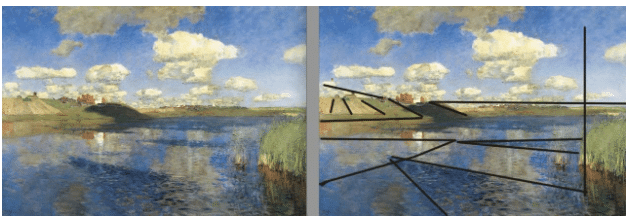
Side-by-side comparison showing triangles (joined diagonals) and leading lines.
You can also say that the overall composition is bounded by two triangles, one atop the other, and an implied “NO EXIT” horizontal along the right side, as shown in the next diagram.
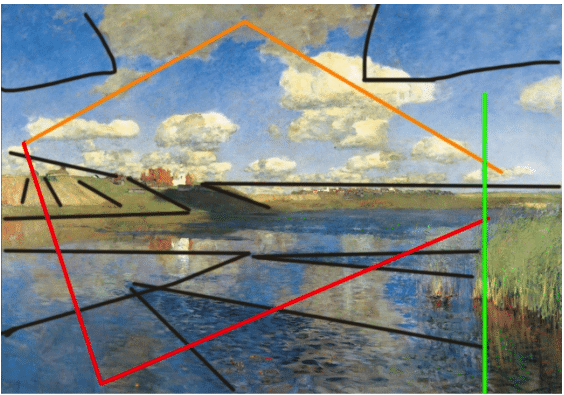
But those are just technical points after the fact. The true beauty of this painting lies in the artist’s felt desire to portray his country as a great poem of beauty and strength and in doing so leave the world with “a true song of joyful, triumphant, festive nature.” Now that’s painting!
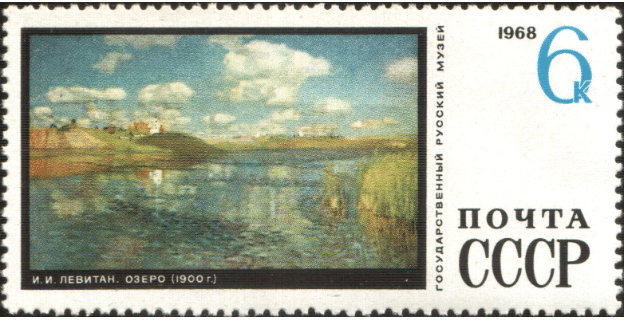
Here it is on a Russian postage stamp.
Once More to the Lake but This Time in Tahoe!
Don’t miss your opportunity to create lifetime memories at the 12th Annual Plein Air Convention & Expo (PACE). The next one is May 19-23, 2025 in Lake Tahoe and Reno!
AND SWITZERLAND
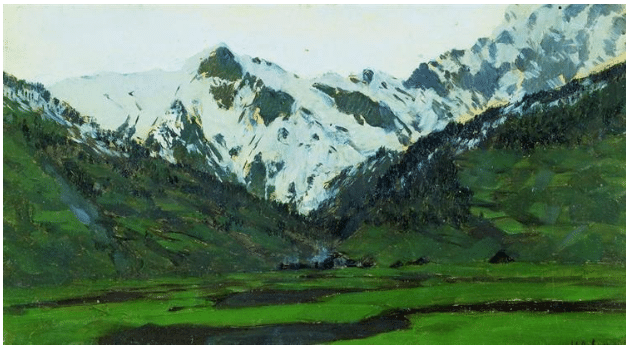
Isaac Levitan, “At the Alps in Springtime,” 1897, 50×83 cm.
There’s a new one this year too – Switzerland – a place that Isaac Levitan loved to paint! Eric Rhoads has designed an extraordinary and exclusive 11-day luxury painting trip through Switzerland’s secluded Alpine valleys and charming villages to create the ultimate body of work and a lifetime of memories. We’ll paint the same scenery which inspired Sargent, Monet, Renoir, Sorolla, Courbet, Cassatt, Pissarro, Bierstadt, Levitan and others. More info at https://www.paintswitzerland.com