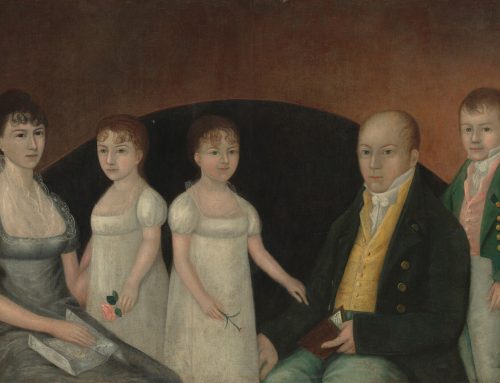
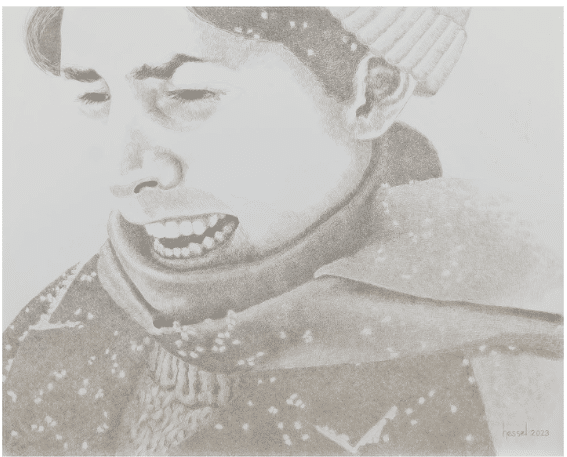
A silverpoint drawing is literally a drawing done in pure silver. Its primary tool is a pen or stylus with a soft metal point that leaves a metallic trace on a pigmented ground. It’s sort of a lost art these days, but there are a handful of contemporary artists who make it their primary medium.
Silverpoint enjoyed wide popularity during the Renaissance but it faded from use as better, cheaper, and more versatile materials for sketching (graphite pencils for one thing) became available during the century after (1500s). But drawing in silver and gold has its own aesthetic appeal. Artists use copper, gold, brass, platinum, and lead to leave a mark on a slightly abrasive surface, so the artform is often referred to as metalpoint.
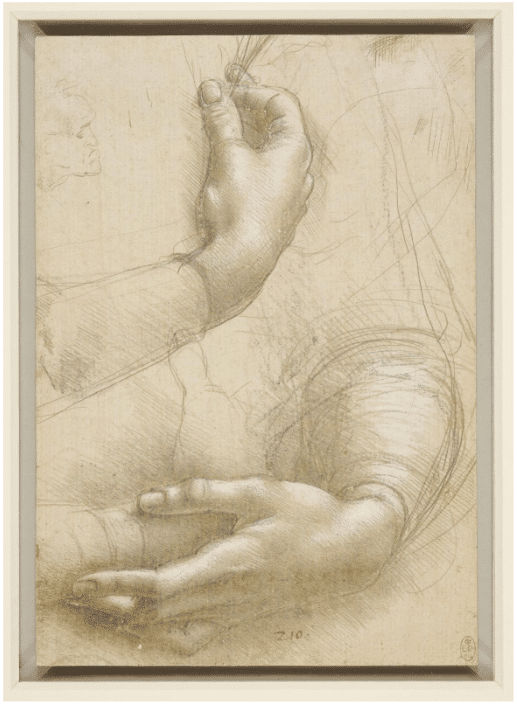
Leonardo DaVinci, study of a woman’s hands, c. 1490, 21.5 x 15.0 cm., charcoal, metalpoint, white heightening, on pale pinkish-buff prepared paper.
For Renaissance artists, especially apprentices in workshops learning to draw, metalpoint drawing had the advantage of impermanence at a time when paper was still a costly luxury. The prepared wooden panels artists used it on could be primed over and over again to start new drawings. Silverpoint was rediscovered in the 19th century after Cennino Cennini’s 1390 manuscript of Il Libro dell’Arte was found in the Laurentian Library in Italy and translated into English.

Traditional metalpoint tools included dry pigment, bone ash, hide glue and bristle brushes to prepare the ground and a variety of cast metal points, styluses and nibs. Today a few of the larger art supply stores provide pre-mixed ground and modernized silverpoint tools and tips. American tonalist and visionary artist Thomas Wilmer Dewing used silverpoint

Thomas Wilmer Dewing, “Head of a Girl,” 1909, 7 1/2 × 6 3/4 in., silverpoint on prepared wove paper
Silverpoint made a big reappearance in 1985 at a ground-breaking silverpoint exhibit, “The Fine Line. Drawing with Silver in America,” at the Norton Gallery and School of Art in West Palm Beach, Florida. The out-of-print catalogue book that came out of that show has attained a sort of cult status in the field. In 2006, the first of several “Luster of Silver” exhibitions of contemporary silverpoint artists drew an interested crowd at the Telfair Museum of Art in Savannah, Georgia.
“While most full-time silverpoint artists often follow the centuries -old techniques (which include using gold, copper, platinum and other metals in addition to silver), they are nonetheless pushing the medium out to new boundaries. Combining different media with silverpoint is technically difficult. But it is happening, and it demonstrates the medium’s ability to reflect and respond to today’s complex and challenging world,” according to SilverpointWeb, the Internet’s top clearing house for information on the medium.
One of metalpoint’s 21st century champions is Jeannine Cook. She’s been “beating the drum” for the medium in the U.S. and abroad, promoting events, exhibition catalogs, tutorials and the like.
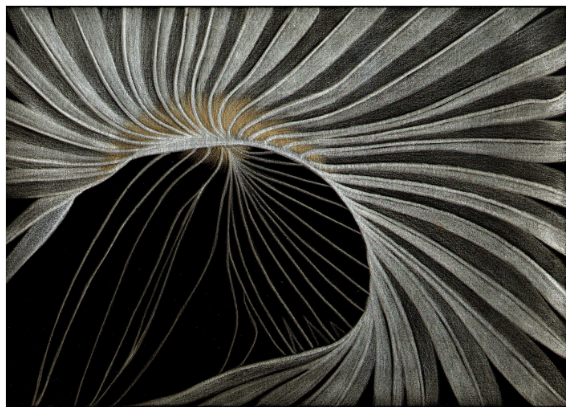
Jeanine Cook, Palmetto Frond, silverpoint, 7 x 10 in.
“Metalpoint lends itself wonderfully to the 21st century,” Cook says. “Its fine lines, shimmering and quiet, are the antithesis of today’s technicolour world, yet it has a power and fascination that can be memorable…. Working in a discrete, intimate drawing medium with a thirteen-century heritage appeals greatly to me. Giving metalpoint a voice that is relevant to our world today is a fascinating challenge, one that I love to share.”
Metalpoint drawing can be very unforgiving, because it’s almost impossible to erase or make corrections. It makes uniform lines, so no shading – you must use delicate cross-hatching to model form. And once those marks are applied to the surface, they’re staying there.
“For all of the challenges, there are also rewards for taking the time and effort to draw in silverpoint,” says contemporary silverpoint artist Tom Hessel. “One of the rewards is the warm patina that the drawing acquires, over time, as the silver oxidizes. Also, I’ve been able to achieve fine details and a richness of tone as I developed my technique for drawing in silver.”
Hessel uses a piece of masonite board, painted with several coats of gesso and sanded until it is smooth and hard enough for the silver to leave a mark. “Although this drawing process can be tedious and time consuming,” Hessel says, “I think the unique appearance of each of the drawings is well worth it.”

Tom Hessel, “Remnants,” silverpoint, 24 x 18 in. (2020)
No matter the medium, drawing skills are paramount. The good news is that drawing can absolutely be learned! Browse a variety of instructional sketchbooks, texts, and video tutorials collected at this link.

Metalpoint artist Jeanine Cook draws in silverpoint