It’s natural to assume that the subject of your painting (what it’s a painting of) is what affects your audience and gets feeling across. For example, you might expect a vase full of flowers to inspire in viewers the same or similar sense of joy and excitement you felt when you decided to paint it. But this same, common misconception will prevent you from capturing it in a meaningful, expressive painting.
Painting’s purpose more or less comes down to expression of one kind or another. The expressive artist sets out to paint “the truth of” (or at least their truth of) the vase of flowers. This means showing us, the viewers, why we should care about any bunch of flowers at all. No degree of sheer accurate observation and rendering of visual reality will achieve this. As Matisse advised, “Exactitude is not truth.”
“Expression, for me, does not reside in passions glowing in a human face or manifested by violent movement,” says Matisse. “The entire arrangement of my picture is expressive; the place occupied by the figures, the empty spaces around them, the proportions, everything has its share.”
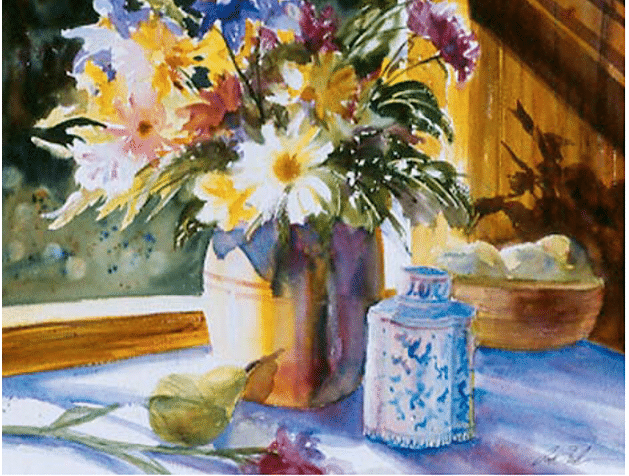
In Pat Fiorello’s watercolor In the Window (above) the subject is a vase of flowers beside a sunny window. But because of her expressive approach, it’s much more than a copy of what was there. It would probably have been impossible (were it even desirable) to create a precise, photorealistic rendering of the objects. Even if someone could, it would look nothing like In the Window – and would be missing everything surprising and delightful about this painting.
That’s because Fiorello worked with something like a “vision” of a vase of beautiful flowers drenched with morning light beside a window. She didn’t copy the flowers; she overlaid them with her feelings and painted how beautiful they looked to her in the light. To do so, she made a multitude of in-the-moment “editorial decisions.” To immediately see this, consider how much more her vase of flowers acts like a fountain of colored light than a gathering of botanical specimens.
Furthermore, she didn’t just simplify, bring out, or downplay certain details, edges, colors and shapes according to some outside formula or “principles of design.” Her choices were expressive.
“The entire arrangement of the picture,” as Matisse would say, “is expressive”:
- her choice to foreground splashes of white and bright yellow and gold-ochre in both the big central daisy and the sunlit side of the vase;
- the way edges blur around the lights, and for that matter how darkening the darks sets off the lights so they “pop,”
- the way the space around the flowers is filled with the play between warm bars of light and cool planes of shadow;
- and perhaps most important of all, how proportionately the mass of bursting flowers takes up more space than anything else. This last choice – filling the most of the frame with the bouquet as if we’re contemplating smelling them, allows the whole thing to burst like fireworks for the viewer.
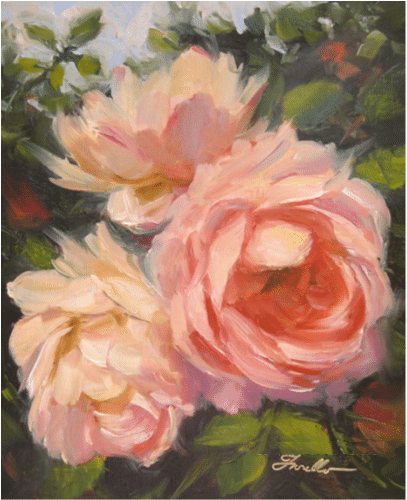
Pat Fiorello, Summer in New York, 10 x 8 inches, oil
There’s something similar at work in Fiorello’s “Summer in New York” (above). The flowers take up so much space in this composition they seem daring us to indulge in them. They’re full of lively and harmonious movement – the one on the right seems to me revolve counterclockwise to the left while the one on the left swirls clockwise toward the right, so that they mesh like turning gears, pushing us out toward the painting’s edges and bringing us back in again. The third flower (on top) bursts upward where the other two face relatively downward – all this dynamic up-down, left-right/right-left movement enlivens the surface – but it also, and most importantly, further expresses the joy and excitement (shared between the artist and viewers) of experiencing the life and beauty in flowers.
And the same for “homage to Claude Monet, Autumn in Giverny (below). Here again, the artist is not concerned with accuracy, copying, or “being faithful” to her subject (in this case, Monet’s waterlilies and garden blooms). She uses “the entire arrangement of the picture” to expresses the feeling of seeing them.
Expressive artists put whatever degree of skill they possess toward expression. They approach any subject matter with the unspoken question, How can I paint this thing so that other people will see in it what I see and care about it as much as I do? For this you either have to have a strong command of technical ability under your belt or consciously decide to paint the feeling of the thing rather than the thing itself.
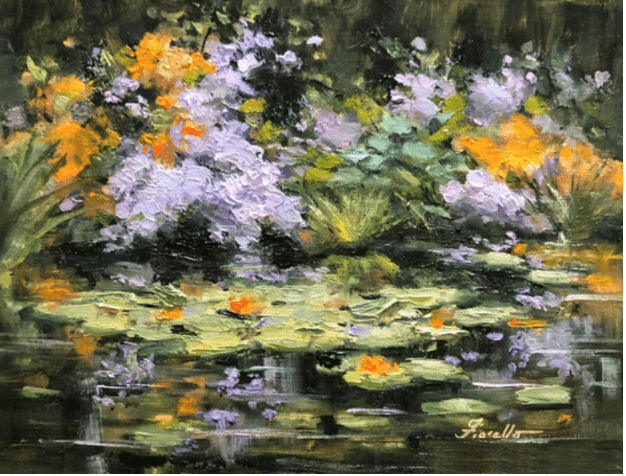
Pat Fiorello, Autumn in Giverny, 9 x 12 inches, oil
Either way, it comes down to starting with an “artistic vision” (i.e., “truth,” what you truly feel in front of the subject). The more creative and expressive artists allow whatever degree of technical ability they’ve developed to support their idea and therefore develop the skills needed for their particular flavor of expression as well as rendering.
The goal is to express what you feel and think about what you see in the world. It’s that simple – and that tantalizing a challenge.
Pat Fiorello teaches her methods and techniques for painting flowers in her teaching video, Elegant Still Life- Fresh and Fearless Painting.