Vincent Van Gogh’s still life paintings rivet the viewer with the same expressive immediacy and presence as do his vividly intoxicating landscapes and portraits. This is true of even the humblest of his motifs, including broken-down workers’ boots and shoes.
Worn-out shoes were an unusual choice of subject. The series (Van Gogh made at least five or six paintings of the subject) has inspired an unusual measure of commentary as well, including weigh-ins from some of the most important philosophers of recent history.
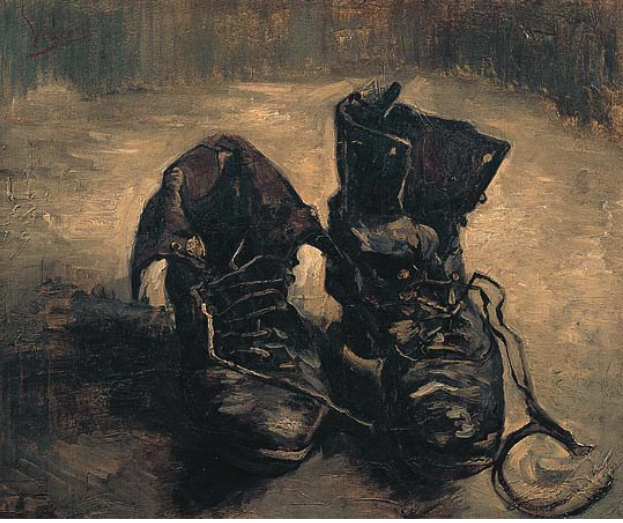
Turning to the painting. They’re clearly workers’ shoes, and it’s often assumed they’re symbolic of not just their former wearers but of basic struggles and hard truths of humanity. Vincent depicts his 1886 “Pair of Shoes” (above) much as he does his “Potato Eaters”(below). Painted around the same time, “The Potato Eaters” is a hugely expressive work showcasing his sincerity and his power to convey deep emotion and social commentary through his art. If the shoes in the painting above are Vincent’s own shoes, as one scholar has documented, it suggests that the artist saw himself working and striving at his craft as humbly as any “common” working man or woman. Vincent rendered the wearables as “so individual and wrinkled in appearance,” wrote the famous art historian Meyer Shapiro, “that we can speak of them as veridical (i.e. true to reality) portraits of aging shoes” and surely by extension their owners.
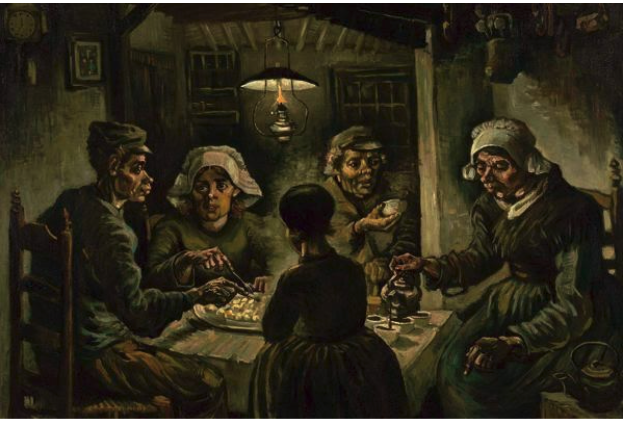
Vincent Van Gogh, “The Potato Eaters,” 1885, oil on canvas
Wrongly assuming the shoes belonged to an “old peasant woman,” one of the greatest philosophers of the 20th century, Martin Heidegger described the painting in an influential essay titled, “The Origin of the Work of Art” (1935) as follows:
“From the dark opening of the worn insides of the shoes the toilsome tread of the worker stares forth. In the stiffly rugged heaviness of the shoes there is the accumulated tenacity of her slow trudge through the far-spreading and ever-uniform furrows of the field swept by a raw wind. On the leather lie the dampness and richness of the soil. Under the soles slides the loneliness of the field-path as evening falls.”
Since then, it’s come to light that an acquaintance of Van Gogh’s in Paris described how the artist bought old work shoes at a flea market. Later he walked through the mud in them until they were filthy. Only then did he feel they were interesting enough to paint. So they may or may not have been 1. Vincent’s own shoes, 2. A working woman or man’s 3. Not that worn-out after all.
But Heidegger isn’t wrong. His famous description of the painting goes to the heart of Van Gogh’s visual-poetic achievement, regardless of the incidental facts around whose shoes they were or how Vincent acquired them. Heidegger continues:
“In the shoes vibrates the silent call of the earth, its quiet gift of the ripening grain and its unexplained self-refusal in the fallow desolation of the wintry field. This equipment is pervaded by uncomplaining anxiety as to the certainty of bread, the wordless joy of having once more withstood want, the trembling before the impending childbed and shivering at the surrounding menace of death. This equipment belongs to the earth, and it is protected in the world of the peasant woman. From out of this protected belonging the equipment itself rises to its resting-within-itself.”
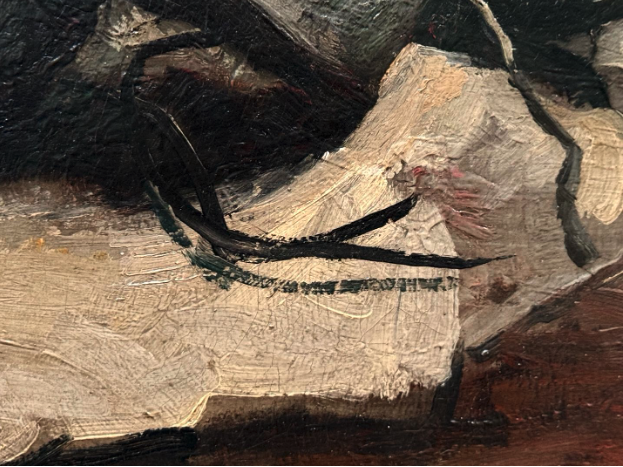
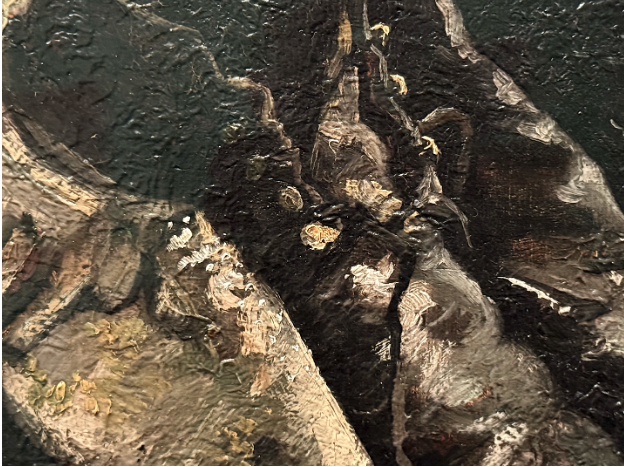
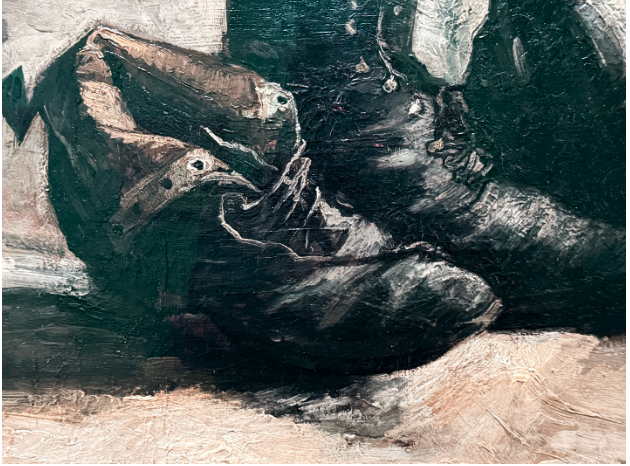
Many other important philosophers and art historians have written about van Gogh’s paintings of shoes, including Jacques Derrida. The French deconstructionist gave special attention to the painterly quality of the work, something we have been able to showcase in some closeups of one of Vincent’s shoe still lifes at the Fogg Museum at Harvard University.
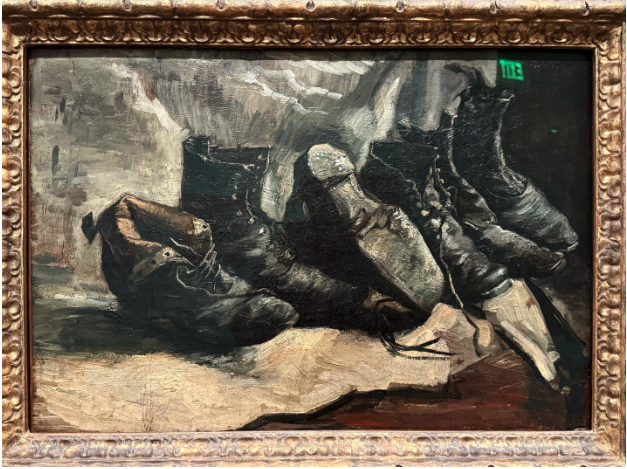
Vincent Van Gogh, “Three Pairs of Shoes,” 1886-87, Oil on canvas. Fogg Museum.
Writes Derrida:
“the laces go through the eyelets (which also go in pairs) and pass on to the invisible side. And when they come back from it, do they emerge from the other side of the leather or the other side of the canvas? The prick of their iron point, through the metal-edged eyelets, pierces the leather and the canvas simultaneously.”
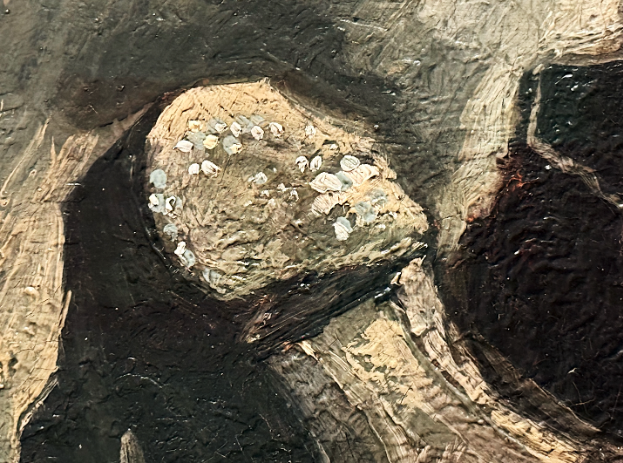
Closeup of Van Gogh’s “Three Pairs of Shoes” showing the “piercing” impasto of the almost sculptural nails in the heel of a Parisian laborer’s show.
“What, one wonders,” mused a New York Times writer reviewing an exhibition of the “Shoes” painting, “would Vincent make of all of this? What did he really mean by those shoes? Sometimes shoes are just shoes, but the visitor coming away from this exhibition may realize that a pair of shoes can contain an entire universe.”