Christine Lashley is known for colorful and dramatic oils that marry strong design with a process infused with artistic risk-taking. As she told us in an interview, keeping the “big idea” in mind and trusting intuition is key, but so is seeing – and composing – like an artist.
What does a scene need to have for you to want to paint it?
Sometimes it’s as simple as a “Wow, got to paint that” factor — something that makes me stop and look. Rarely is this due to a concrete singular object or thing (such as a bouquet of flowers). Usually complex items are better for me, with layers and reflections (the flowers + glass vase + refracted light and shadow).
What makes a painting vibrant from a value standpoint? (And how much more important is that than color — or is it?)
Value is absolutely essential to making any painting work. Even if you choose to disregard the value presented in reference (or artistically change it), value is the foundation that makes all aspects of art work (composition, color, and feeling).
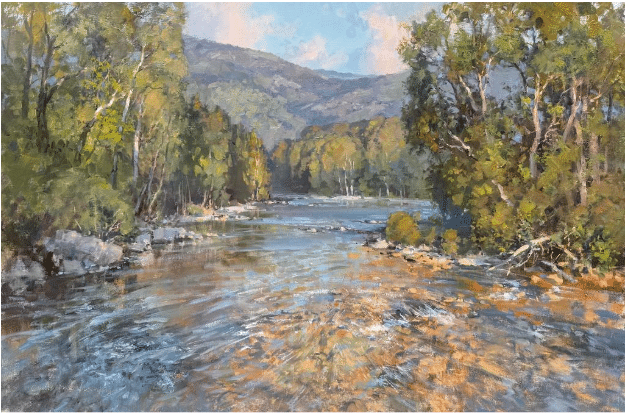
Christine Lashely, “Clear Waters,” Oil, 24 x 36 in.
What does your composition need to have for you to trust it will make a strong painting?
I don’t know. Less planning means risk of failure, but I like to paint this way. I’ve found that if I plan too long, the painting’s vitality can suffer. I like to make use of mistakes and wiping out. So I’ve learned to trust my process of “blob to reality,” or making order out of chaos. I like this manipulation process better than planning extensively and knowing the answer.
In the end, holding strongly on to the “big idea” is more useful to me than planning composition, value, or color, as all those might change depending on what the painting needs.
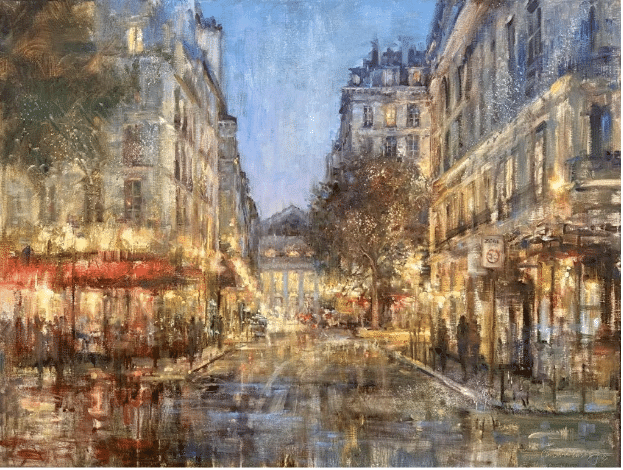
Christine Lashley, “Nuit Des Lumieres,” Oil, 36 x 48 in.
Could you walk us through your process? What do you need to have figured out at each stage?
I like to have nothing totally figured out. Not to be cheeky, but I always like to keep my options open as long as possible with suggestive marks. Over-planning is not good for me. The concept gets exhausted. Studies and planning are good, and I will do some, but not always. I need to see the art evolve in real time. At some point I tighten everything up; however, a scrape down, merge, and repaint choice is often made, even when supposedly done. Nothing is treated as precious.
I like to work with a lot of gesture, chaos, and mess in the beginning stage, all while holding on strongly to a feeling or big idea. This can lead to failed paintings or ones I repaint, but this is part of the process now for me.
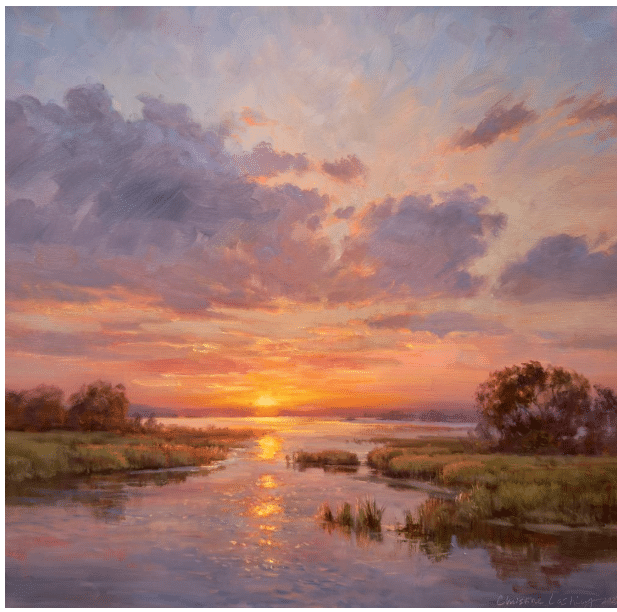
Christine Lashley, “Finale Perfection,” Oil, 30 x 30 in.
How important is drawing to you as an artist? Is that just about getting likeness, or does it go beyond that?
Drawing is a critical skill to know what you want to say visually. I also try to test myself to work from memory. Gesture and expression are very important too.
How much or how little do you change the color in your reference? How do you decide that?
I might radically change the color if needed — it all goes back to, what does the painting need to support the big idea?
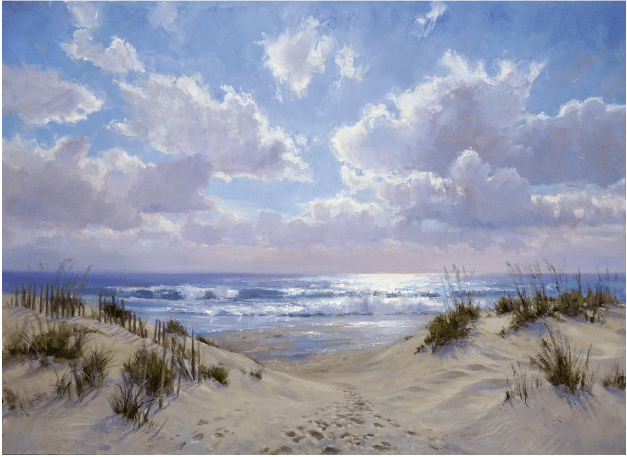
Christine Lashley, “Ocean Breeze,” Oil, 36 x 48 in.